
TL;DR:
- Matching three garment dimensions to your body measurements ensures the best fit and reduces sizing mistakes.
- Authentic cuts run slimmer and use numeric sizes, while replica lines are roomier and labeled S–XXL.
Match three garment dimensions to your body measurements and you will pick the right jersey size every time: half chest, body length from the high point shoulder (HPS) to hem, and shoulder width seam-to-seam. Ignore S/M/L labels and height/weight charts as your primary decision tool. Those shortcuts are why most sizing mistakes happen.
Here is what to do right now, before you read further:
- Grab a soft tape measure and a jersey that already fits you well.
- Lay it flat and measure pit-to-pit (half chest), HPS to hem (length), and seam-to-seam (shoulder width).
- Pull up the product page for the jersey you want to buy and compare those three numbers.
- Confirm the cut type (authentic/numeric vs. replica/S–XXL) and choose your size based on intended use, not instinct.
Pro Tip: Raise both arms overhead and rotate your shoulders after trying on or simulating a size. Static standing checks miss the fit failures that show up the moment you move.
Gfacegear publishes garment dimensions on product pages specifically so you can run this comparison before checkout. Use them.
Table of Contents
- How do you measure your body correctly for a jersey?
- How to measure an existing jersey using the flat-lay method
- Authentic numeric cuts vs. replica S–XXL: which one are you buying?
- How should a jersey fit for your body type and the look you want?
- Print-on-demand realities and a pre-order checklist
- What to do when you're between two sizes
- How to convert measurements into US sizes
- Key Takeaways
- Why sizing for limited drops deserves a different mindset
- Gfacegear makes sizing on limited drops less of a gamble
- FAQ
How do you measure your body correctly for a jersey?
Three measurements predict real-world jersey fit better than any label: half chest, body length from HPS, and shoulder width seam-to-seam. Take them at home in under five minutes.
- Chest circumference. Wrap a soft tape around the fullest part of your chest, keeping it level and relaxed. Do not pull it tight or puff your chest. This is your chest circumference; divide by two for the half-chest figure vendors publish.
- Body length (HPS to hem). Stand straight. Place the tape at the bony tip of your shoulder (the high point shoulder) and run it straight down to where you want the hem to sit.
- Shoulder width. Measure across your back from the outer edge of one shoulder to the outer edge of the other. This seam-to-seam number is the most overlooked measurement and the one that causes the most discomfort.
- Sleeve length (when relevant). Start at the center back of your neck, run the tape across your shoulder and down to your wrist. Relevant for long-sleeve jerseys and hoodies.
Common mistakes: letting the tape droop across your back, measuring over a thick hoodie, or slouching. All three add phantom inches and push you into a size that is actually too big.
Pro Tip: Keep a small "fit profile" card with your half-chest, HPS length, and shoulder width. When a limited drop goes live, you can compare specs in seconds instead of guessing under pressure.
Pre-order body measurement checklist:
- Soft tape measure (not a rigid ruler)
- Thin base layer only while measuring
- Stand relaxed, weight even on both feet
- Measure twice, record once
- Simulate movement: raise arms, rotate shoulders, reach forward
How to measure an existing jersey using the flat-lay method
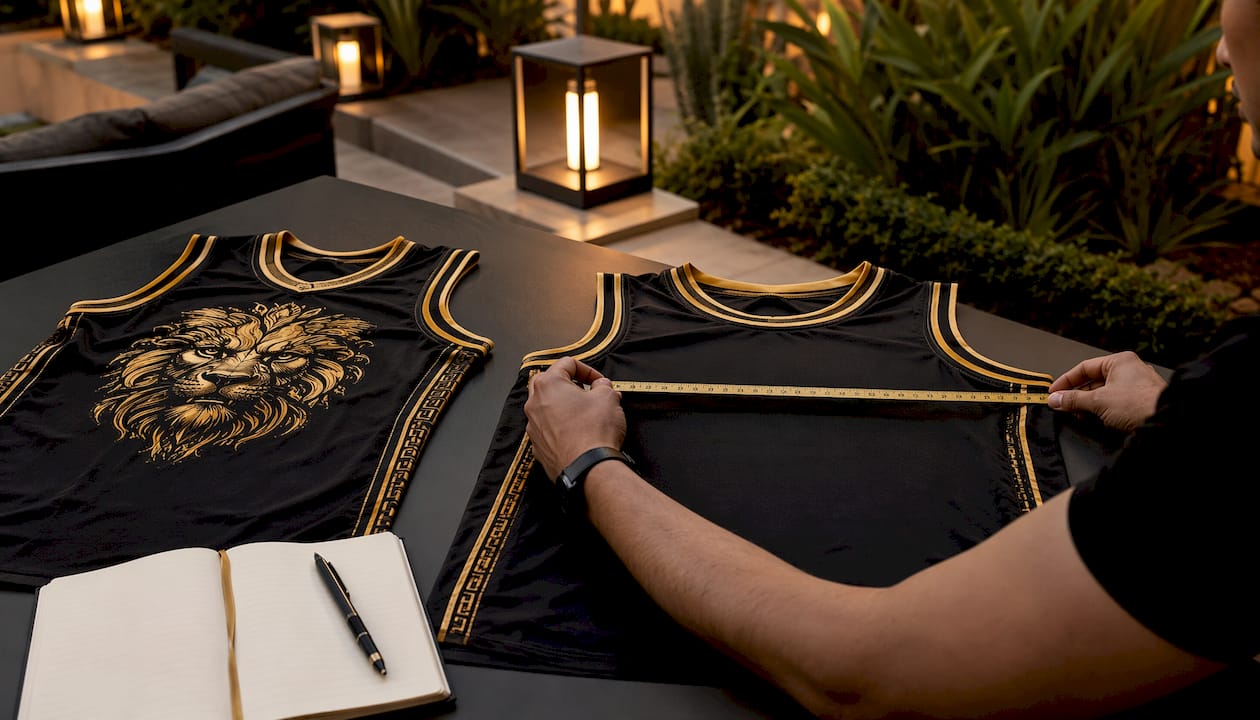
Measuring a favorite-fitting jersey on a flat surface is the fastest, most accurate way to match sizes before you buy. Vendors publish these same three dimensions; your job is to capture them from something you already love wearing.
- Lay the jersey face-down on a flat surface. Smooth out all wrinkles.
- Pit-to-pit (half chest). Measure horizontally from one armhole seam to the other, one inch below the armpit. This is the half-chest figure. Multiply by two for full chest circumference.
- HPS to hem (body length). Measure from the highest point of the shoulder seam straight down to the bottom hem.
- Seam-to-seam (shoulder width). Measure across the back from shoulder seam to shoulder seam.
| Dimension | How to measure | What to compare |
|---|---|---|
| Half chest | Pit-to-pit, 1 in. below armhole | Vendor's half-chest spec |
| Body length | HPS straight down to hem | Vendor's length spec |
| Shoulder width | Seam to seam across back | Vendor's shoulder spec |
Once you have those three numbers, pull up the product page and compare to the garment dims listed there. If the vendor publishes a half-chest of 21 inches for a size L and your favorite jersey measures 20.5 inches pit-to-pit, that L will fit. If it lists 22.5, size down.
Authentic numeric cuts vs. replica S–XXL: which one are you buying?
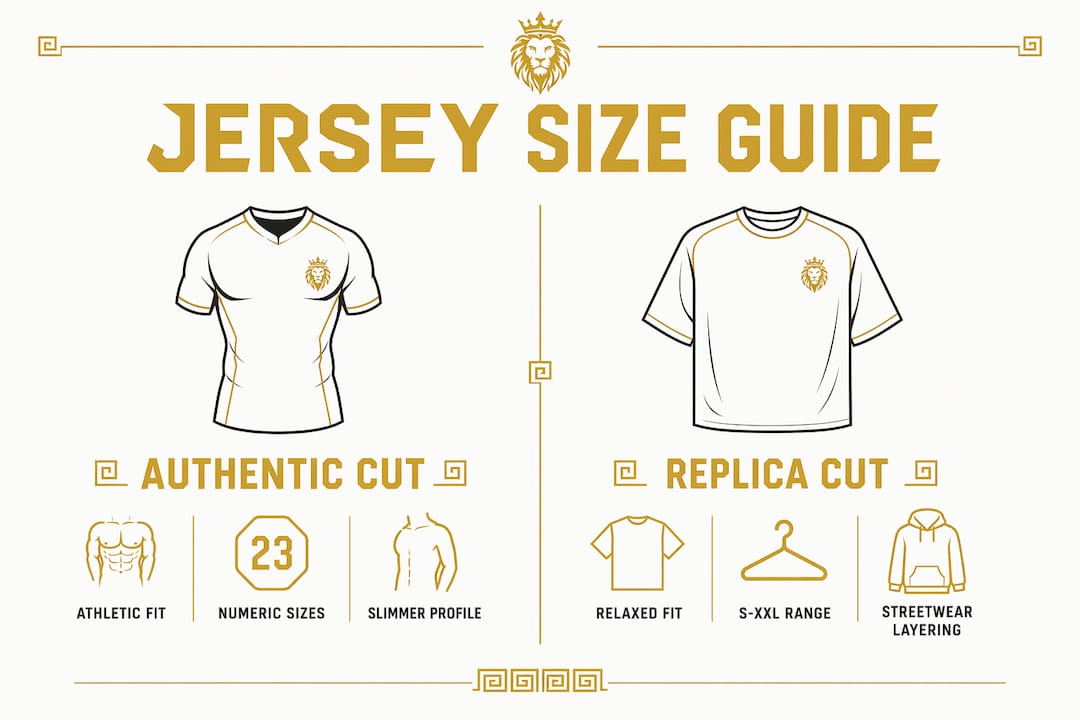
Cut is the single largest driver of unexpected fit. Authentic performance cuts run slimmer and often use numeric sizes (40, 44, 48); replica and Swingman lines use S–XXL and are noticeably roomier.
| Feature | Authentic / Performance (numeric) | Replica / Swingman (S–XXL) |
|---|---|---|
| Cut intent | Athletic, close to body | Relaxed, everyday wear |
| Typical stretch | Minimal | Moderate |
| Hem length | Longer, designed to stay tucked | Standard, sits at hip |
| Best use-case | On-court performance | Streetwear, layering, casual |
| Numeric ↔ S/M/L rough map | 40 ≈ S, 44 ≈ M, 48 ≈ L, — ≈ XL | Label matches body measurement chart |
That numeric mapping is approximate. Always confirm with garment dimensions because the same label can fit differently across product lines and production runs.
Pro Tip: If the product page says "performance" or "authentic," plan to size up one for streetwear layering. If it says "replica" or "relaxed," the listed size likely gives you enough ease already.
How should a jersey fit for your body type and the look you want?
Choose by intended use first: pick the smaller size for performance needs, the larger for layering and streetwear silhouette. Then factor in your body type.
Body-type considerations:
- Broad shoulders. Prioritize shoulder width over chest. If the shoulder fits, a slightly roomier chest is easy to live with.
- Long torso. Check HPS-to-hem length carefully. A jersey that fits the chest but rides up constantly is the most common complaint from tall buyers.
- Fuller chest. Size to the chest measurement first, then check if the shoulder seam still lands correctly.
- Slimmer frame. Authentic cuts may fit well off the shelf. Replica cuts will have excess fabric; consider sizing down or choosing a fitted cut if available.
Questions to ask on the product page before buying:
- Does the listing describe the cut as performance, authentic, replica, or relaxed?
- Are garment dimensions (half chest, length, shoulder) published?
- What size is the model wearing, and what are the model's measurements?
- Does the fabric have stretch, and how much?
- What is the production tolerance (typically ±0.5–1 inch on POD items)?
For limited drops, if the fit notes are thin and you are between sizes, ordering two sizes is worth considering when the return window allows it.
Print-on-demand realities and a pre-order checklist
POD products can vary run-to-run. Checking garment specs and ordering a sample when possible are the only reliable ways to avoid surprises on a limited drop.
POD variance sources to know:
- Grading tolerances. Small-batch production typically carries a ±0.5–1 inch variance across dimensions.
- Fabric dyelot differences. Different dye lots can subtly change fabric weight and drape, which affects how a jersey hangs on the body.
- Print and backing. Large prints stiffen fabric slightly, changing the feel and sometimes the effective chest measurement after the print is applied.
- Shrinkage after washing. Heavier mesh and vintage fabrics shrink more than performance technical knits. Always check care instructions before deciding on a final size.
Pre-order checklist:
- Confirm half-chest, body length, and shoulder width on the product page.
- Read the model info (size worn + model measurements).
- Check fabric content and stretch percentage.
- Review the return and exchange policy for limited drops specifically.
- Note care instructions and expected shrinkage behavior.
- If available, order a sample or use a two-size strategy.
Pro Tip: Gfacegear VIP members get early access to limited drops and extended return windows, which effectively gives you a lower-risk window to test fit before the drop sells out.
What to do when you're between two sizes
Choose based on use: performance means size down; streetwear and layering means size up. Beyond that, you have real options.
- Size up for layering. Extra room accommodates a tee or compression layer underneath without pulling across the chest.
- Size down for performance. Less excess fabric means less movement and less chafing during activity.
- Order both sizes when the return policy allows and the drop is limited. Decide after trying both.
- Tailor a larger jersey. Side seams and hem alterations are straightforward and inexpensive. A tailor can take in two inches of width for less than the cost of a return shipping label.
- Use an undershirt strategically. A fitted compression layer under a slightly-too-large jersey fills the gap and improves the silhouette.
Pro Tip: Factor in fabric behavior before you commit. Heavier mesh shrinks more after a hot-dry cycle, so if you are between sizes in a heritage-style jersey, the larger size may fit perfectly after the first wash.
How to convert measurements into US sizes
The table below shows a general adult men's jersey sizing chart based on chest circumference, the standard reference for US sizing.
| US Size | Chest circumference | Approximate numeric (authentic) |
|---|---|---|
| S | 34–36 in (87–92 cm) | 40 |
| M | 36–38 in (93–98 cm) | 44 |
| L | 39–41 in (99–104 cm) | 48 |
| XL | 41–43 in (105–110 cm) | — |
| XXL | 44–46 in (111–116 cm) | — |
These ranges reflect general adult men's jersey sizing. Women's jerseys follow narrower chest bands: S runs roughly 32–34 in (82–87 cm), M at 35–37 in (88–93 cm), and L at 37–39 in (94–99 cm). Always treat these as starting points. Brand- and line-specific grading means the same label can measure differently across product lines, so garment dimensions on the product page override any generic chart.
Key Takeaways
Matching three garment dimensions (half chest, body length, shoulder width) to your own measurements is the most reliable way to pick the right jersey size and avoid returns.
| Point | Details |
|---|---|
| Three dimensions matter most | Half chest, body length (HPS to hem), and shoulder width predict fit better than any label. |
| Flat-lay your favorite jersey | Measure a jersey that already fits you and compare those numbers to the product's garment specs. |
| Cut type changes everything | Authentic/numeric cuts run slimmer; replica/S–XXL cuts are roomier. Confirm the cut before ordering. |
| POD variance is real | Small-batch production carries tolerances and shrinkage differences; check care instructions and garment dims every time. |
| Gfacegear sizing support | Gfacegear publishes garment dimensions and offers VIP early access and extended return windows for limited drops. |
Why sizing for limited drops deserves a different mindset
Most sizing guides are written for in-store try-ons or mass-produced basics. Limited drops are neither. When a Gfacegear drop goes live, you have minutes, not days, to decide. The standard advice to "just try it on" is not an option.
That reality is why Gfacegear built its product pages around garment dimensions rather than vague fit descriptions. Brooklyn streetwear buyers are not shopping for a generic athletic jersey. They want a specific silhouette, a specific weight, a specific statement. The ROAR identity behind every Gfacegear piece demands that the fit matches the intention.
The practical upshot: keep your fit profile updated (half chest, HPS length, shoulder width), check the garment dims the moment a drop page goes live, and use the VIP early-access window to make that call before the size you need is gone. For pieces like the limited Boriqua Swimwear or the men's tees, the cut notes on the product page are there for exactly this reason. Read them.
Gfacegear makes sizing on limited drops less of a gamble
Every Gfacegear jersey and apparel drop comes with published garment dimensions, model size references, and fabric notes so you can run the three-measurement comparison before you hit checkout.
Here is what you get as a buyer:
- Garment dims on every product page. Half chest, body length, and shoulder width listed so you can compare to your fit profile.
- Model measurements and pictured fit. See the actual size worn and the model's stats so you can calibrate.
- VIP early access. Get into limited drops before the general public, with more time to check specs.
- Extended return windows for VIP members. Lower the risk on a size gamble.
- Care and shrinkage guidance. Know what to expect after the first wash before you commit to a size.
Browse the current drops and check garment specs at the Gfacegear lookbook, or head straight to the main shop to join VIP and lock in early access to the next limited release.
FAQ
What are the three measurements that matter most for jersey sizing?
Half chest (pit-to-pit), body length from the high point shoulder to hem, and shoulder width seam-to-seam. Matching these three garment dimensions to your own measurements reduces most sizing errors.
How should a jersey fit for streetwear vs. performance?
For streetwear and layering, size up for extra ease and silhouette. For performance use, size down to reduce excess fabric and movement. When between sizes, intended use is the deciding factor.
What is the difference between authentic numeric sizing and replica S–XXL?
Authentic cuts use numeric labels (40, 44, 48) and run slimmer, designed for athletic bodies. Replica and Swingman cuts use S–XXL and are roomier, making them better suited for everyday wear and layering.
Do print-on-demand jerseys run true to size?
POD items carry small production tolerances, typically around ±0.5–1 inch, and fabric behavior can shift between runs. Always check the garment dimensions on the product page rather than relying on the size label alone.
How does Gfacegear help with sizing on limited drops?
Gfacegear publishes garment dimensions and model measurements on product pages, and VIP members receive early access and extended return windows, giving you more time and information to make the right size call before a drop sells out.