
How does on-demand manufacturing work in fashion?
On-demand manufacturing in fashion means garments are produced only after a customer places an order. No forecasting, no warehouses stacked with unsold stock, no guessing what will sell. The digital workflow connects a brand's storefront directly to the production floor, triggering manufacturing the moment an order is confirmed.
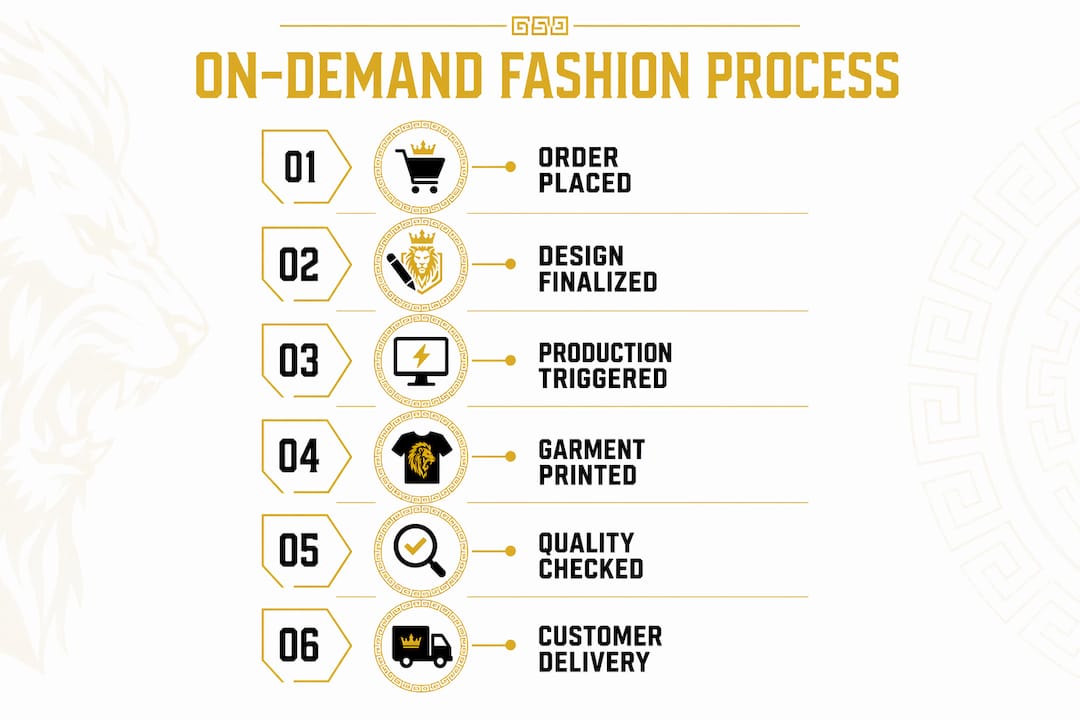
Here is the basic sequence:
- Order placement: A customer buys through an ecommerce storefront, such as Shopify.
- Digital processing: The order data, including size, color, and design, flows automatically to the production system.
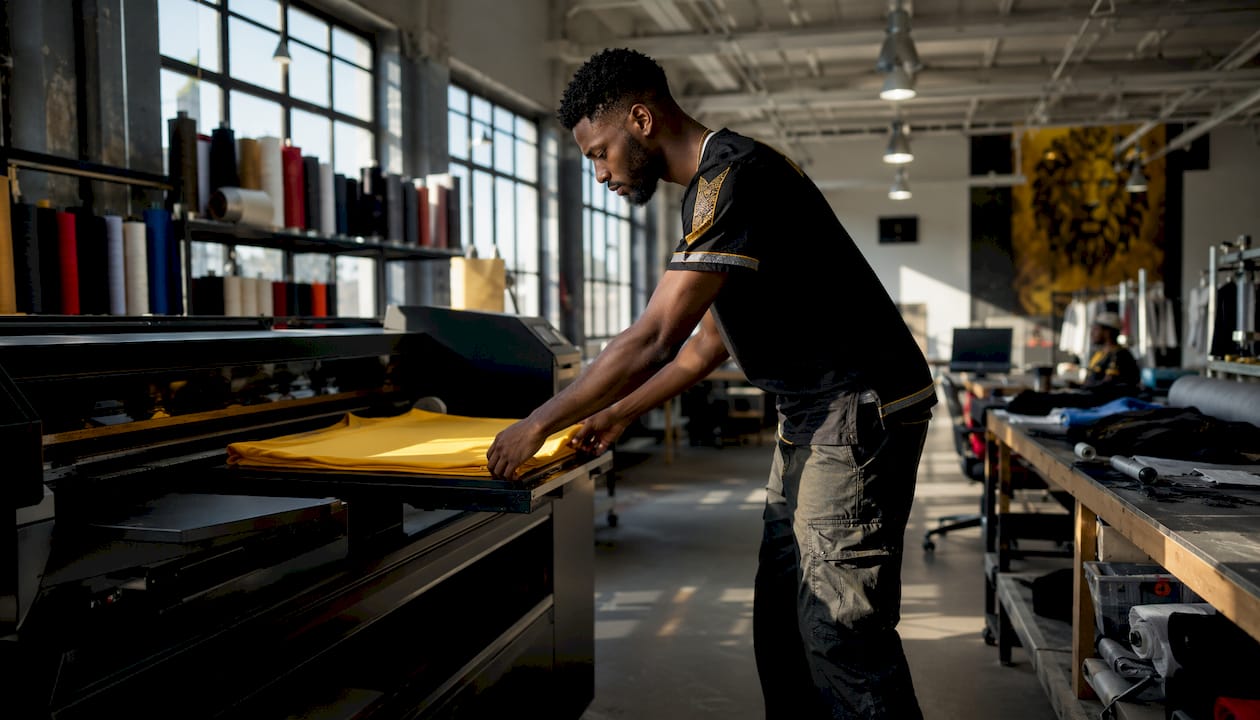
- Production: Garments are cut, printed, sewn, or assembled to spec for that specific order.
- Quality control: Each piece is inspected before packaging, since there is no bulk batch to average out defects.
- Direct shipping: The finished item ships straight to the customer, often from a domestic facility.
Customization is built into every step. US manufacturers now support orders as small as 50 units, which makes low-risk design testing genuinely accessible for emerging brands. The model eliminates excess inventory by design, not by discipline, because nothing gets made until someone pays for it.
Table of Contents
- Why on-demand manufacturing is reshaping fashion brands
- What technologies make on-demand apparel production possible?
- What challenges do brands face when adopting on-demand models?
- How Gfacegear applies on-demand manufacturing to luxury streetwear
- What does on-demand manufacturing actually cost?
- How does on-demand manufacturing compare to traditional fashion production?
- What does the future of on-demand fashion manufacturing look like?
- Key Takeaways
- Gfacegear: where on-demand streetwear meets the ROAR
- FAQ
Why on-demand manufacturing is reshaping fashion brands
The business case is straightforward, but the scale of the problem it solves is worth sitting with. In 2023, 2.5 to 5 billion excess garments were produced globally, costing the industry an estimated $70–140 billion in unsold goods. Made-to-order fashion cuts that problem at the root.
Here are the core advantages, ranked by impact:
- Waste elimination. Nothing is produced speculatively. Overproduction, the defining sin of fast fashion, simply cannot happen in a true on-demand model.
- Sustainability gains. Producing closer to the consumer reduces transportation emissions and cuts water usage compared to bulk offshore manufacturing.
- Inventory cost savings. Zero unsold stock means zero write-downs, no storage fees, and no end-of-season markdowns that erode margin.
- Cash flow improvement. Brands collect payment before production begins. That reversal of the traditional cash cycle is significant for small and mid-size labels.
- Faster trend response. Shorter lead times let brands introduce new styles in days rather than months, keeping product lines current without committing to large runs.
- Personalization at scale. Customers get products tailored to their specifications, which drives satisfaction and reduces returns.
- Lower barrier to entry. A new brand can launch with a single design and no upfront inventory investment, then scale based on actual demand data.
The consumer psychology shift matters here. Shoppers, particularly in the luxury and streetwear segments, are increasingly treating made-to-order garments as investments rather than impulse purchases. That reframing turns a longer wait time into a feature, not a flaw.
The sustainable fashion manufacturing angle is no longer a niche selling point. It is becoming a baseline expectation, especially among younger US consumers who research brand practices before buying.
What technologies make on-demand apparel production possible?
The model only works at scale because of specific technologies that compress production time and maintain quality without bulk efficiencies. AI and integrated digital systems are the primary engine driving scalable on-demand fashion manufacturing in 2026.
- Integrated storefront-to-floor connectivity: Order management systems link ecommerce platforms directly to production software, eliminating manual handoffs and reducing errors.
- AI-driven demand forecasting: Predictive analytics help brands anticipate which designs will sell, informing limited-run decisions without reverting to bulk speculation.
- Digital textile printing (DTG and dye sublimation): Direct-to-garment printing deposits ink directly onto fabric with no setup plates or minimum runs. Dye sublimation bonds dye into synthetic fibers at the molecular level, producing vivid, durable prints ideal for activewear and swimwear.
- Laser-guided cutting automation: Computer-controlled cutting machines reduce fabric waste and improve precision on complex pattern pieces.
- Smart sewing technology: Semi-automated sewing stations handle repetitive seams, freeing skilled workers for detail and finishing work.
- 3D knitting and weaving: Emerging production methods that construct garments in a single pass, eliminating cut-and-sew waste almost entirely.
- AI design prototyping: Brands can generate and test digital samples before committing to physical production, catching fit and aesthetic issues early.
The supply chain connectivity between retail storefronts and manufacturing floors is where most brands either succeed or stall. When that integration is tight, turnaround times compress dramatically.
Pro Tip: Before choosing a production partner, test their digital integration with a small order. A partner whose system requires manual order entry is a bottleneck waiting to happen at scale.
What challenges do brands face when adopting on-demand models?
Switching from bulk manufacturing to on-demand production is not a plug-and-play transition. The operational logic is fundamentally different, and the friction points are predictable.
Common obstacles:
- Turnaround expectations: Customers accustomed to two-day shipping from mass retailers may resist a 7–14 day production window. Managing that expectation requires deliberate communication, not just a disclaimer in the FAQ.
- Per-unit cost: Without bulk economies of scale, the cost per garment is higher than traditional manufacturing. Brands must price accordingly or absorb margin compression.
- Supply chain complexity: Real-time order fulfillment demands that every upstream input, fabric, ink, trim, is reliably available. A single stockout disrupts the entire model.
- Production scalability: A viral moment can generate orders faster than a small production partner can fulfill them. Capacity planning matters even when you are not holding inventory.
- Quality consistency: Without a large batch to average across, every unit must meet spec. Quality control processes need to be tighter, not looser.
How successful brands address these challenges:
- Use data-driven small-batch testing before scaling any design. A 50-unit run reveals fit issues, color accuracy problems, and demand signals before you commit to a larger production run.
- Build supplier redundancy into the supply chain. Single-source dependencies are a structural risk in real-time fulfillment.
- Frame wait times as part of the brand story. Exclusivity and craftsmanship narratives shift customer perception from impatience to anticipation.
- Invest in order management software that provides real-time visibility across production stages, so customer service can answer "where is my order" without guessing.
- Set pricing that reflects true per-unit cost plus margin, not bulk-manufacturing benchmarks. Customers buying made-to-order products in the streetwear and luxury segments expect to pay a premium.
The brands that struggle are usually the ones that try to compete on price with fast fashion while using an on-demand model. The ones that win position the model itself as the value proposition.
How Gfacegear applies on-demand manufacturing to luxury streetwear

Gfacegear is a Brooklyn-born streetwear brand built around the ROAR identity: lion imagery, Greek Key medallion motifs, and the conviction that stepping out demands a Gameface. Every product in the catalog, from lion sneakers and structured hats to men's tees and the Limited Boriqua Swimwear, is produced through an on-demand model that makes the brand's exclusivity structural rather than manufactured.
The operational approach reflects the model's best practices:
- Digital prototyping for complex garments: Lion-patterned jerseys and limited-edition swimwear pieces are developed through digital design workflows that catch precision issues before physical production begins, reducing material waste on high-detail items.
- Limited-edition drops as demand signals: Each drop, including the Limited Boriqua Swimwear, functions as a real-world test of demand before any scaling decision. This is data-driven exclusivity in practice.
- Wait time as brand narrative: Gfacegear frames production time as part of the premium experience. Customers are not waiting for a product to ship from a warehouse. They are waiting for their piece to be made.
- VIP membership for demand smoothing: Monthly VIP memberships with sitewide discounts and early access create a predictable demand layer, giving production planning a more stable signal than pure open-market drops.
- Social media and UGC-driven marketing: Short-form video content and user-generated content build anticipation for drops without requiring inventory to exist before the campaign launches.
Pro Tip: For streetwear brands running limited drops, announce the drop before production begins. The pre-order window doubles as a demand measurement tool and funds the production run simultaneously.
The sustainability dimension is not incidental. By producing only what is ordered, Gfacegear avoids the overproduction that defines fast fashion's environmental footprint. For a brand whose aesthetic is built on power and intention, making nothing by accident is consistent with the identity.
What does on-demand manufacturing actually cost?
Per-unit costs in on-demand production run higher than bulk manufacturing, and that is not a bug. It is the price of eliminating inventory risk, and for most brands the math still works in their favor.
The cost structure breaks down into three layers. First, production cost per unit covers materials, printing, cutting, sewing, and finishing for a single garment rather than amortizing setup costs across thousands of units. A custom jersey that costs $8 per unit at 5,000 pieces may cost around $18 per unit at 50 pieces. Second, platform and fulfillment fees include ecommerce hosting, payment processing, and any per-order fees charged by the production partner. Third, shipping costs are typically higher per order than bulk freight, though domestic US production facilities reduce the gap.
Pricing models vary by brand positioning. Brands in the premium and luxury streetwear segment, where Gfacegear operates, price to reflect craftsmanship and exclusivity rather than competing on cost with mass-market alternatives. A limited-edition swimwear piece or a lion-print jersey carries a price point that accounts for on-demand production economics and reinforces the product's perceived value.
The financial upside is real: no capital tied up in unsold inventory, no end-of-season markdowns, and no storage costs. For a brand running $0 in unsold stock, the higher per-unit cost often nets out favorably against a traditional model carrying 30% excess inventory.
How does on-demand manufacturing compare to traditional fashion production?
The differences are structural, not just operational.
| Factor | Traditional bulk manufacturing | On-demand manufacturing |
|---|---|---|
| Production trigger | Forecast-based | Order-based |
| Minimum order quantity | Hundreds to thousands of units | As few as 1–50 units |
| Inventory risk | High (unsold stock is a direct loss) | Near zero |
| Per-unit cost | Lower at scale | Higher per unit |
| Time to market | Weeks to months | Days to weeks |
| Customization | Limited by batch economics | Built into the model |
| Environmental impact | High (overproduction, long-haul freight) | Lower (produce only what sells) |
| Cash flow | Capital intensive upfront | Payment before production |
| Trend agility | Slow (committed to seasonal buys) | Fast (new designs launch immediately) |
Traditional manufacturing rewards scale and punishes uncertainty. On-demand manufacturing rewards agility and punishes overcommitment. For a brand like Gfacegear, whose identity is built on limited drops and cultural specificity rather than mass volume, the on-demand model is not a workaround. It is the right tool for the job.
What does the future of on-demand fashion manufacturing look like?
Several converging trends are accelerating the model's adoption across the US market.
AI design generation is moving from prototype assistance to full design creation, where a brand can input aesthetic parameters and receive production-ready artwork. For streetwear brands working with complex motifs like Greek Key patterns or photorealistic animal prints, this compresses design cycles from weeks to hours.
Hyper-localized production is gaining traction as domestic US manufacturing capacity grows. Producing closer to the customer reduces shipping time and carbon footprint simultaneously, and tariff pressures on imported goods are making domestic production more cost-competitive than it has been in decades.
On-demand 3D knitting is approaching commercial viability for knitwear and performance apparel. A garment constructed in a single machine pass with no cut-and-sew waste represents the logical endpoint of sustainable fashion manufacturing.
Blockchain-based supply chain transparency is emerging as a trust signal for conscious consumers. Brands that can show a verifiable chain of custody from raw material to finished garment will have a meaningful advantage as transparency expectations rise.
Personalization at the SKU level is the next frontier. Rather than choosing from preset colorways, customers will configure garments, selecting fit, print placement, and colorway, with the order flowing directly into automated production. Gfacegear's existing infrastructure, connecting Shopify storefronts to on-demand production, positions the brand well for this shift.
The brands building on-demand capabilities now are not just reducing waste. They are building the operational foundation for a fashion market where every garment is made for someone, not just made.
Key Takeaways
On-demand manufacturing in fashion eliminates inventory risk by producing garments only after orders are placed, using digital workflows, AI, and digital textile printing to deliver customized apparel with minimal waste.
| Point | Details |
|---|---|
| Production is order-triggered | Garments are made only after purchase, eliminating overstock and the losses it creates. |
| Waste reduction is structural | In 2023, 2.5 to 5 billion excess garments were produced globally under traditional models — on-demand prevents this by design. |
| Technology drives the model | AI prototyping, DTG printing, and storefront-to-floor integration are what make scalable on-demand production viable. |
| Per-unit cost is higher, but math favors it | No unsold inventory, no markdowns, and no storage costs offset the higher cost per garment for most brands. |
| Gfacegear exemplifies the model | Gfacegear's limited-edition drops, digital prototyping, and VIP membership structure demonstrate on-demand manufacturing applied to luxury streetwear. |
Gfacegear: where on-demand streetwear meets the ROAR
If this article has you thinking about what on-demand manufacturing looks like when it is done with genuine conviction, Gfacegear is the answer worth looking at. This is not a brand that adopted the model to cut costs. It was built around it, from the Limited Boriqua Swimwear drops to the lion-print jerseys and structured hats that define the catalog.
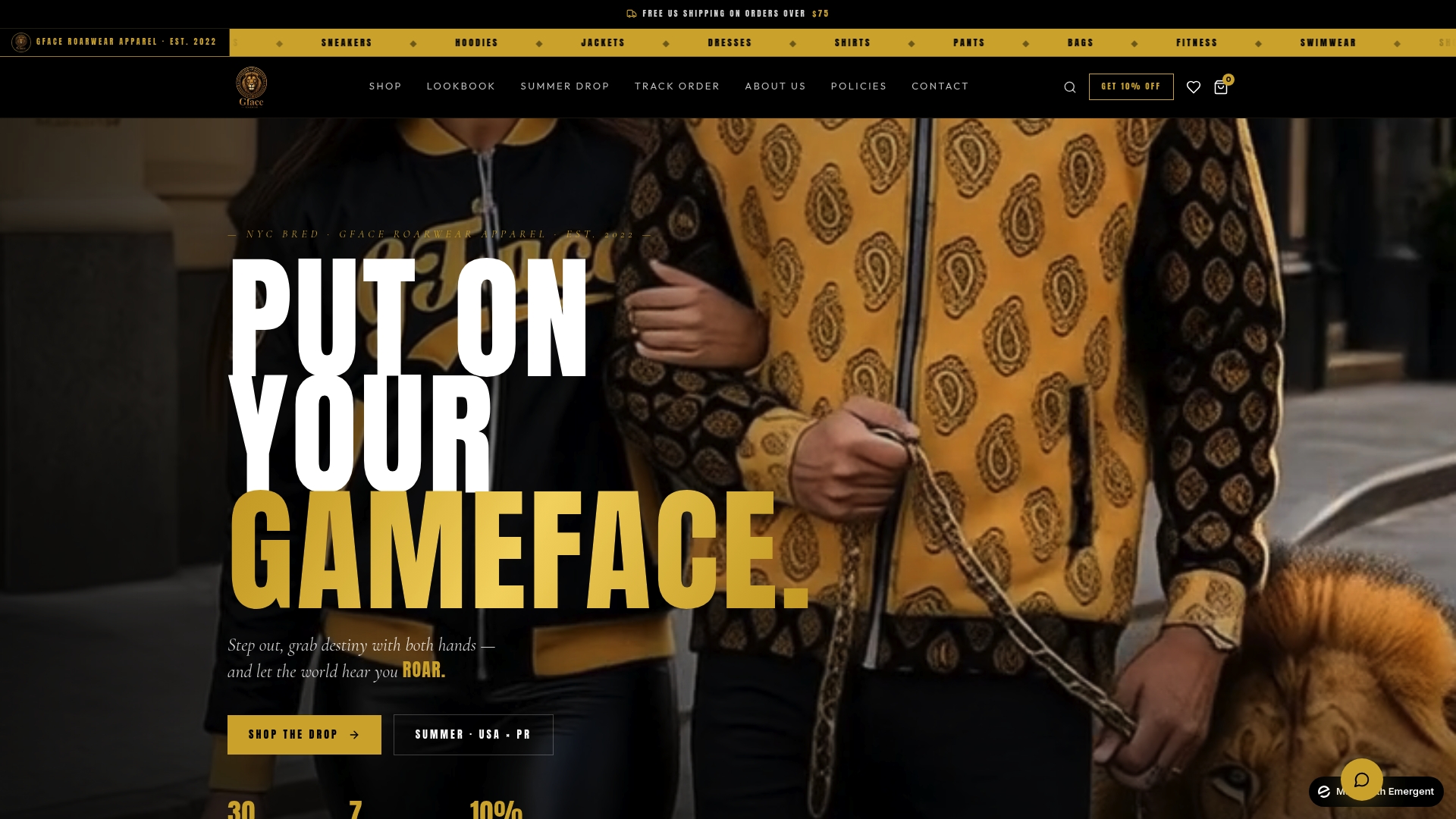
Every piece in the Gfacegear lineup is produced on demand, which means nothing exists until someone claims it. That is the point. The Greek Key medallion, the lion imagery, the ROAR identity — these are not mass-market aesthetics. They are made for people who wear their confidence as a statement and want the garment to match that energy.
VIP members get early access to drops, sitewide discounts, and exclusive perks that make the limited-edition model work in their favor. The full collection spans men's and women's apparel, sneakers, hats, swimwear, and more. Browse the lookbook, find your drop, and put on your Gameface.
FAQ
What is on-demand manufacturing in fashion?
On-demand manufacturing in fashion is a production model where garments are made only after a customer places an order, eliminating the need for pre-produced inventory and reducing overproduction waste.
How does on-demand manufacturing reduce waste?
By producing only what is ordered, brands avoid the overproduction that generates unsold stock. In 2023, traditional manufacturing produced 2.5 to 5 billion excess garments globally, a problem on-demand models eliminate structurally.
Is on-demand manufacturing more expensive than bulk production?
Per-unit costs are higher without bulk economies of scale, but brands offset this through zero inventory write-downs, no storage fees, and no end-of-season markdowns, making the overall economics favorable for many labels.
What technologies power on-demand apparel production?
Direct-to-garment (DTG) printing, dye sublimation, AI-driven design prototyping, laser-guided cutting, and integrated storefront-to-production software are the core technologies enabling scalable on-demand fashion manufacturing.
How does Gfacegear use on-demand manufacturing?
Gfacegear produces all apparel, including limited-edition swimwear, lion-print jerseys, hats, and tees, through on-demand digital workflows, using small-batch drops to test demand and digital prototyping to maintain quality on complex designs.