
Wrap a soft tape around your head about half an inch above your eyebrows, level over your ears, at the widest point of your skull, and that number is your key to a hat that actually fits. A head circumference around 22 to 23 inches converts to a US fitted size in the 7 to 7 1/4 range, commonly considered a Large bracket by most brands. Get that one number right, straight from your own measurements, and every conversion chart below turns from confusing numbers into a hat that fits like it was made for your head. That's the whole game, and Victor at GfaceGear breaks it down step by step from here.
TL;DR:
- Most adults with a head circumference of 22 to 23 inches should size between 7 and 7 1/4, which is generally considered large.
- Accurate head measurement involves wrapping a flexible tape snugly about half an inch above the eyebrows and level over the ears, accounting for hairstyle volume.
- Between sizes, always choose to size up, as a slightly loose hat can be fixed, while a tight one is difficult to wear comfortably.
- Variations in hat construction, such as sweatband thickness and internal padding, mean a size 7 1/4 can feel different across brands, requiring brand-specific sizing charts.
- For styles like beanies and adjustable caps, sizing rules differ, but the key measurement remains the head circumference to ensure a proper fit.
Table of Contents
- How to Measure Your Head for a Hat Size Guide
- Hat Size Conversion Chart: Inches to Fitted Size to Letter Sizing
- How Hat Style Changes the Sizing Rules
- What to Do When You're Between Two Sizes
- Common Measuring Mistakes That Lead to Returns
- Why Victor and GfaceGear Know Hat Fit
- Why the Same Size Number Fits Differently by Brand
- The One Number That Actually Matters
- Shop Hats Sized Right, the First Time
- Where This Sizing Data Comes From
- Sources
- FAQ
How to Measure Your Head for a Hat Size Guide
Get this part right and everything else falls into place. A soft, flexible tape measure works best, but if you don't have one, a strip of string and a ruler gets the job done just as well.
- Wrap the tape around your head about half an inch above your eyebrows, keeping it level over the tops of your ears.
- Find the largest point of your skull, usually right at the back where your head curves out the most, and make sure the tape sits there all the way around.
- Pull the tape snug against your skin or hair, not tight enough to compress anything, just enough that it holds its shape without slack.
- Read the number where the tape overlaps, then repeat the whole measurement a second time to confirm it.
- Write down both the inches and centimeters, since some brands (especially cowboy hatmakers and European labels) size exclusively in one or the other.
If you rock thick hair, buns, or braids and plan to wear the hat over them, measure with your hair exactly how you'll style it under the hat. Add about half a centimeter if you're between measurements with hair pulled up versus down, since that's roughly how much volume sits under the sweatband either way. Consistency between your two measurements matters more than hitting a "perfect" number on the first try. Stetson's measuring guide confirms this exact placement, half an inch above the brow line, is the industry standard millinery reference point.
Pro Tip: Measure at the end of the day, not right after waking up. Heads swell slightly overnight from fluid retention, so an evening measurement gives you the more reliable, "real world" number.
Hat Size Conversion Chart: Inches to Fitted Size to Letter Sizing
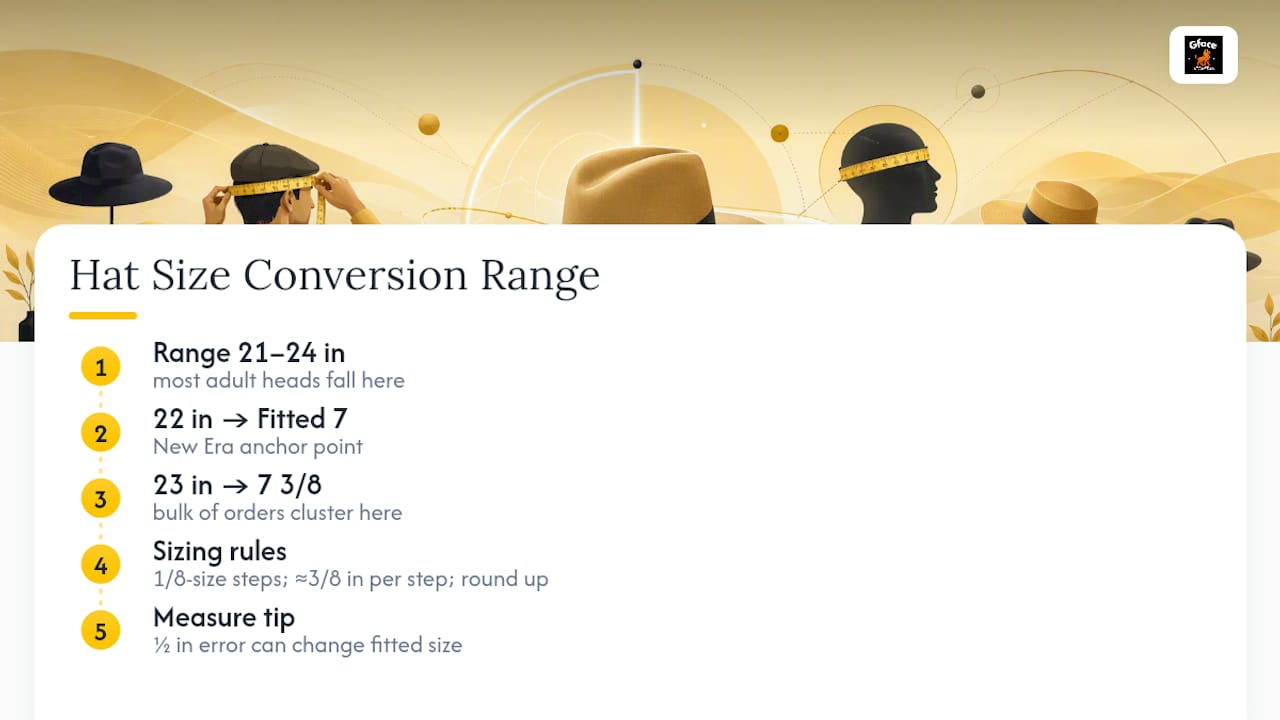
Once you've got your circumference, converting it into a size label a brand actually understands is simple math. US fitted sizes increment in 1/8-inch steps, and letter sizes (S, M, L, XL) bundle several fitted sizes into broader ranges for adjustable and stretch-fit styles.
New Era's official fitted chart uses this exact scale, with size 7 sitting at 22 inches and each 1/8-size step adding roughly 3/8 inch. If your number falls between two rows, round up, always. A hat that's a touch loose can be padded down; one that's too tight just won't work.
Most adult heads fall somewhere between 21 and 24 inches, with the bulk of orders clustering around 22 to 23 inches (fitted sizes 7 to 7 3/8). A half-inch measuring error is enough to bump you a full fitted size in either direction, which is exactly why that first measurement deserves your full attention.
How Hat Style Changes the Sizing Rules
Not every hat on the rack uses the same sizing logic, and knowing which system applies before you shop saves you a return shipment.
- Fitted caps run on the numeric chart above with zero stretch or ease built in, so if you're between sizes, size up every time.
- Adjustable snapbacks use One Size Fits Most (OSFM) ranges, typically 21.5 to 23.5 inches, though structured crowns fit snugger than unstructured, floppier builds.
- Beanies rely on letter sizing (S/M/L) with generous stretch, often covering a 21 to 24 inch range in a single size thanks to ribbed knit fabric.
- Bucket and camp hats usually size by letter but hold their shape more than a beanie, so check the brand's specific chart rather than assuming universal stretch.
- Cowboy hats and fedoras size numerically like fitted caps, and some makers offer oval-shape variants for heads that aren't perfectly round.
Adjustable OSFM styles deserve one more note: because most are built around average male head dimensions, they can sit looser than expected on smaller heads even at the tightest snap setting, per TailorSizeGuide's fit data. If that's you, a structured fitted cap or a beanie with real stretch will serve you better than a snapback.
What to Do When You're Between Two Sizes
Round up. That's the rule for every structured, fitted hat on the market, and it's not close. A hat that's slightly roomy is fixable in five minutes; a hat that's too tight is a hat you'll stop wearing.
- Foam hat size reducer strips stick inside the sweatband and can take up a quarter to half an inch of extra room.
- Adhesive foam sweatbands do the same job while adding a touch of cushion against your forehead.
- A milliner or hat shop can sew in a thicker sweatband for a more permanent fix if you plan to wear the hat constantly.
- Skip stretching a too-small hat. It works occasionally on raw felt but ruins the shape on structured caps and dress hats far more often than it saves them.
Alfred University's sizing guidance backs the same logic: size up first, then pad down, never the reverse.
Pro Tip: Keep the foam strips even the first time you try a slightly large hat. An uneven pad tilts the crown and throws off the whole look, not just the fit.
Common Measuring Mistakes That Lead to Returns
Most hat returns trace back to one of a handful of measuring errors, all easy to catch before you check out.
- Placing the tape too high on the forehead instead of the half-inch-above-eyebrow line, which shrinks your reading and gets you a hat that's too tight.
- Measuring over a bun, braid, or ponytail when you actually plan to wear the hat with hair down, or vice versa.
- Letting the tape sag in the back instead of keeping it level all the way around, which skews the number smaller than reality.
- Skipping the second measurement and trusting a single reading that could easily be off by a quarter inch.
Once the hat arrives, run a quick check: does a light breeze lift it slightly without it flying off? Can you slide one finger between the band and your forehead without force? If you spot red pressure marks after wearing it five to ten minutes, size up. Long oval heads sometimes need a shape variant rather than a bigger round size, a detail worth asking about on cowboy hats and dress fedoras specifically, per Stetson's fit guidance.
Why Victor and GfaceGear Know Hat Fit
This guide comes from Victor, a GfaceGear blog contributor who's spent real time untangling the numbers behind hat sizing so you don't have to guess. GfaceGear is a Brooklyn-born streetwear brand, and hats sit right alongside our lion sneakers, tees, and long dresses in the lineup, which means fit accuracy isn't an afterthought for us. If you're building out a full look, our jersey size guide covers the same measurement-first approach for tops, and our piece on bucket hat outfits pairs style with the sizing notes from this guide.
Why the Same Size Number Fits Differently by Brand
A 7 1/4 from one label can feel completely different from a 7 1/4 somewhere else, and it's not your measuring that's wrong. Crown height, sweatband thickness, and the foam or buckram structure inside the cap all shift how a stated size actually sits on your head. A brand using a thin, low-profile sweatband runs roomier than one padding the interior with a thick moisture-wicking band, even at an identical numeric size.
Industry pros at Hats in the Belfry point out that construction differences between manufacturers are common enough that your safest move is always checking the specific brand's own chart rather than assuming your size carries over. This matters even more with structured caps and fedoras, where the buckram frame inside the crown can add or subtract real interior room compared to a soft, unstructured cap of the "same" size.
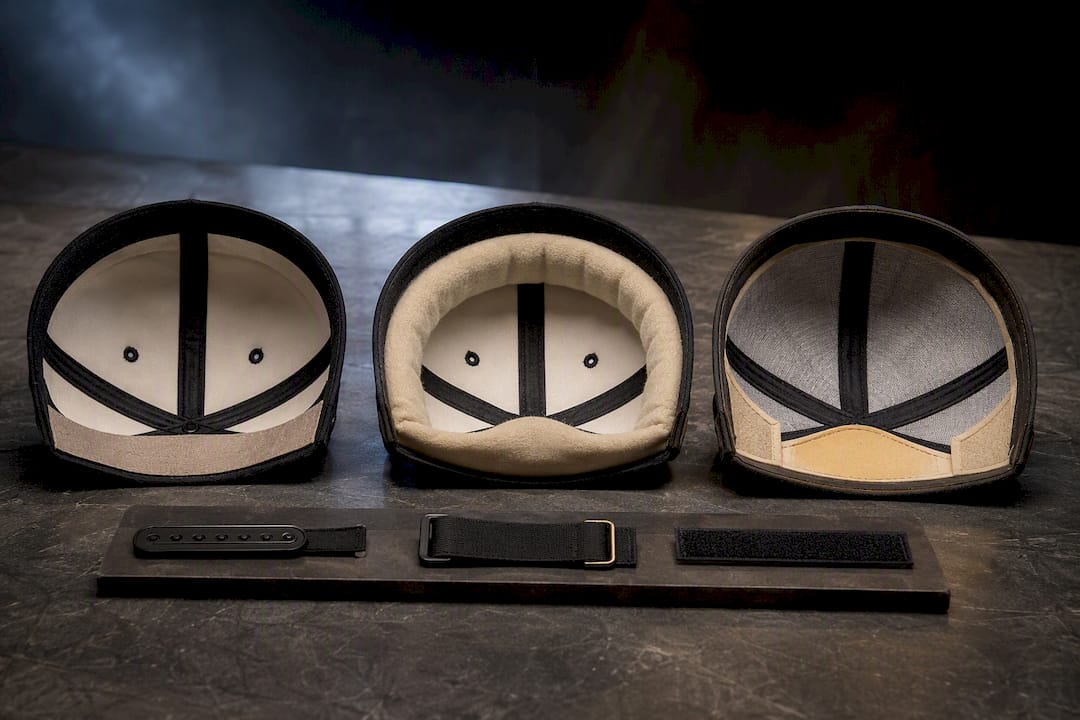
Adjustable and OSFM hats complicate this further, since the snap, strap, or velcro range varies by a full inch or more between manufacturers depending on the closure style. A snapback with six adjustment notches gives you more precision than a strap-back with three. When you're shopping online across different brands, treat your measured circumference as the constant and the size label as the variable. Pull up each brand's own conversion chart before you buy rather than trusting that a size once verified elsewhere will repeat itself.
The One Number That Actually Matters
Most hat-buying advice online buries the lede. Sites pile on brand history, hat style trivia, and fashion tips before ever telling you to grab a tape measure, and that ordering is backwards. Your circumference measurement is the entire foundation. Everything else, style choice, brand preference, letter size versus numeric, is downstream of that one number.
Where I think shoppers get it wrong is trusting memory over measurement. If you bought a Large somewhere three years ago, that doesn't mean Large is still your size today, or that it translates to a different brand's Large tomorrow. Heads don't change much, but hat construction does, and every brand builds its sweatband and crown a little differently.
Prioritize the measurement, then the chart, then the style. Skip straight to browsing hats by size label without measuring first, and you're gambling with a return shipment. Measure once, measure twice, write down both inches and centimeters, and you'll shop every hat brand with actual confidence instead of a guess dressed up as a size.
— Victor
Shop Hats Sized Right, the First Time
GfaceGear builds hats the same way we build everything else in the ROAR lineup: with real size charts on every product page, not vague "one size" guesswork. Match your measurement to the chart above, then check the specific product page for that hat's exact fitted or OSFM range before you check out.

If you land between two sizes, size up and lean on a foam reducer strip rather than betting on stretch. And if the fit still isn't right once your hat arrives, check the return and exchange policy before you write it off. It's there for exactly this reason. Ready to gear up? Head to the GfaceGear hat collection and put your measurement to work on a piece from the current drop, lion sneakers, long tshirt dresses, and the limited-edition swimwear included.
Where This Sizing Data Comes From
- How to Determine Your Hat Size — Stetson Stories
- Sizing Chart — New Era Cap
- Hat Size Chart: Every Hat Type with Measurements & Specs — MFGMerch
- Hat Sizing Guide — Plaid Gorilla Golf
Sources
- How to Determine Your Hat Size — Stetson Stories
- How to Measure Your Head for a Hat (All Brands, All Styles) — TailorSizeGuide
- Sizing Chart — New Era Cap
- Hat Size Chart: Every Hat Type with Measurements & Specs — MFGMerch
FAQ
How do you know your hat size?
Wrap a tape measure around your head half an inch above your eyebrows and level over your ears, then match that circumference to a fitted-size chart, rounding up if you land between two sizes.
Does hat size 7 3/8 vary depending on the brand and style, so measuring your head circumference is the best way to find an accurate fit, medium or large?
A 7 3/8 fitted size falls in the Large bracket on most conversion charts, corresponding to roughly a 23 1/8-inch head circumference.
Can I use Dawn dish soap to wash my hats?
Dish soap can be too harsh for delicate hat materials like wool felt or structured buckram, so it's safer to spot clean with a mild detergent and check the manufacturer's care instructions first.
Is a 7 1/4 hat size a big head?
A 7 1/4 sits right around the average adult range, roughly 22 3/4 inches, so it's a common, mid-range size rather than an unusually large one.