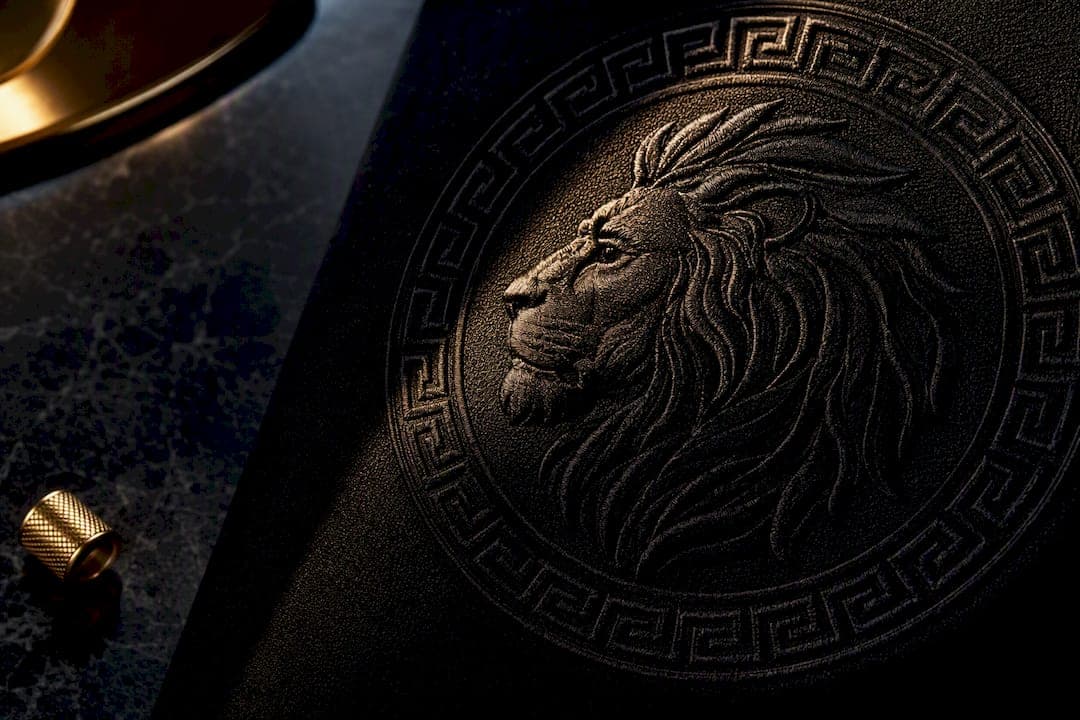
A lion medallion tells the world you're claiming strength, courage, leadership, and protection, all at once, before you say a single word. The exact message shifts depending on the lion's pose, the medallion's origin, and where you wear it, but the core meaning has held steady since ancient Egypt and medieval Europe. Today, people wear the symbol as personal armor and a fashion statement rolled into one.
TL;DR:
- The scale, placement, and context of a lion medallion significantly influence its message, whether as a subtle personal symbol or a bold statement piece.
- Historical origins like heraldry, Egyptian talismans, and ancient jewelry reveal that lion symbols have long represented protection, authority, and spiritual power.
- Different cultural interpretations, such as the Lion of Judah or guardian lions, shape the meaning of lion imagery based on origin and purpose, from spiritual pride to warding off evil.
- The lion's pose, especially whether it is rampant, passant, or seated, changes the perceived message from aggression to calm authority or vigilance.
- Wearing a lion medallion often signifies qualities like strength, courage, and leadership, with additional layers of protection or status depending on design and cultural context.
Table of Contents
- What Does a Lion Medallion Represent?
- Where the Symbol Comes From: Heraldry, Egypt, and Ancient Talismans
- How Different Cultures Read the Same Lion
- Reading the Pose: What Position Tells You
- Wearing the Symbol Today: Styling and Gifting a Lion Medallion
- The GfaceGear Take on Lion Symbolism
- Shop the Lion Symbolism: Gfacegear Product Picks
- Sources
- FAQ
What Does a Lion Medallion Represent?
Strip away the history for a second and ask what the animal itself communicates. A lion doesn't hide, doesn't apologize, and doesn't back down from a threat. That's the raw material every culture has built on when it turned the animal into an emblem.
Strength is the obvious read, but it's rarely about physical muscle. Worn on a chest or wrist, a lion medallion usually signals inner fortitude, the kind that gets you through a bad year, not just a heavy lift. Courage works the same way. It's less "I fight" and more "I don't flinch when things get hard." Leadership comes from the lion's real-world role as the animal other animals organize around, which is exactly why lion behavior and social structure get cited so often when people explain why the symbol reads as authority rather than just aggression.
Protection and pride/royalty round out the core five. Protection ties back to the lion's ancient role as a guardian figure, something we'll dig into in the next section. Pride and royalty are about status and dignity, the sense that you carry yourself like someone who belongs at the front of the room, not the back.
A few things change how loud that message reads:
- Scale matters. A small lion signet ring whispers the meaning. A bold pendant on a chain shouts it.
- Placement matters. A medallion print across a shirt front reads as identity and fashion. The same lion engraved small on a ring reads as personal, almost private.
- Context matters. The same symbol on a business card versus a streetwear drop lands completely differently.
There's also a psychological layer worth naming directly: choosing predator imagery is a deliberate identity move. People don't accidentally pick a lion over a rabbit. Lion symbolism in heraldry has represented courage, regal authority, and leadership for centuries, and that reputation is exactly why the animal still gets chosen over any other creature when someone wants to project confidence.
Where the Symbol Comes From: Heraldry, Egypt, and Ancient Talismans
The lion's job as a status symbol didn't start with jewelry counters. It started with royal courts and battlefields.
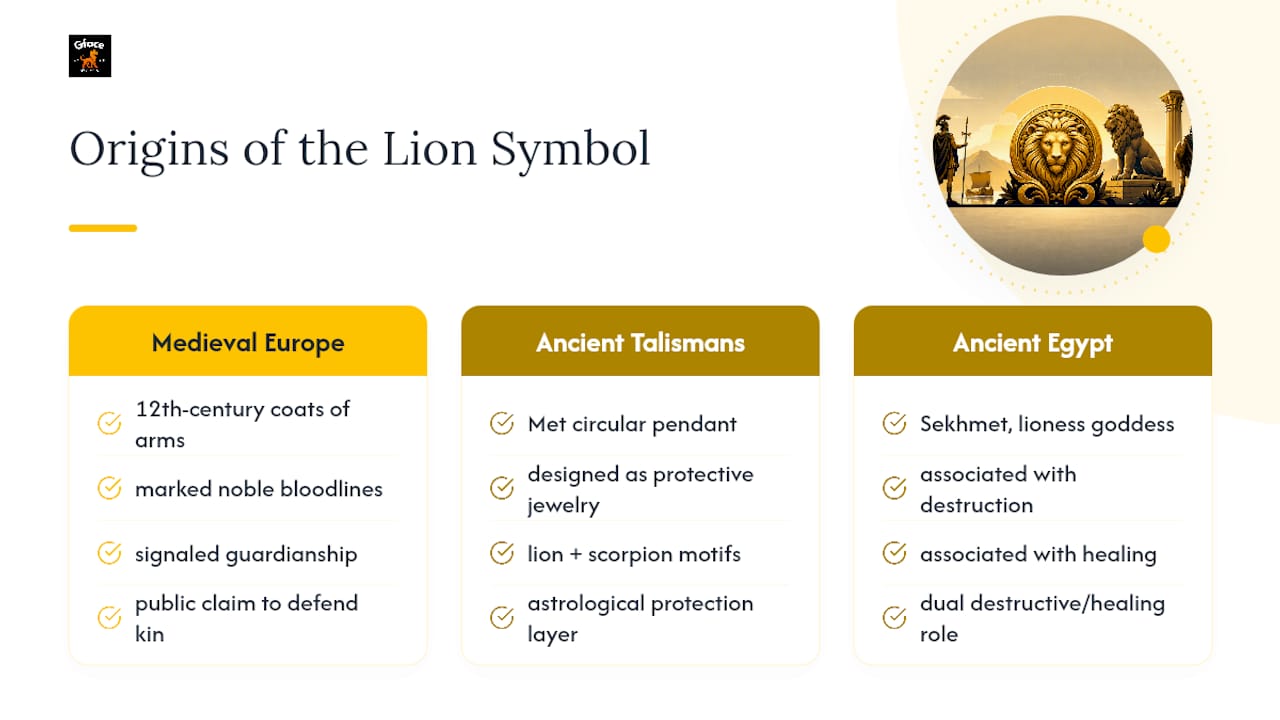
In medieval Europe, the lion became one of the most common figures on coats of arms starting in the 12th century, marking noble bloodlines and signaling guardianship as much as raw power. A lion on a family crest wasn't just decoration. It was a public claim that this house would defend its own and answer for its actions with the same fearlessness the animal represents.
Go back further and the lion shows up as protective jewelry, not just political branding. The Metropolitan Museum of Art holds a circular pendant featuring lion and scorpion motifs, cataloged as a talismanic object believed to shield its wearer from harm. The pairing of lion and scorpion, along with pseudo-writing worked into the design, points to a piece meant to do double duty: astrological protection layered on top of raw guardian symbolism. Ancient Egyptian tradition ran a parallel track through Sekhmet, the lioness-headed goddess associated with both destruction and healing, proof that even in one civilization the lion carried two faces at once.
One documented artifact, two functions: the Met's lion-and-scorpion pendant shows how a single object was designed to be both a status marker and a working charm against danger, not one or the other.
That double meaning never really left. Scholarly work on the lion in medieval Western Europe describes the symbol as genuinely ambivalent, standing for both divine power and earthly authority depending on the context. That flexibility is exactly why a lion medallion can still mean "protect me" and "respect me" in the same breath, thousands of years after the first version of that idea got carved into metal.
How Different Cultures Read the Same Lion
Provenance changes everything. The same rampant lion silhouette carries a different weight depending on who put it there and why.
- Lion of Judah: Rooted in Ethiopian imperial history and deeply tied to Rastafari belief, this version signals spiritual pride, resistance, and a connection to African heritage. Wearing it is rarely casual. It's a statement of identity and lineage.
- Komainu and guardian lions: East Asian traditions place lion pairs at temple and building entrances specifically to guard against evil spirits. The meaning here is almost entirely protective, less about personal status and more about watching a threshold.
- Snow lion: In Tibetan Buddhism, the snow lion represents fearless joy and mental clarity rather than dominance, a gentler cousin to the Western reading of the symbol.
- Sikh "Singh" identity: The name Singh literally translates to lion, adopted as part of Sikh identity to represent courage and equality among believers. Lion imagery for a Sikh wearer often functions as a personal declaration of faith and resolve, not decoration.
The takeaway: before you assume a lion piece means "strength" and stop there, look at where the design comes from. A komainu-style pair means something structurally different from a Lion of Judah medallion, even though both trace back to the same animal.
Reading the Pose: What Position Tells You
Heraldry developed an actual vocabulary for lion poses, and a lot of it survived into modern jewelry design without most wearers realizing it.
- Rampant (standing on hind legs, ready to strike): reads as readiness and aggression, the most common pose on medallions built to project raw power.
- Passant (walking, one paw raised): signals steady forward motion, more measured than rampant.
- Guardant (body in profile, head facing forward): built specifically to communicate vigilance, a lion watching you watch it.
- Sejant (seated): suggests authority at rest, confidence that doesn't need to prove itself in motion.
- Couchant (lying down, head up): calm but alert, a softer read on the same theme.
- Dormant (lying down, eyes closed): rare in jewelry, symbolizing peace rather than threat.
A frontal lion head, staring straight out at the viewer, reads as confrontational and direct. A profile or rampant pose reads as coiled readiness instead. Added details push the meaning further: a crown turns the lion into explicit royalty, a shield behind it leans back toward heraldic guardianship, and zodiac symbols or pseudo-writing, like the scorpion pairing on that Met pendant, add an astrological or protective layer on top of the base symbolism.
Pro Tip: If you want a piece that reads as quiet authority rather than a challenge, look for a seated or profile lion instead of a frontal, roaring one. Same animal, completely different social signal.
Wearing the Symbol Today: Styling and Gifting a Lion Medallion
Lion medallions moved from castle walls to streetwear racks without losing their weight. In urban fashion, a lion print or medallion graphic operates as a personal crest, the same function it served on a 12th century shield, just printed on a tee instead of stamped in metal. Limited drops built around lion imagery tend to sell on identity as much as design, which is exactly why the symbol keeps showing up on everything from lion streetwear staples to full outfit builds for game day looks.
Gifting a lion piece carries its own logic. People give lion jewelry for milestones like graduations, promotions, and birthdays, when the message is "you've earned this authority." It also shows up as a protection gift, something given before a big move, a new job, or a risky chapter, echoing that ancient talismanic use. Passed down within a family, a lion medallion picks up heirloom weight fast.
Matching the piece to the message matters:
- Want subtle? A discreet lion signet or small pendant keeps the meaning personal.
- Want loud? A bold medallion or full lion graphic across apparel makes the statement impossible to miss.
- Want texture? Decorative lion motifs, like the kind found in Art Nouveau lion pattern work, show how the same animal reads completely differently rendered in flowing, ornamental detail versus a hard heraldic outline.
The GfaceGear Take on Lion Symbolism
We built this brand around one animal for a reason. Gfacegear started in Brooklyn with the ROAR identity front and center, a Greek Key medallion running through the designs as a nod to a legacy of strength that goes back further than any single culture can claim alone.
When we put a lion on a piece, we're not decorating. We're pointing at everything this article just covered: courage, leadership, protection, pride, passed down and repurposed drop after drop. Limited runs get built around that weight on purpose, never slapped on as an afterthought. When you put on your Gameface, you're stepping into a symbol that's been carrying people through hard seasons since before streetwear existed.
— Victor
Shop the Lion Symbolism: Gfacegear Product Picks
Reading about lion medallion meaning is one thing. Standing in a piece that actually carries that weight is another. Gfacegear channels every symbol covered above, strength, protection, pride, straight into apparel built for people who want to wear it, not just understand it.

Look for the ROAR identity across lion sneakers, hats, mens tshirts, and the long tshirt dresses that carry the Greek Key medallion detailing into everyday rotation. If you want the boldest read on the symbol, the limited edition swimwear drops, including past releases like the Limited Boriqua Swimwear, put lion and heritage imagery front and center for a statement piece that doesn't blend in. Membership perks unlock early access and sitewide discounts on new drops before the general release, worth checking if you plan to build a full lion-coded wardrobe instead of grabbing one piece. Head to the Gfacegear lookbook to see the current lineup and find the piece that matches the message you're trying to send.
Sources
- Lion (heraldry) — Wikipedia
- Pendant with Lion and Scorpion — The Metropolitan Museum of Art
- The lion in medieval Western Europe: Toward an interpretive history — Traditio (Cambridge Core)
- Lion fact sheet — PBS
FAQ
Can You Wear a Lion Pendant?
Yes. There's no restriction on who can wear a lion pendant, though many wearers choose one specifically because of what it represents: strength, courage, and protection.
What Does Wearing a Lion Necklace Mean?
Wearing a lion necklace typically signals confidence, leadership, and personal resilience, with roots in heraldic and talismanic traditions where the lion represented courage and regal authority. Some wearers also connect it to protection, echoing museum-documented talismans like the Met's lion pendant.
What Does a Lion Statue in Front of Your House Mean?
A lion statue at an entrance traditionally functions as a guardian marker, a tradition most visible in East Asian komainu pairs placed to protect a threshold from harm. The same protective logic applies whether it's a stone statue or a metal medallion worn on the body.
What Is the Meaning Behind Wearing a Lion Pendant?
The meaning centers on five core ideas: strength, courage, leadership, protection, and pride, though the exact emphasis shifts based on the pendant's pose and cultural origin. A rampant lion leans toward readiness and power, while a seated or guardant lion leans toward calm authority or vigilance instead.