
Pick a crew neck when you want a bold, versatile silhouette that adds width to your shoulders and works with almost any streetwear fit. Pick a V-neck when you want to elongate your neckline, layer under an open shirt, or stay cooler in warm weather. Fit and fabric weight matter more than the neckline itself, and a shallow V splits the difference for most guys who want to dress up without overthinking it.
TL;DR:
- Shallow V-necks (1-2 inches below the collarbone) are most versatile for layering and professional settings, while deeper V-necks suit beach or festival looks.
- Crew necks are ideal for streetwear, graphic tees, and cold-weather layering, as they add width and hold heat better than V-necks.
- Fit and fabric weight matter more than neckline shape, with heavyweight cotton crew shirts preferred for bold prints and lightweight V-necks for warmth and layering.
- Neckline choice should depend on body type: crew necks widen the upper body, while V-necks elongate the neck and slim the torso, especially with shallow depths.
- When layering, avoid stacking similar necklines and opt for a shallow V under crew or shirts to prevent bulking or gaps.
Table of Contents
- Crew Neck Vs V Neck: The Quick Comparison
- How Does Neckline Choice Flatter Different Body Types?
- What Necklines Work Best For Each Occasion?
- Should You Layer A Crew Or A V-Neck Underneath?
- What Should You Check Before Buying A Shirt?
- How Do You Keep A Neckline From Losing Its Shape?
- Victor's Take: How GfaceGear Picks Necklines For Every Drop
- The Real Answer Nobody Wants To Hear
- Shop GfaceGear's Crew And V-Neck Lineup
- Sources
- FAQ
Crew Neck Vs V Neck: The Quick Comparison
Both necklines start from the same round-collar family, but the shape does different visual work. A crew neck sits close to the base of the throat, a rounded band that's been the default T-shirt silhouette for decades. A V-neck cuts diagonally from the shoulders to a point at the sternum, and that single design choice changes how your whole upper body reads.
Here's the breakdown, attribute by attribute:
- Shape: crew neck is round and closed; V-neck is angular and open at the chest.
- Visual effect: crew neck widens the shoulder line; V-neck creates a vertical pull that elongates the neck, according to style experts who break down the two side by side.
- Typical V depth: shallow (1 to 2 inches), moderate (2 to 3 inches), or deep (3+ inches).
- Warmth and airflow: crew neck holds heat near the collarbone; V-neck opens up ventilation at the chest.
- Layering friendliness: V-neck disappears under an open shirt or jacket; crew neck works better as the top layer.
- Formality: shallow V-necks read slightly more polished; crew necks lean casual and graphic-first.
- Best use: crew for streetwear, graphic tees, and cold-weather base layers; V for layered fits and warm-weather comfort.
If you're building a wardrobe around bold prints and heavyweight cotton, crew neck wins by default. If you're stacking pieces or dressing for heat, the V-neck earns its spot.
How Does Neckline Choice Flatter Different Body Types?
Neckline shape works like a frame around your face and shoulders, and the wrong frame can throw off proportions you'd otherwise want to show off. A crew neck draws a horizontal line, which visually broadens whatever it sits on top of. A V-neck does the opposite: it draws the eye down and in, stretching the neck and slimming the upper torso according to menswear breakdowns on the difference between the two cuts.
V depth isn't one-size-fits-all, and knowing the categories helps you shop smarter:
- Shallow V (1 to 2 inches below the collarbone): the safest, most versatile depth. Works under blazers, open flannels, and even some business-casual settings.
- Moderate V (2 to 3 inches): more casual, more chest exposure, best for warm-weather streetwear and off-duty fits.
- Deep V (3+ inches): reserved for beach days, festival looks, or intentionally bold statement pieces. Not the move for the office.
Here's how that plays out across real builds:
- Slim frame, longer neck: crew necks add welcome width and stop the neck from looking too stretched.
- Broad chest, shorter neck: a shallow V opens things up and keeps the torso from reading boxy.
- Athletic build, wide shoulders: crew works fine, but a moderate V can soften the width if you want a leaner line.
- Rounder face shape: a V-neck's vertical pull draws the eye downward and balances a fuller jawline.
- Angular or narrow face: crew necks fill out the frame instead of sharpening it further.
Before you buy anything, run this three-point check in the fitting room: the shoulder seam should sit right at the edge of your shoulder bone, the chest should skim without pulling across buttons or print, and the neckline itself shouldn't gap or ride up when you raise your arms. Skip any shirt that fails more than one of those checks.
What Necklines Work Best For Each Occasion?
Streetwear, smart-casual, business-casual, nightlife, and gym days all call for different collar depths, and matching the neckline to the setting is half the battle.
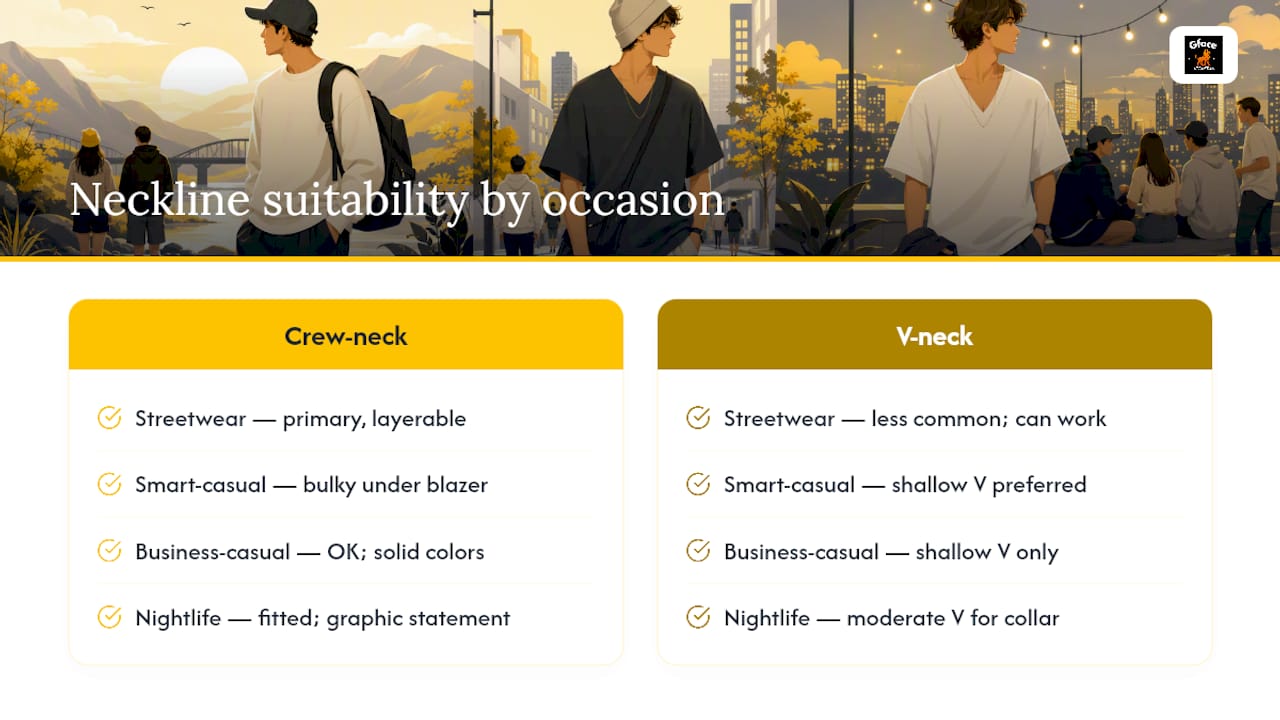
Casual and streetwear is crew-neck territory. A heavyweight graphic crew paired with cargo pants and lion sneakers hits the ROAR energy without trying too hard. Stack it with an open flannel for cooler days, or throw a bomber over it for a night out. If you're building toward colder months, GfaceGear's winter streetwear outfit formulas lean heavily on crew-neck layering for exactly this reason.
Smart-casual is where a shallow V-neck earns its keep. Worn solo under an unbuttoned overshirt or blazer, it keeps your neckline clean without a crew's collar poking out. Pair it with tailored joggers and low-profile sneakers for a look that reads put-together, not sloppy.
Business-casual rarely calls for a deep V. Stick to shallow depths, solid colors, and a fit that doesn't gap at the chest when you sit down.
Nightlife opens the door for a moderate V or a fitted crew, depending on whether you want the graphic-first statement (crew) or the leaner, exposed-collar look (V). Either way, fabric weight matters more here than depth. A cheap, thin tee kills the effect fast.
Gym and athletic wear almost always favors crew necks for stability during movement, though moderate V-necks show up in performance lines built for airflow. For graphic-heavy crew looks across any of these settings, the outfit ideas built around bold prints are a solid starting point.
Should You Layer A Crew Or A V-Neck Underneath?
The one rule that saves every outfit: never stack the same neckline twice. Two crew necks on top of each other creates a bulky double collar. Two V-necks layered together looks like a mistake, not a style choice. The fix is simple.
- Layering under a crew-neck sweater: wear a shallow V-neck tee underneath so nothing peeks out at the collar.
- Layering under an open shirt or flannel: a V-neck stays invisible; a crew neck will show above the shirt's collar line.
- Choosing an undershirt: shallow V-necks work under dress shirts and button-ups; crew-neck undershirts work fine under other crew pieces or heavier hoodies where nothing shows anyway.
- Thermal trade-off: crew necks trap more heat near the throat, which is why they dominate cold-weather base layers, while V-necks open up airflow for warmer days or high-movement layering.
Before you leave the fitting room or step out the door, run this check: no visible undershirt collar peeking above your outer layer, no rolling or bunching at the neckline, and no visible seam lines showing through a lighter fabric.
Pro Tip: Keep one shallow V-neck tee in heavyweight cotton specifically for layering under crew-neck hoodies and sweaters. It's the single most versatile piece for solving the stacking problem before it starts.
What Should You Check Before Buying A Shirt?
Fit and fabric decide whether a shirt looks good longer than one wash cycle, and both matter more than which neckline you pick.
- Check shoulder alignment first. The seam should land exactly at your shoulder's edge, not creeping down your arm or pulling up toward your neck.
- Test the chest drape. The fabric should skim your chest and stomach without pulling tight across a graphic print or stretching thin at the seams.
- Match fabric to use case. Ring-spun cotton in the 180 to 220 GSM range holds up well for everyday crew tees, while lighter cotton-poly blends with a bit of stretch suit V-necks meant for layering.
- Pick your V depth on purpose. Shallow for work and layering, moderate for casual weekend fits, deep only for beach or festival looks.
- Inspect the neckline binding. A well-made shirt has reinforced stitching around the collar that won't stretch out or curl after a few washes.
For sizing across GfaceGear's print-on-demand cuts, the jersey size guide breaks down exactly how each fit runs before you commit to a drop.
How Do You Keep A Neckline From Losing Its Shape?
Crew necks can feel tighter around the throat simply because of how the ribbing sits, and heavier fabric weights amplify that. V-necks, by contrast, open up airflow at the chest, which tends to mean less sweat buildup and a cooler feel through the day, especially in warmer months.
Keeping either neckline in shape comes down to a few habits:
- Wash in cold or warm water, never hot. Heat breaks down the elastic ribbing fast.
- Skip the high-heat dryer cycle. Air-dry or use low heat to protect the collar band.
- Turn shirts inside out before washing to protect printed graphics and reduce collar friction.
- Replace a shirt once the ribbing loses its snap and the collar starts sagging permanently. No amount of washing brings that back.
Victor's Take: How GfaceGear Picks Necklines For Every Drop
When we're designing a limited-edition run, the neckline decision happens early, and it's driven by the piece itself. Heavyweight, graphic-first tees built to carry the lion and Greek Key medallion go crew every time. The round collar gives the print room to breathe and holds up under the weight of thick cotton. V-necks show up in our more lifestyle-oriented pieces, the ones meant to layer under an open jacket or work into a lighter, warm-weather rotation.
That split isn't arbitrary. A bold graphic wants a frame that doesn't compete with it, and a crew delivers that every time. A layering piece wants to disappear, and a shallow V does exactly that. If you're building a rotation that includes both heavyweight tees and lighter layering pieces, the streetwear layering guide walks through how we approach that mix across a full drop.
The Real Answer Nobody Wants To Hear
Most guides treat crew neck vs V-neck like a permanent identity choice, as if picking one locks you out of the other. That's backwards. The better question isn't which neckline is objectively superior. It's which neckline solves the specific problem in front of you: a graphic you want front and center, a layering piece that needs to vanish, a hot day that calls for airflow.
The conventional wisdom oversells neckline as the deciding factor in how a shirt looks, when fit and fabric weight do far more of that work. A well-cut crew neck in heavyweight cotton will outperform a sloppy, thin V-neck every single time. Chase the fit first. Then let the neckline follow the outfit's job, not the other way around.
What I'd push back on hardest: the idea that deep V-necks are inherently more "elevated." Depth without the right fabric and fit just reads as trying too hard. A shallow V or a clean crew, cut well, beats a deep V cut poorly in almost every setting that matters.
— Victor
Shop GfaceGear's Crew And V-Neck Lineup
GfaceGear builds both necklines with the same standard: heavyweight cotton, bold graphics, and fits that hold their shape past the first wash. If you've settled on a crew for your next graphic tee or a V-neck for layering under this season's drop, the lineup is print-on-demand, so limited-edition designs stay limited without sitting in a warehouse waiting for the next restock.

Membership perks unlock sitewide discounts and early access to drops like the Limited Boriqua Swimwear line, on top of the everyday rotation of lion sneakers, hats, and long tshirt dresses. Check the jersey size guide before you order to lock in the right fit, or review the layering guide if you're planning to stack pieces this season. For style inspiration beyond GfaceGear's own drops, Only Queer Crew is worth a look for crew-neck-focused design ideas. When you're ready, head to GfaceGear to browse the current lineup and grab your size before the drop sells out.
Sources
- Crew Neck vs. V-Neck: Style Experts Break Down How to Choose Between the Two — Men's Health
- V-Neck vs Crew Neck T-Shirt - What’s the Difference? – Tapered Menswear
FAQ
Does A V-Neck Or Crew Neck Look Better?
Neither wins outright. A crew neck widens the shoulder line and suits bold graphics, while a V-neck elongates the neck and slims the upper torso, so the better choice depends on your build and the outfit's purpose.
Who Should Wear V-Necks?
Guys with a shorter neck, a broader chest, or a rounder face tend to benefit most from a V-neck's elongating effect. It's also the better pick for layering under open shirts and jackets.
Are V-Necks Out Of Style?
V-necks remain a staple, not a trend, especially in shallow depths that work across smart-casual and layered outfits. Deep V-necks stay more situational, best saved for beach or festival settings rather than everyday rotation.
Who Should Avoid A V-Neck?
Guys with a longer, thinner neck or a narrow face often look better in a crew neck, since a V-neck's vertical pull can stretch those proportions further instead of balancing them. Deep V-necks in particular are risky for anyone chasing a more polished look.
Is A Crew Neck Better For Layering Than A V-Neck?
No, it's the opposite. A shallow V-neck disappears under an open shirt or crew-neck sweater, while a crew neck tends to show above the collar line, which is why GfaceGear's layering approach defaults to V-neck undershirts for stacked outfits.