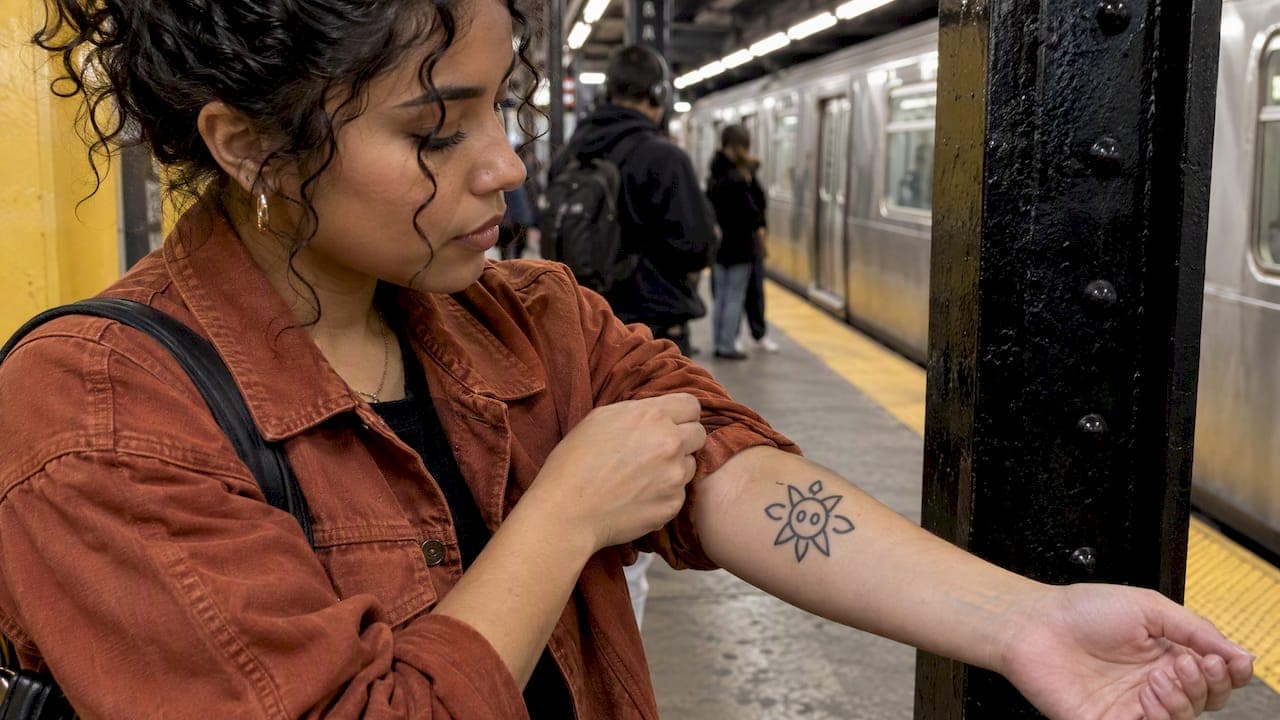
The Taíno sun symbol is a round, radiant face that stands for the sun god, life, light and Indigenous Caribbean identity. Most people mean one specific image: the Sol de Jayuya, a petroglyph in Puerto Rico. Here is the part most posts skip. The name is modern, and so are many of the "official" meanings. That doesn't make the symbol fake. It makes it alive.
Let's break it down: where it comes from, what the Taíno believed about the sun, what is solid history and what is later interpretation, and how to carry it with pride.
TL;DR
- The best-known Taíno sun is the Sol de Jayuya, a petroglyph on the Zamas mural in Jayuya, Puerto Rico, estimated to predate 1493.
- The Taíno told of the sun and moon emerging from the cave of Mautiatibuel, the Lord of the Dawn.
- The name "Sol de Jayuya" dates to around 1968. Calling the carving a sun is an interpretation, and some local sources suggest it could be a turtle.
- The Taíno had no written language, so petroglyphs can't be read like hieroglyphs. Treat any single "translation" with care.
- Today it works as a symbol of heritage and resistance to erasure. Wear it with knowledge, not just as a pattern.
Table of Contents
- What the Taíno sun symbol is
- The sun in Taíno belief
- What is proven, and what is modern
- Why the sun matters to Boricuas today
- What about the Taíno language and "I love you"?
- How to wear the Taíno sun with respect
- Perspective: how we think about heritage on the chest
- Wear your roots: pieces that carry the energy
- Styling ideas that respect the symbol
- Common mistakes to avoid
- FAQ
- Sources
What the Taíno sun symbol is
Picture a round face. Two eyes, a line across it, an oval mouth, and small double circles ringing the outside like rays. That is the image people tattoo on forearms, hang from rearview mirrors and print on flags at the Puerto Rican Day Parade. oldsymbols.com describes it as a petroglyph on the Zamas mural in Jayuya, in the mountains of central Puerto Rico.
You will hear it called:
- Sol de Jayuya (Sun of Jayuya), the name tied to the carving's location.
- Sol Taíno, the general phrase for the Taíno sun motif.
- Sol Boricua, "Puerto Rican sun," the nickname that shows how far the image has traveled beyond the rock.
- Dios del sol, sun god, the meaning most often attached to it.
So when someone asks what "sol Taíno" means, the short answer is simply "Taíno sun." Sol is Spanish for sun. The deeper answer is about belief, memory and identity.
The sun in Taíno belief
The Taíno were the Indigenous people of Puerto Rico and much of the Greater Antilles when Columbus arrived. They left no books. What we know comes from carvings, ceremonial objects, caves, Spanish chroniclers who wrote with their own bias, and the oral memory of descendants.
One story comes up again and again. In Taíno mythology, the sun and moon both emerged from the cave of Mautiatibuel, a name rendered as "son of dawn" or "Lord of the Dawn." The sun rises from that cave each day. The moon, often linked with the goddess Atabey, hides inside it, and then the roles swap.
That gives you a clear picture of how the sun fit into daily life:
- Light and time. The sun marked the day, the harvest and the rhythm of the village.
- Strength and longevity. The sun symbol is frequently associated with a sun god believed to give strength and long life to people and crops.
- Balance. Sun and moon born from the same cave suggests two forces that belong together, not rivals.
Sun imagery also shows up beyond Jayuya. A photo essay on Caribbean caves notes a pictograph of the sun in the Cueva Jose Maria, and ties life itself to both rain and sun. The sun was never a single logo. It was a theme that appeared on stone, in caves and on ritual objects.
What is proven, and what is modern
This is where most pages get sloppy. Here is the honest version.
| Claim | Where it stands |
|---|---|
| The petroglyph exists at Zamas, Jayuya | Yes. It is part of a mural estimated to date before 1493. |
| The Taíno associated the sun with a powerful deity | Widely reported in myth and symbol guides, including the Mautiatibuel cave story. |
| The name "Sol de Jayuya" is ancient | No. Local sources say it was given around 1968 by a local cultural center, after archaeologist Ricardo Alegría visited. |
| The carving is definitely a sun | Not certain. That is a modern reading, and some local sources suggest it could be a turtle. |
| Each Taíno symbol has one fixed meaning | No. Scholars sort petroglyphs into human-like, animal-like and abstract forms, but many specific "definitions" are modern attributions. |
Anthropologist Jorge Baracutay Estevez cautions that treating these carvings as a code to translate oversimplifies a lost system that depended on context and varied by island. So any list promising the one true meaning of every Taíno symbol deserves a raised eyebrow.
Does the modern naming weaken the symbol? We don't think so. Communities name and reread old artifacts to build pride in the present. That is what happened in Jayuya, and it is what Puerto Ricans on the island and in New York and Philadelphia are doing now.
Why the sun matters to Boricuas today
The Sol de Jayuya is not just decoration. The Smithsonian notes that tattoos like it and similar motifs have been used by Caribbean people with Indigenous ancestry to claim their national identities and push back against colonial erasure.
That history is heavy. For generations, a story circulated that the Taíno were simply gone. Descendants and cultural groups have pushed back on that story, and the symbols are part of the answer. Wearing the sun says: we are still here.
For many in the diaspora, it also does something simpler. It connects a kid in Brooklyn or North Philly to a mountain town they may have visited once, or never. It is a way to carry abuela's island on your chest.

What about the Taíno language and "I love you"?
People searching this topic often ask how to say sun, or "I love you," in Taíno. Be careful here.
The Taíno language fell out of everyday use after the Spanish conquest. There is no historically recorded or verified translation of "I love you". Phrases you see on social media are modern reconstructions, often built from related Arawakan languages.
What survives is real, though. Caribbean Spanish and English still carry words of Taíno origin, including hurricane, hammock, barbecue, canoe, guava and tobacco. The Taíno gave us those. Every time you say "barbecue" at a cookout, you are speaking a little Taíno.
How to wear the Taíno sun with respect
The symbol is for people who want to honor it. Here is how to do that well.
- Learn the story first. You've just read the basics. Know that the carving is in Jayuya, that the name is modern, and that the Mautiatibuel legend is part of the belief system.
- Say what it means to you. If someone asks, you can say it represents the sun, life and Taíno heritage, and that you wear it for ancestry, pride or respect. You don't need to claim ancient certainty.
- Avoid fake precision. Don't tell people the symbol "spells" something. It isn't a written language.
- Pair it with your own story. Heritage looks best when it's personal: a family flag, a neighborhood, a lion for strength, a name you were given.
- Know where the design came from. Look for makers who credit the culture and don't treat it like a random pattern.
Perspective: how we think about heritage on the chest
We're a Brooklyn-born streetwear brand. Our whole identity is about stepping out in your Gameface, so we think hard about what goes on a shirt. Our drops lean into lion imagery, the Greek Key medallion and Boricua heritage themes, and we've run limited editions like our Limited Boriqua Swimwear.

Here is our take. Heritage is not a trend, and it's not a costume. The best pieces start with a reason. Maybe it's a flag your family has flown since forever, maybe it's a symbol you've researched, maybe it's something you wear because it makes you stand taller on the block. Gear should back that up and never replace it.
We'd rather you wear something you can explain in one sentence than something that just looks good on a feed. Know it, own it, then roar. If you want to go deeper on the culture side, start with our take on what the Puerto Rican flag means in streetwear and our guide to Boricua streetwear drops.
— Victor
Wear your roots: pieces that carry the energy
Sun symbol or not, the move is the same: pick pieces that say who you are. These are the categories we'd point you to first.
- Limited edition swimwear. Summer heritage hits different at the beach or the pool party. Our swimwear collection is where our limited Boricua drops live, and our Puerto Rican swimwear drop guide shows how to catch them.
- Men's tees. The easiest way to put a statement on your chest. Browse shirts for everyday heat.
- Long tee dresses. One piece, no fuss, full presence. Find dresses in our full shop.
- Hats. A small piece that finishes a fit. Lion energy goes well here too.
- Lion sneakers. Start at the feet and let the whole fit follow. Sneakers are in the same shop.
Planning a parade day? Our list of Puerto Rican Day Parade outfits breaks down six looks. Curious why the lion keeps showing up in our designs? Read about the lion medallion poses and what they mean.
Want more every month? The Pride Membership is 9.99 $ per month and brings sitewide discounts, early access to drops and VIP perks. Join the Pride, get first look at limited drops, and lock in your gear before it's gone.

Styling ideas that respect the symbol
You don't need the sun printed on everything. Heritage styling is about layering meaning.
For Gen-Z in NYC
Think city layers. A men's tee under a jacket, a hat pulled low, sneakers that stand out on the train platform. Lion and Greek Key details give you that Brooklyn edge, while a small flag pin or a sun tattoo covers the heritage story. Keep one loud piece and let the rest support it.
For Gen-Z in Philadelphia
Philly has a deep Puerto Rican community, and game days and block parties are where outfits get seen. Our game day outfit guide covers lion streetwear for the stands and the street. A jersey over a tee, a fresh hat, and you are set.
For couples
Pairs work. Matching tees or his-and-hers fits make a statement without saying a word. Choose one theme, the lion, the flag colors or a shared heritage detail, and let each piece stand on its own.
Common mistakes to avoid
- Treating the sun as a generic "tribal" shape. It has a place, a people and a story.
- Mixing it up with other cultures. Some posts online compare it to sun gods from entirely different civilizations. The Taíno symbol belongs to the Caribbean and should not be blended with those.
- Trusting one meaning. Scholars debate petroglyph interpretations, so "the definitive meaning" is usually marketing.
- Forgetting the people. Taíno descendants and Boricuas are living communities. Support them, credit them and listen to them.
FAQ
What does the Taíno sun symbol mean?
It is most often read as the Taíno sun god, a source of light, life and strength for people and crops. Today it also stands for Indigenous Caribbean ancestry and Puerto Rican pride. The exact original meaning of any single petroglyph can't be confirmed, since the Taíno left no written record.
What is the Sol de Jayuya?
It is a petroglyph on the Zamas mural in Jayuya, Puerto Rico, and it is the image most people picture as the Taíno sun. The name is modern: local sources say it was given around 1968. Some local sources even suggest the carving could represent a turtle, so the sun reading is an interpretation.
How do you say sun in Taíno?
In Spanish, the word is sol, and that is the term used in "Sol Taíno." The Taíno language is no longer spoken as a living language, and reconstructed phrases are modern creations. Be cautious with any site that claims to give exact Taíno translations.
Can anyone wear the Taíno sun symbol?
No one polices a tattoo or a shirt, but context matters. It carries real cultural weight for Puerto Ricans and Taíno descendants. If you wear it, learn the story, avoid claiming certainty you don't have, and give the culture credit.
Sources
- Taíno sun (Sol de Jayuya): Taíno symbol meaning and history
- Symbols, Taino Museum
- Waking a Language from Its Slumber, American Indian Magazine
- Bringing Taíno Peoples Back Into History, Smithsonian Magazine
- Puerto Rican Tribal Art: Taino Symbols and Petroglyphs, Study.com
- Taino Caves, the Photo Essay, by Lynne Guitar