
Your wrist doesn't care about the number stamped on the case back. It cares about lug-to-lug, the distance from tip to tip across the watch's face, because that measurement decides whether the case sits flush on your wrist or hangs off the edge like a hubcap. As a fast rule: 6"–6.5" wrists do best around 36–40mm diameter with a max lug-to-lug near 44–46mm, 6.5"–7.5" wrists handle 38–42mm with up to 47–49mm lug-to-lug, and wrists past 7.5" can run 42–46mm with lug-to-lug up to 52mm.
- Under 6" wrist: 34–38mm case, max lug-to-lug ~42mm
- 6"–6.5" wrist: 36–40mm case, max lug-to-lug ~44–46mm
- 6.5"–7.5" wrist: 38–42mm case, max lug-to-lug ~47–49mm
- Over 7.5" wrist: 42–46mm case, max lug-to-lug ~50–52mm
Lug-to-lug and thickness matter more than diameter because they're what actually touches your skin. A 42mm watch with short lugs can wear tighter and cleaner than a 40mm watch with long, straight lugs that spill over your wrist bones.
Key Takeaways
Lug-to-lug fit inside your wrist's flat width, not case diameter, determines whether a watch feels comfortable and looks proportional on your arm.
| Point | Details |
|---|---|
| Prioritize lug-to-lug | Compare a watch's lug-to-lug against your wrist's flat width, not just its diameter. |
| Calculate your flat width | Divide wrist circumference by 3 to 3.2 to find your usable flat measurement. |
| Watch thickness thresholds | Under 10mm reads slim, 10–14mm is versatile, over 14mm adds real wrist presence. |
| Match specs to real watches | Models like the Tudor Black Bay Fifty-Eight or Seiko SKX show how lug design changes fit at the same diameter. |
| Style completes the fit | Gfacegear's lion sneakers, hats, and Roarwear tees give a well-fitted watch a bolder frame to sit in. |
Table of Contents
- How to Measure Your Watch Case Size and Wrist
- Why Case Diameter Alone Can Mislead You
- What Case Size Fits Your Wrist Circumference?
- Does Case Thickness Change How a Watch Feels?
- Real Watch Examples: How Specs Translate to Fit
- Buying Checklist: Avoid the Return Line
- The Flat-of-Wrist Rule, Explained With Real Numbers
- Watch Case Size Is About Fit, Not Just the Number on the Bezel
- Complete Your Look With Gfacegear
- Sources
- FAQ
How to Measure Your Watch Case Size and Wrist
Grab a soft measuring tape, a piece of string with a ruler, or a set of calipers if you own one. Any of these gets the job done, though calipers give you the tightest precision on lug-to-lug and thickness.
- Measure wrist circumference. Wrap the tape snugly (not tight) around your wrist bone, where a watch would naturally sit.
- Convert to flat width. Divide circumference by 3 to 3.2. A 7" wrist works out to roughly 2.2"–2.3" (about 56 to 58mm) of usable flat surface.
- Measure case diameter. Go bezel to bezel, straight across the widest point, excluding the crown.
- Measure lug-to-lug. Run the tape or calipers from the very tip of the top lugs to the tip of the bottom lugs, following the strap's axis.
- Measure case thickness. Go from the top of the crystal to the bottom of the case back.
- Measure lug width. Check the gap between the spring bars, which tells you what strap sizes will fit.
This same measurement approach lines up with how model-specific screen protectors ensure perfect fit by matching exact lug-to-lug and case dimensions before you buy.
Pro Tip: Keep an old watch or a strip of card stock cut to your calculated flat width in your pocket when you shop. Hold it against any watch's lug-to-lug spec before you commit, and you'll never overbuy a case again.

Why Case Diameter Alone Can Mislead You
Sellers lead with diameter because it's the one number that fits neatly on a spec sheet. It tells you how much dial you'll see, nothing more. Two watches at exactly 40mm can wear worlds apart depending on bezel width, dial-to-case ratio, crown size, and how the lugs are shaped.
- A thin bezel makes the dial look bigger even at a smaller diameter.
- Long, straight lugs extend a watch's real footprint well past its quoted size.
- Curved or short lugs pull the case in, letting a 42mm watch wear closer to a 40mm.
- Crown guards and pushers add visual bulk without changing the diameter number at all.
Lug geometry and case shape change how identical diameters wear, which is exactly why two "40mm" watches can feel like different sizes on the same wrist.
What Case Size Fits Your Wrist Circumference?
Lay your wrist measurement next to this chart and you've got your working range in under a minute.
| Wrist Circumference | Approx. Flat Width | Suggested Diameter | Max Lug-to-Lug |
|---|---|---|---|
| 6"–6.5" | ~44–48mm | 34–38mm | 40–42mm |
| 6"–6.5" | ~48–52mm | 36–40mm | 44–46mm |
| 6.5"–7" | ~52–56mm | 38–40mm | 47mm |
| 7"–7.5" | ~56–58mm | 40–42mm | 48–49mm |
| 7.5"+ | ~60–62mm | 42–44mm | 50mm |
| Over 7.5" | ~62–64mm | 44–46mm | 52mm |
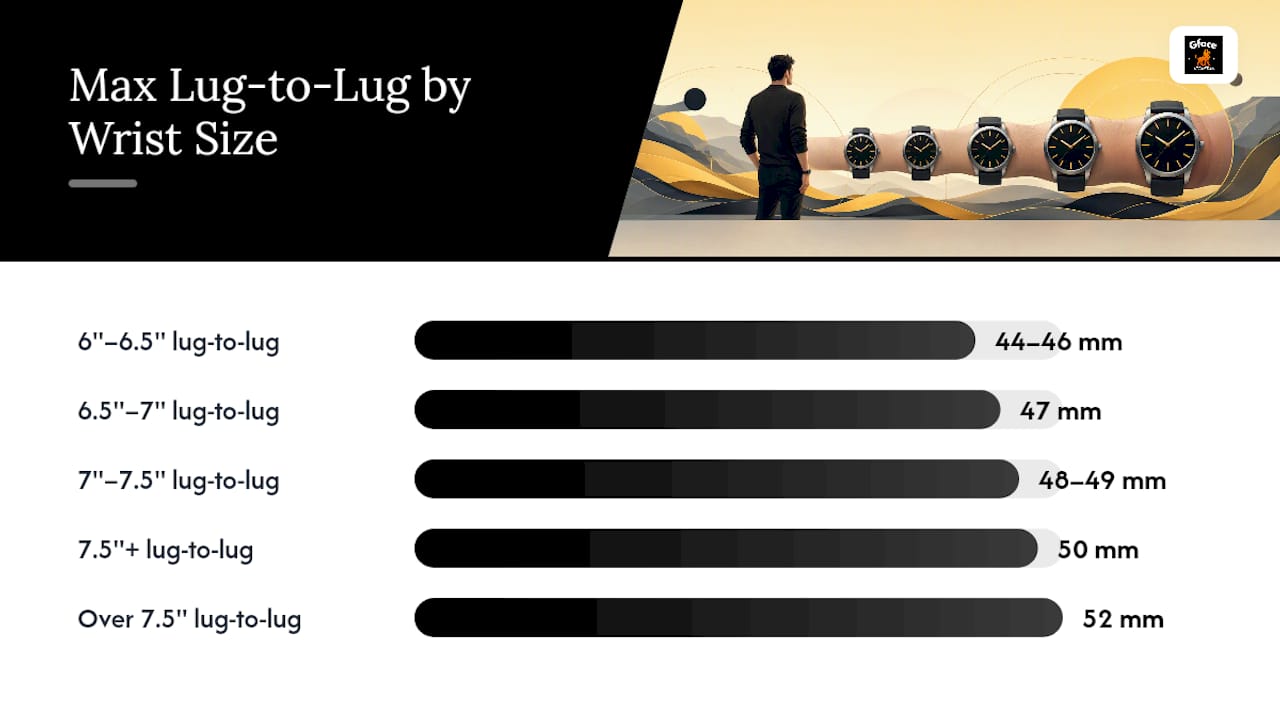
A 6.5" wrist's ideal case lands around 40mm with a max lug-to-lug near 47mm, a figure that matches what most fit calculators spit out once you plug in your own numbers.
Treat every row as a rule of thumb, not gospel. Once your wrist crosses 7.5", lug-to-lug stops being the limiting factor. At that point, style, wrist presence, and how a case sits under a sleeve matter more than whether it technically fits.
Does Case Thickness Change How a Watch Feels?
Thickness is the sleeper spec nobody checks until their watch won't slide under a cuff. Anything under 10mm reads as slim and dressy. The 10–14mm range is where most sport and everyday watches live, striking a comfortable balance. Past 14mm, you're in dive-watch or oversized-chronograph territory, and the case will visibly stack up off your wrist.
- Slimmer watch cases typically slide under shirt cuffs more easily and feel lighter on the wrist.
- Mid-range thicknesses offer a balance between comfort and wrist presence.
- Cushion and tonneau case shapes often appear smaller than their stated diameter.
- Square cases tend to look larger than their diameter because diagonal measurements exceed width.
- A curved case back hugs the wrist better than a flat one, even on thicker watches.
Pro Tip: If you're stacking a watch with fitted streetwear sleeves, a curved case back on a mid-thickness watch will sit flatter and more comfortably than a flat-backed piece of the same thickness.
Real Watch Examples: How Specs Translate to Fit
Numbers only click once you see them on watches people actually recognize. Here's how five well-known cases stack up against the wrist-size math above.
- Tudor Black Bay Fifty-Eight: 39mm diameter, roughly 46–47mm lug-to-lug, 11.9mm thick. Fits a 6"–7.5" wrist comfortably, and the short lugs keep it wearing smaller than the number suggests.
- Rolex Submariner 41: 41mm diameter, about 48mm lug-to-lug, 12.5mm thick. Suits 6.5"–7.5" wrists; smaller wrists will feel the lugs edge past the flat.
- Seiko SKX-style 40mm diver: 40mm diameter, roughly 46–47mm lug-to-lug, 13mm thick. A safe pick from 6"–7.5" thanks to its compact lug design.
- Cartier Tank (square case): Around 25mm wide, but corner-to-corner it reads visually larger. Fits nearly any wrist since there's no lug overhang to worry about.
- Panerai Luminor: 44mm diameter, often 50mm+ lug-to-lug. Built for 7"+ wrists; the oversized wire lugs make it a poor fit below that.
Swap a bracelet for a leather strap on any of these and the watch will read visually smaller. Bracelets add hard edges and bulk; a soft strap lets the case sit closer to the skin.
Buying Checklist: Avoid the Return Line
Run through this before you check out, especially when buying online where you can't try before you buy.
- Measure your wrist and calculate your flat width.
- Compare that flat width to the watch's lug-to-lug, not just diameter.
- Check thickness against your typical cuff or sleeve fit.
- Confirm lug width matches the straps you actually want to wear.
- Verify the seller's return or exchange policy before you click buy.
- Try on a similar-sized watch in person if you're on the fence.
Red flags to walk away from: lugs that visibly overhang your wrist bones, a case so thick it rolls to one side, or a crown that digs into the back of your hand when you bend your wrist. If you're pairing a watch with a bold streetwear fit, sneakers, a fitted cap, a graphic tee, lean into wrist presence with a slightly larger case. If you want something that disappears under a jacket sleeve, go smaller and slimmer every time.
The Flat-of-Wrist Rule, Explained With Real Numbers
The flat-of-wrist rule exists because circumference measures a curve, not the flat surface a watch actually rests on. Divide your wrist circumference by 3 to 3.2 to get that flat width, then treat it as your ceiling for lug-to-lug.
- A 6.5" wrist (16.5cm) works out to roughly 52–55mm of flat surface.
- A watch with a 47mm lug-to-lug fits comfortably inside that flat, leaving room on both sides.
- Push past 55mm lug-to-lug on that same wrist, and the lugs will start creeping past your wrist bones.
This ratio comes from tools built specifically to convert circumference into a usable flat measurement, and it's the single best predictor of whether a case will overhang before you even try it on. Treat it as a strong guideline, not an exact science. Caseback curvature and personal comfort with a bit of overhang will always shift the math slightly in your favor or against it.
Watch Case Size Is About Fit, Not Just the Number on the Bezel
Most watch shopping advice still treats diameter like it's the whole story. It isn't, and the data backs that up. Lug-to-lug is what determines whether a case looks like it was built for your wrist or borrowed from someone else's.
Here's where conventional advice falls short: it treats every 40mm watch as interchangeable. It's not. A 40mm dive watch with long lugs and a thick bezel can wear bigger than a 42mm dress watch with a slim bezel and short lugs. If you're only checking the diameter before you buy, you're gambling with the one spec that actually predicts comfort.
Prioritize the flat-of-wrist math first, thickness second, and diameter last. Once you've nailed the fit, style becomes the fun part. That's where you get to decide if you want a piece with wrist presence to match a bold streetwear stack or something slim enough to disappear under a hoodie sleeve. Case size and character should work together, not against each other.
Complete Your Look With Gfacegear
Getting your watch case size right is only half the fit equation. What's stacked around it, on your feet, your head, your chest, tells the rest of the story. Gfacegear built the ROAR identity for exactly that: bold lion graphics, the Greek Key medallion, and pieces designed to carry presence the same way a well-fitted watch does.

If you're building a fit where your watch has real wrist presence, pair it with something that matches that energy instead of fighting it. Our lion sneakers anchor a look the same way a 42mm case anchors a wrist, bold, deliberate, unmissable. Stack a Roarwear tee or one of the long Betty Boop dress shirts underneath, top it with one of our hats, and you've got a fit that reads intentional from your collar to your cuff. The Limited Boriqua Swimwear drop works the same logic for warm-weather days when your watch is the only accessory doing the talking.
Browse the current ROAR collection and build a fit that matches the confidence of a watch you finally sized right.
Sources
- Watch Size Calculator — What Fits Your Wrist? | lug²lug
- How to choose the right watch size | Wrist Enthusiast
- Watch Size Guide: What Watch Fits Your Wrist? | WatchPolice
FAQ
How Do I Know My Watch Case Size?
Measure your wrist circumference, divide by 3 to 3.2 to get your flat width, then match that number against a watch's lug-to-lug measurement rather than its diameter alone.
What Does 42mm Mean on a Watch?
It refers to the case diameter measured bezel to bezel, excluding the crown, and tells you how much dial the watch shows, not how it will actually sit on your wrist.
What Is the Standard Case Size for a Watch?
There's no single standard, but most men's watches fall between 38mm and 42mm, while smaller cases in the 34mm range are common for women's watches and slimmer wrists.
How Do I Pick the Right Watch Case Size?
Start with your wrist's flat width, keep lug-to-lug within that number, then adjust diameter and thickness based on whether you want a subtle or bold look, the same logic Gfacegear applies when pairing accessories with statement streetwear pieces.