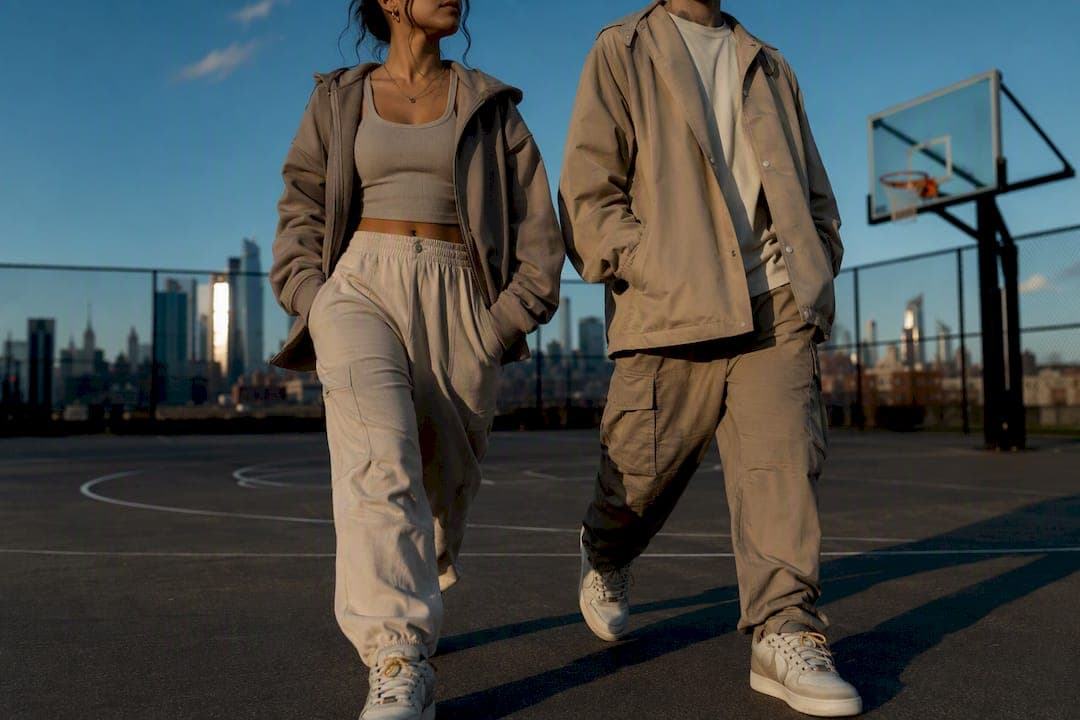
The easiest way for couples to nail streetwear is to coordinate by palette or proportion, not copy each other piece for piece. Pick one shared anchor, usually a sneaker silhouette or a color family, and build around it. Below you'll find ready-to-copy formulas, seasonal swaps, and fit rules straight from Victor and the GfaceGear crew, built so every look reads intentional, never like a costume.
TL;DR:
- Focusing on one shared anchor item, such as sneakers or a hat, creates a deliberate look without risking a costume effect from full duplication.
- Texture contrast and silhouette variation are key to achieving visually interesting coordination, especially with tonal or proportion-based outfits.
- Seasonal swaps should maintain the core anchor while rotating complementary pieces like jackets, shorts, or layered hoodies suited to weather.
- Investing in one or two high-quality anchor pieces per season supports a sustainable wardrobe and better photo results than full matching sets.
- Avoid combining more than one or two matching elements, as multiple identical pieces quickly shift a coordinated look into costume territory.
Table of Contents
- Couples Streetwear Outfits: 9 Formulas Worth Copying
- How to Coordinate Streetwear Outfits Without Twinning
- Seasonal Streetwear for Couples: What to Swap Each Quarter
- Fit and Shopping Checklist for Coordinated Looks
- Meet Victor: The Voice Behind GfaceGear's Style Guides
- Avoiding the Costume Trap in Couples Streetwear
- Styling Streetwear for Different Body Types and Gender Expressions
- Accessories That Tie a Couples Streetwear Look Together
- Where to Shop Streetwear for Couples on Any Budget
- Why Most Couples Overthink Matching
- Shop Coordinated Streetwear Pieces at GfaceGear
- Sources
- FAQ
Couples Streetwear Outfits: 9 Formulas Worth Copying
These pairings work because one element repeats between partners while everything else stays personal. That's the whole trick behind good couples matching outfits: shared logic, not identical items.
- Oversized tee + cargo pants + lion sneakers. Partner A wears a boxy graphic tee and relaxed cargos; Partner B wears a cropped or tucked tee with straight-leg cargos. The shared lion sneakers do the talking. No sneakers on hand? Swap in matching sock colors instead.
- Tonal all-black stack. Both partners in black, but one leans matte cotton, the other leans a sheen jacket or vinyl-look pant. Texture contrast is what saves all-black from looking flat, and it's a formula GfaceGear's all-black streetwear guide covers in more depth.
- Matching sweat set, broken up. One partner wears the full hoodie-and-jogger set; the other wears just the hoodie over jeans or the joggers with a different top. Full-set twinning reads try-hard fast unless you break the uniform somewhere.
- Shared hat, separate fits. Two GfaceGear bucket hats or fitted caps in the same colorway anchor otherwise unrelated outfits. Cheap to coordinate, hard to overdo.
- Long tee dress + oversized tee. She wears a long tshirt dress in the drop's core colorway; he wears the matching graphic tee sized up. Same print family, two completely different silhouettes.
- Denim-on-denim, staggered washes. One partner in dark wash, one in light. The mismatch in shade keeps it from looking like a uniform while the fabric still ties the look together.
- Bomber + hoodie combo. One layers a bomber jacket over a plain tee, the other wears a hoodie in a complementary shade. Different outerwear, same temperature logic, same palette.
- Boricua heritage tees, contrast bottoms. Both wear graphic tees from the same heritage-print run, but pair them with different bottoms (shorts vs. joggers) so the shirts do the coordinating.
- Limited-edition swimwear sets. For beach days, matching a GfaceGear limited-drop swim piece with neutral cover-ups keeps the vacation photos coordinated without forcing a costume moment.
How to Coordinate Streetwear Outfits Without Twinning
Three techniques cover almost all couples matching outfit that actually works: tonal dressing, silhouette matching, and shared-accessory anchoring.
- Tonal dressing means staying in one color family, like olive, warm white, or brown, while mixing fabrics. A canvas jacket next to a knit sweater in the same tan reads far more deliberate than two identical shirts.
- Silhouette matching balances proportion instead of color. If one partner goes oversized on top, the other should keep the bottom slim, or both go fully relaxed with oversized layering on both ends. The goal is structural logic, not a mirror image.
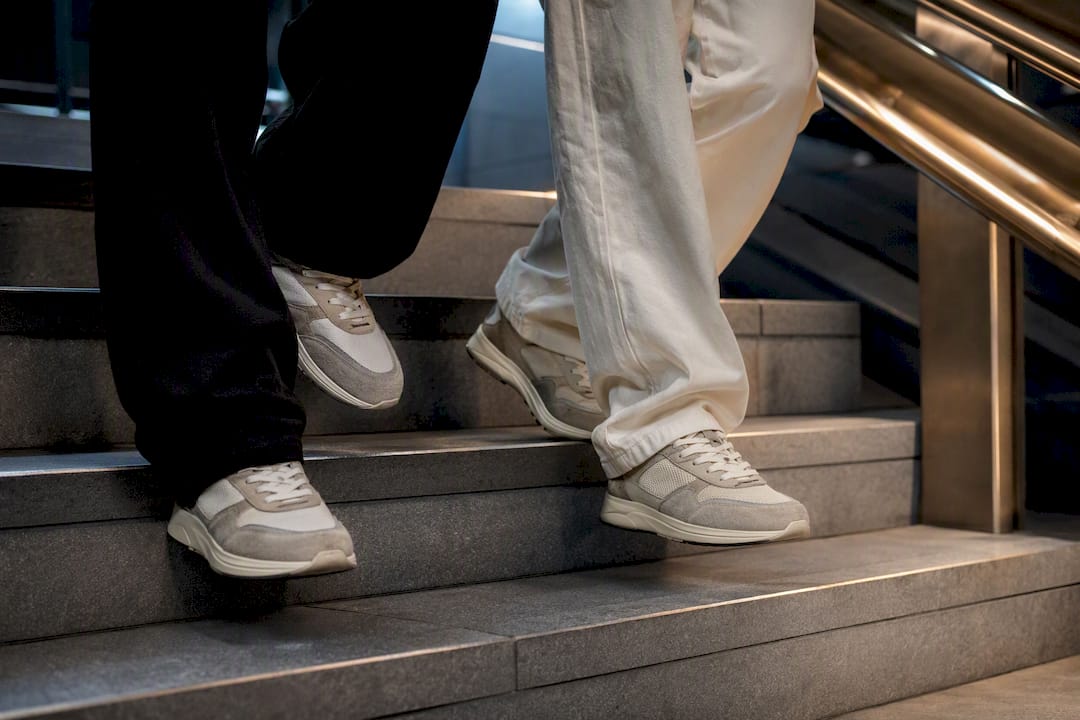
- Shared accessory anchors let you skip full coordination entirely. A single repeated item, a watch, a hat, or the same sneaker silhouette in both sizes, signals intent without either person feeling costumed.
The order matters: pick your anchor first, then match proportions around it, then keep textures varied so the photo doesn't flatten into one block of color. Sneakers are usually the strongest anchor of the three, since a standout silhouette does more visual work than three separate branded pieces stacked together.
Pro Tip: If you only buy one shared item for a couples look, make it the sneakers. One matching pair on both feet reads more intentional than matching tops on both bodies.
Seasonal Streetwear for Couples: What to Swap Each Quarter
Weather changes the formula, not the philosophy. Keep the shared anchor and rotate the rest.
- Spring: Lightweight jackets over tonal tees, low-top sneakers, and lighter denim washes. Pastels and warm whites photograph clean against outdoor greenery.
- Summer: Oversized tees, shorts, and slides or low-top canvas sneakers. This is also when limited-edition swimwear pairs come into play for beach or pool days.
- Fall: Layered hoodies under a bomber or light puffer, finished with high-top sneakers or boots. Layering gives you two or three fabric textures to play with, which photographs better than flat matching.
- Winter: Insulated outerwear, coordinated beanies, and shared boot or sneaker energy. Heavier fabrics (wool, fleece) next to leather or nylon shells add the texture contrast that keeps winter looks from reading flat.
Pro Tip: Shooting outdoors versus indoors changes how coordinated colors actually read in photos, so check your lighting before committing to a palette that only works in one setting; learn more about what photography context gets more matches in our guide on outdoor vs indoor dating photos.
Fit and Shopping Checklist for Coordinated Looks
Bad fit turns a good couples outfit into a costume faster than bad color choices ever will. Run this check before you leave the house:
- Shoulder seams should sit at the shoulder edge, not halfway down the arm, unless the oversized fit is deliberate.
- Sleeve length and pant break (where the hem meets the shoe) should be consistent within each person's outfit, even if the two of you are dressed in different silhouettes.
- Oversized pieces need room in the body but shouldn't swallow the hands or drag on the ground; tailored pieces should still allow full arm movement.
- The 3-3-3 rule, a wardrobe guideline of 3 tops, 3 bottoms, and 3 shoes that mix into multiple outfits, works well as a packing or capsule test for couples building a shared streetwear rotation.
- If a full matching set starts to feel stiff in photos, break it. Swap one top for a solo piece and let the sneakers or hats carry the coordination instead.
Meet Victor: The Voice Behind GfaceGear's Style Guides
Victor writes GfaceGear's style breakdowns, including the sneakers outfit guide and the streetwear layering guide referenced above. GfaceGear itself started in Brooklyn, built around lion imagery and the Greek Key medallion, and now sells tees, hoodies, hats, lion sneakers, and limited drops designed to mix into looks like these. A GfaceGear hoodie, a pair of neutral cargos, and matching lion sneakers on both partners is one of the fastest ways to build a cohesive couple look with almost zero planning.
Avoiding the Costume Trap in Couples Streetwear
The line between "coordinated" and "costume" comes down to repetition. One shared element reads as style. Three or four identical pieces on both bodies reads as a Halloween pair-up, even when every individual piece is good.
Keep it to one anchor: the sneakers, the hat, or the color family, never all three at once. If you're both in the same graphic tee, put different bottoms and different outerwear on each person. If you're both in the same sneaker, let your tops diverge in color or cut. Matching sets are the riskiest move here; they work best in neutral tones with one piece swapped for something unrelated, like a jacket that doesn't belong to the set.
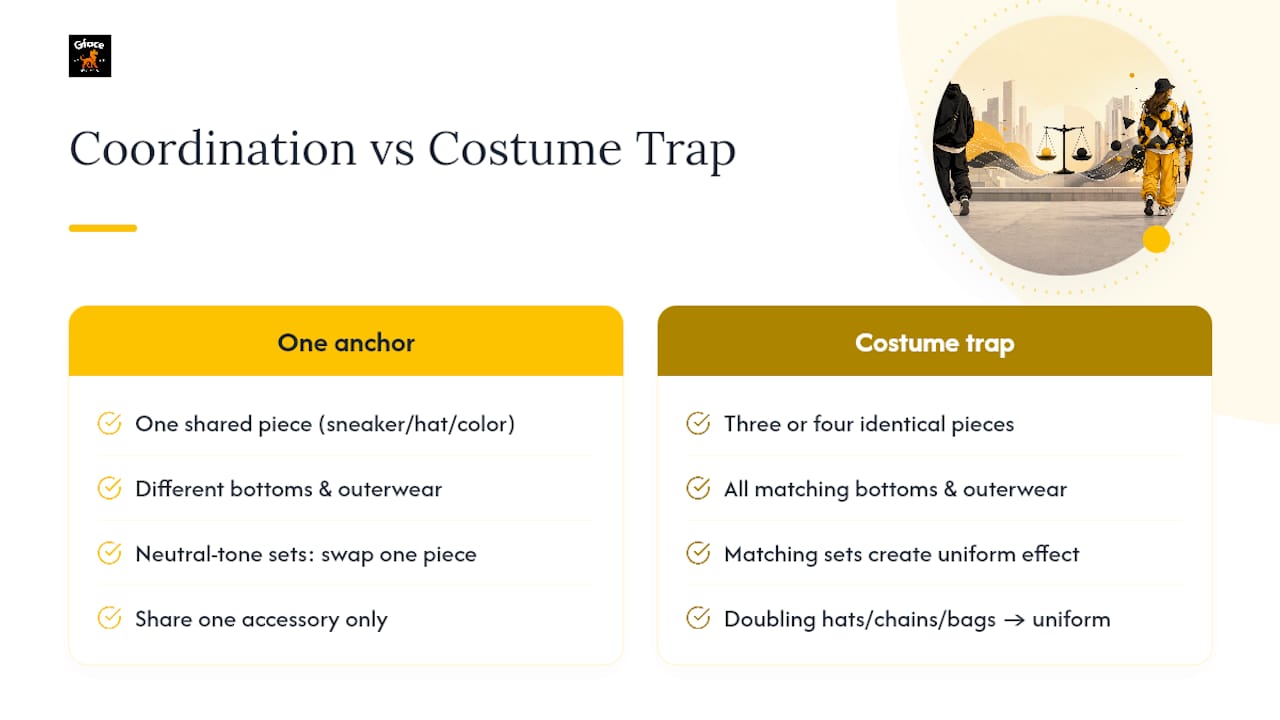
Watch the accessories too. Doubling up on hats, chains, and bags in the same look tips the balance from coordinated into uniform fast. Pick one accessory to share and let the rest of the outfit stay personal. The safest test before walking out the door: if a stranger could describe your outfits as "the same" rather than "clearly together," pull one piece and swap it for something in a different texture or cut.
Styling Streetwear for Different Body Types and Gender Expressions
Coordination rules bend easily around different bodies and styles, which is the whole point of proportion-based matching over identical dressing.
For a couple with a size difference, oversized on one partner and a more fitted cut on the other often looks more deliberate than both wearing the same relaxed fit, since it turns the size gap into a style choice. For couples where both partners are broad-framed or both are petite, matching proportions (both oversized, or both fitted) keeps the visual weight even instead of exaggerating the difference.
Streetwear also flexes naturally across gender expression. A long tshirt dress paired with a boxy graphic tee in the same print works for any combination of partners, since the silhouette does the differentiating, not a gendered cut. Mens tshirts sized up work as an easy unisex layer for either partner in a couple, and cargo pants, hoodies, and sneakers read the same regardless of who's wearing them. The anchor-piece method (shared sneakers, shared hat, shared palette) is inherently flexible here, because it never depends on both people wearing the same cut or category of clothing, just the same color or the same accessory.
Accessories That Tie a Couples Streetwear Look Together
Accessories are the lowest-effort, highest-payoff way to coordinate, since they don't require either partner to change their core outfit.
A matching hat, whether it's two fitted caps or two bucket hats in the same colorway, is one of the cheapest anchors available and works across every season. Bags follow the same logic: a crossbody or sling bag in a shared tone ties two otherwise unrelated outfits together without either person compromising on their top or bottom choices. Jewelry works best kept minimal and shared rather than doubled. Matching chains or a single repeated ring style read as intentional; loading up both partners with the same five pieces starts drifting toward costume territory.
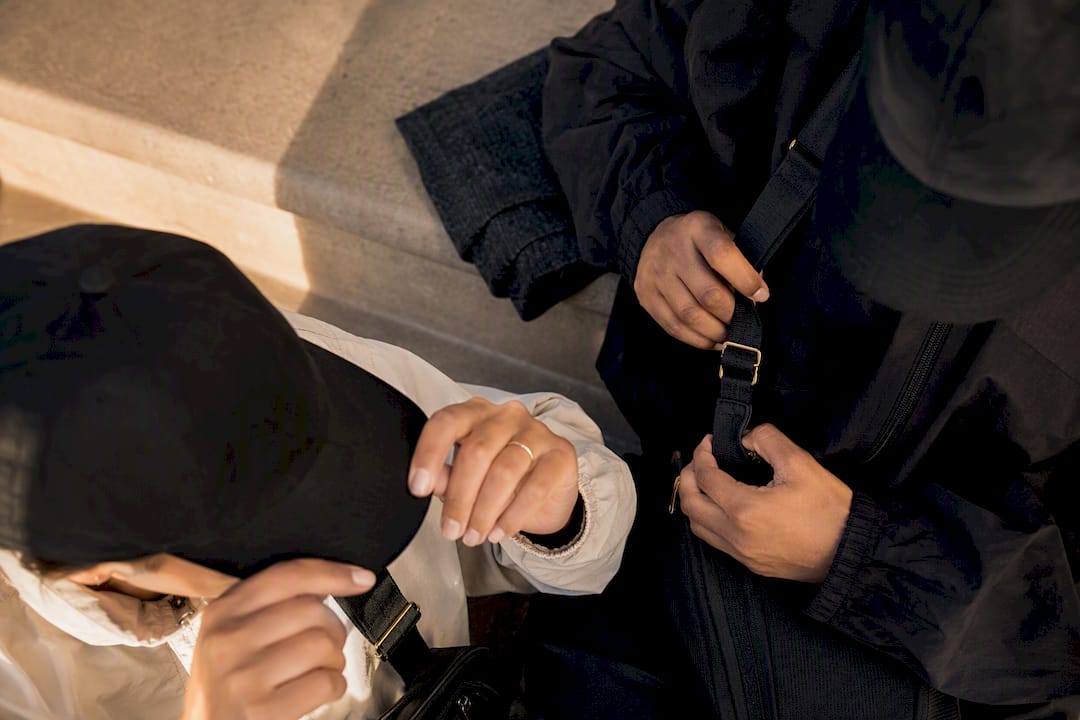
The rule from the coordination section applies here too: pick one accessory category to match and leave the rest solo. If the hats match, let the bags differ. If the sneakers match, skip the matching hats and let hair and headwear stay independent.
Where to Shop Streetwear for Couples on Any Budget
Budget shapes the strategy more than most guides admit. Fast-fashion basics work fine for the parts of the outfit that don't need to last, plain tees, basic joggers, and seasonal layers you'll cycle out anyway.
Where it pays to spend more is on the anchor piece, since that's the item doing the coordinating work and the one that'll show up in every photo. A limited-edition drop or a standout sneaker silhouette holds up better over repeat wear than a cheap version of the same idea, and it won't be sitting in every third closet on the block. Higher-end or limited pieces also matter more for occasion dressing, anniversaries, concerts, or the kind of night out where you actually want the outfit to be remembered.
A practical split: build the base wardrobe (tees, basic bottoms) affordably, then invest in one or two pieces per season, a jacket, a sneaker, a limited tee, that become the repeat anchor across multiple outfits. That's a more sustainable approach than buying an entirely new matching set every time.
Why Most Couples Overthink Matching
Most advice on couples streetwear still pushes full matching sets, identical colors, identical logos, as the goal. That advice is outdated. The couples who actually look good together in photos are the ones who picked one shared detail and let everything else stay true to their individual style. Full twinning ages a couple's look fast, both literally, since matching sets date quickly once the trend cycles, and visually, since it reads as a costume the moment either person moves differently than planned.
What the research on this actually supports is proportion and palette over duplication. Tonal dressing with texture contrast photographs better than exact matches, and a single strong anchor, almost always the sneakers, carries more visual weight than three or four smaller matching items combined. If you take one thing from this guide, let it be this: buy one great shared piece before you buy five coordinated ones. Build the rest of the outfit around your own style, not your partner's closet.
— Victor
Shop Coordinated Streetwear Pieces at GfaceGear
If you'd rather buy pieces built for this kind of coordination than assemble it from five different closets, GfaceGear's storefront is stocked for exactly that. Every drop leans on the same anchor logic covered above, lion sneakers, graphic tees, hoodies, hats, and long tshirt dresses that pair naturally across two different body types and two different styles.

Browse tees, hoodies, hats, sneakers, and swimwear designed to mix and match rather than force a matching set. Members get early access to new drops and sitewide discounts, useful if you're planning to build out a seasonal rotation instead of a one-off outfit. Head to the GfaceGear storefront and start with one anchor piece, a hoodie, a hat, or the sneakers, and build your next couples look around it.
Sources
- Mens wear: Grown-up streetwear — FashionBeans
- Matching Sets in Streetwear: Cool or Try-Hard in 2026 — WEAR2AM Blog
- Matching Couple Outfits: The Complete Guide | My Couple Goal
FAQ
What is the 3-3-3 rule for clothes?
The 3-3-3 rule is a wardrobe guideline of 3 tops, 3 bottoms, and 3 pairs of shoes that all mix into multiple outfits. Couples can use it to build a shared streetwear rotation without buying duplicate pieces for every look.
What are some cute couple outfit ideas for streetwear?
Strong options include an oversized tee with cargo pants and matching lion sneakers, a tonal all-black stack with contrasting textures, or a shared hat paired with completely separate outfits underneath. The common thread is one repeated anchor, not identical clothing.
What are the key streetwear trends for couples in 2026?
Neutral and tonal palettes, texture-contrast dressing, and sneaker-led outfits are dominating over matching sets this year. When matching sets do appear, they work best in neutral colors with one piece swapped out to avoid looking uniform.
How do I avoid looking like a costume when matching with my partner?
Pick one shared element, sneakers, a hat, or a color palette, and keep everything else independent. Doubling up on multiple identical pieces at once is what tips a coordinated look into costume territory.
Where should couples shop for streetwear on a budget?
Build the everyday basics affordably and spend more on the one anchor piece that carries the coordination, whether that's a sneaker silhouette or a limited-edition drop. Tees, hoodies, and sneakers can work well as that higher-value anchor piece within an otherwise budget-friendly outfit.