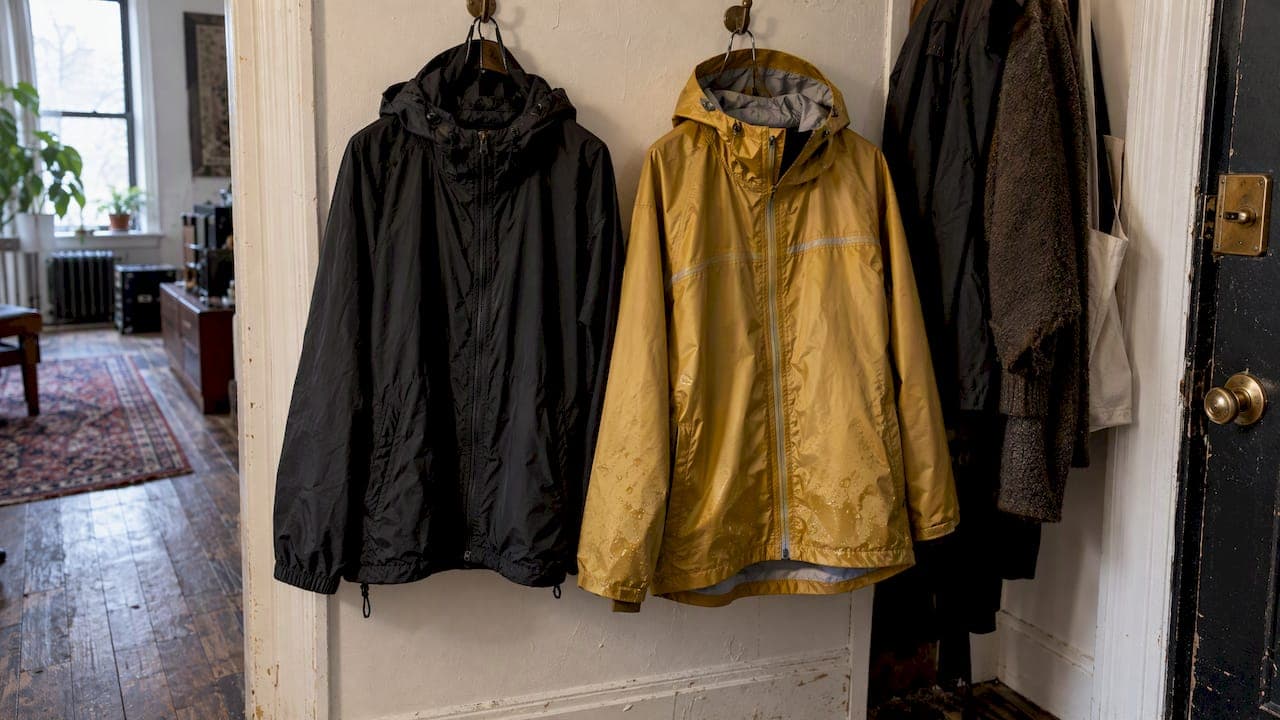
Pick a windbreaker when the sky is dry and windy and you need to move fast and light. Pick a rain jacket when the forecast calls for real, sustained rain and you need sealed, waterproof protection. A windbreaker with a DWR coating can shrug off a quick drizzle, but it's not built to replace a true membrane rain jacket once the rain settles in.
TL;DR:
- A DWR coated windbreaker sheds brief showers, but washing, abrasion, and time wear the finish down; once it wets out, the fabric feels damp.
- For steady rain, check for a waterproof membrane, sealed seams, and storm resistant zippers; a water resistant finish alone does not provide dependable coverage.
- For hard runs or climbs, choose airflow over a sealed shell; pit zips and mesh vents help, but a tight, unvented rain jacket traps heat.
- Windbreakers can weigh about 80 grams, while rain jackets commonly exceed 200 grams; choose the lighter shell when pack space and high output matter most.
- For one jacket, choose a rain shell with pit zips; it handles sustained rain and vents heat, though it breathes less than a windbreaker.
Table of Contents
- Windbreaker vs Rain Jacket: The Quick Comparison
- Materials and Construction: Membranes, Layers, and DWR Explained
- Breathability and Matching Your Jacket to Activity Intensity
- Weight, Packability, and Durability: What to Expect
- Fit and Features That Actually Affect Protection
- Running, Hiking, Commuting, and Travel: What to Actually Pack
- How to Choose: A Shopping Checklist That Actually Works
- Victor's Streetwear Take: Function Without Losing the Fit
- Thermal Insulation and Layering for Temperature Control
- What the Research Actually Tells You to Prioritize
- Gear Up With GfaceGear: Jackets Built for Real Days
- FAQ
- Sources
Windbreaker vs Rain Jacket: The Quick Comparison
Before you dig into the fabric science, here's the breakdown that actually decides what goes in your bag.
- Primary function: windbreakers block wind and light moisture; rain jackets exist to keep you fully dry in sustained rain.
- Water resistance: windbreakers rely on a DWR finish that wears off over time, while rain jackets use a waterproof membrane built for real downpours.
- Breathability: windbreakers win here because they skip the heavy membrane, which is exactly why rain jackets rank among the least breathable activewear.
- Weight and packability: windbreakers can compress down to something the size of a small citrus fruit, while rain jackets usually pack closer to the size of a large apple according to field reviewer comparisons.
- Price and durability: windbreakers tend to run cheaper, though a top-tier ultralight wind shell can still land above $150, and rain jackets generally cost more for the membrane tech inside them.
- Best use case: grab a windbreaker for a breezy run or a dry hike with gusty conditions, and grab a rain jacket when the forecast is unreliable or rain is guaranteed.
If you're the type who checks the five-day forecast before deciding what to wear out, this comparison is your cheat sheet. If you're the type who grabs whatever's on the hook, keep reading, because the fabric story below explains why that habit eventually gets you soaked.
Materials and Construction: Membranes, Layers, and DWR Explained
The real difference between these two jackets isn't the cut. It's what's happening inside the fabric.
Rain jackets are built around a waterproof membrane sandwiched into a layered construction. A 2-layer jacket bonds the membrane to the outer fabric with a separate liner hanging inside for protection. A 2.5-layer jacket skips the liner for a thin protective coating instead, cutting weight but sacrificing some durability. A 3-layer jacket bonds the membrane between the face fabric and an inner liner in one unit, which is why premium rain shells tend to feel stiffer and last longer. BackpackingLight's testing on these constructions confirms that the membrane is what delivers reliable waterproofing, but it's also the reason breathability drops compared to a simple wind shell.
A windbreaker skips all of that. It's typically a single-layer woven fabric treated with a Durable Water Repellent, or DWR, finish. That coating makes rain bead up and roll off instead of soaking in, which is great until the coating wears down from washing, abrasion, or just time. Once DWR fails, the fabric "wets out," meaning it still physically blocks water from fully passing through, but it absorbs moisture on the surface and starts feeling damp and heavy. OutdoorGearLab's buying advice notes DWR is genuinely useful for light or passing showers, but it was never designed to replace a membrane in sustained rain.
Waterproof ratings get thrown around a lot, and the concept behind them is hydrostatic head, a measure of how much water pressure a fabric can resist before it leaks. Rain jackets are engineered and tested against that standard. Windbreakers generally aren't, because that's not the job they're built for.
If you want the plain-language version of DWR versus membrane before you shop, our breakdown of water-resistant vs waterproof jackets walks through exactly what to check on a product label so you're not guessing in the store.
Breathability and Matching Your Jacket to Activity Intensity
Breathability is where the two jackets split hardest, and it's also where most people pick the wrong one.
Windbreakers are significantly more breathable than rain jackets because they don't carry the impermeable, multi-layer membrane that blocks high-pressure water. That makes them the better call for running or fast-paced hiking, where your body is generating heat and sweat faster than most fabrics can vent it. NailTheTrail's comparison specifically calls out rain jackets as some of the least breathable pieces in activewear, precisely because the membrane that keeps rain out also traps vapor in.
Rain jackets fight back against that trade-off with ventilation. Pit zips, mesh-lined torso vents, and looser cuts all give trapped heat and moisture somewhere to escape, and BackpackingLight's testing treats these features as just as important as the fabric's technical breathability rating. A rain jacket with zero ventilation and a tight cut is going to feel like a sauna on a climb, no matter how good the membrane is.
Here's a quick test if you're unsure which way to go: if you're sweating through your base layer within ten minutes of moving, that's your sign you need more airflow, either through ventilation features or a lighter shell altogether. The same principle applies below the jacket too. Fabric that's engineered to move moisture instead of trap it matters at every layer, which is the whole idea behind breathable base layers built for everyday movement.
Pro Tip: On cool, wet days with high output, wear a breathable windbreaker over a moisture-wicking base layer instead of a heavy rain shell. You'll stay drier from sweat management than you would from a jacket that seals in every drop.
Weight, Packability, and Durability: What to Expect
If you're choosing between carrying one jacket or two, the numbers make the decision easier.
Windbreakers are the lightest, most packable shell option out there, often weighing as little as about 80 grams, roughly 3 ounces, according to OutdoorGearLab's buying guide. A solid rain jacket commonly weighs 200 grams or more, which doesn't sound like much until it's the fifth thing in your bag on a long travel day. That weight gap is also why a windbreaker crushes down to something pocket-sized while a rain jacket takes up noticeably more room.

Durability tells a different story. Windbreaker fabrics are thin by design, which keeps them light but makes them more vulnerable to tearing on branches, zippers, or rough pavement. Rain jackets use heavier face fabrics and bonded membrane layers that hold up better against abrasion, though a 3-layer build will generally outlast a 2.5-layer one simply because there's no separate coating to wear off.
Repairs follow the same logic. A small tear in a windbreaker's woven fabric is an easy patch job. A puncture in a membrane jacket is trickier, since you're not just mending fabric, you're resealing a waterproof barrier. For trail use, that means a rain jacket is worth the extra care in rocky terrain. For city use, a windbreaker's lighter build is usually fine since sidewalks are a lot more forgiving than scree fields.
Fit and Features That Actually Affect Protection
The spec sheet matters more than the marketing photos here.
- Hood shape: a structured hood with a stiffened brim keeps rain off your face without blocking your peripheral vision, which matters far more in a downpour than in a breeze.
- Seams and zippers: sealed seams and waterproof or storm-flap zippers are what separate a true rain jacket from a water-resistant jacket that just looks the part.
- Ventilation and closures: pit zips, adjustable hems, and cinchable cuffs let you dump heat or lock out wind depending on what the moment calls for.
- Pocket placement: pockets positioned above a hip belt or backpack strap stay usable on the trail, while low pockets work better for everyday commuting.
Commuters should prioritize packability and a clean silhouette, travelers should look for sealed seams in a compact build, and trail users should weigh hood structure and pit zips above everything else.
Running, Hiking, Commuting, and Travel: What to Actually Pack
Match the jacket to the day, not the season.
- Running or high-output training: reach for a light windbreaker with a breathable woven fabric, and only swap in a thin rain shell if the forecast shows persistent rain rather than a passing shower.
- Day hikes: check the forecast confidence. An uncertain or wet outlook means a rain jacket is the safer call, while a clear, dry, breezy day is exactly what a windbreaker was made for.
- Commuting: prioritize look and packability. A DWR-treated streetwear shell handles short showers and still looks right walking into the office, while a compact rain jacket is the better call if your commute means standing at a bus stop in steady rain.
- Travel: pack for versatility over specialization. A single ultralight rain shell with underarm ventilation can cover both a windy ferry ride and an unexpected downpour, which beats hauling two jackets for a one-week trip.
The honest answer for a lot of people is that you don't need to choose at all. Carrying a packable windbreaker in your bag for dry, breezy days and a compact rain shell for the days rain is actually forecast covers nearly every scenario without overpacking. For a deeper look at building a layering system that handles both, our streetwear layering guide breaks down how to stack pieces without looking bulky.
How to Choose: A Shopping Checklist That Actually Works
Before you buy, run through this list instead of relying on the product photo.
- Expected precipitation: light drizzle or dry wind favors a windbreaker, sustained rain favors a rain jacket.
- Activity intensity: high-output movement favors breathability, low-intensity or stationary exposure favors waterproofing.
- Weight and packability: if it's going in a daypack or carry-on, weigh the ounces, not just the price tag.
- Budget: windbreakers are usually the cheaper entry point, though premium ultralight versions can run over $150.
- Repairability: a torn windbreaker is a quick patch, a punctured membrane jacket takes more care to reseal.
- Product specs to check: membrane type, layer count (2, 2.5, or 3-layer), sealed seams, pit zips, and a stated hydrostatic head if the brand lists one.
Outdoor gear analysts consistently point to activity intensity as the deciding factor: high-intensity movement favors windbreakers for air permeability, while low-intensity exposure in wet conditions favors a waterproof hardshell. That single rule resolves most of the back-and-forth shoppers get stuck on.
If you only want to own one jacket, the compromise that covers the most ground is an ultralight rain shell with pit zips or mesh venting. It won't out-breathe a dedicated windbreaker on a hard run, but it handles wind, light showers, and real rain without needing a second jacket in your bag. For more on reading labels before you commit, our guide on water-resistant vs waterproof jackets is worth a look before you check out.
Victor's Streetwear Take: Function Without Losing the Fit
Gear that performs doesn't have to look like it belongs on a mountain. One formula that works: a packable windbreaker thrown over a hoodie, cuffed joggers, and sneakers gives you wind protection and movement without the bulky "outdoor" silhouette. Choose a windbreaker in a matte, non-shiny weave and a slimmer cut, since a boxier fit and a glossy face fabric are what scream "technical gear" instead of "street fit."

A DWR-treated street shell reads less outdoorsy when it's layered close to the body instead of worn as a standalone statement piece. For five full outfit breakdowns built around rainy-day streetwear, from footwear swaps to hood styling, check out Victor's gorpcore formulas, and for curated windbreaker picks that lean street over trail, browse our top windbreaker picks for 2026.
Thermal Insulation and Layering for Temperature Control
Neither a windbreaker nor a rain jacket is designed to insulate on its own, and that's by design. Both are shells, meant to block wind or water while your actual warmth comes from what's underneath.
A windbreaker's thin, single-layer fabric traps almost no heat, which makes it a strong outer layer over a fleece or hoodie on cold, windy days. The wind-blocking alone can make a mid-layer feel noticeably warmer, since wind chill is often the bigger comfort problem, not the ambient temperature itself.
Rain jackets behave differently because the membrane construction holds in more warmth by default, even without added insulation. That's useful in cold, wet weather, but it becomes a liability during high-output movement, since the same membrane that blocks rain also blocks the vapor your body needs to vent. The fix is layering strategically: a wicking base layer, a light insulating mid-layer, and the shell on top, adjusted by swapping the mid-layer rather than the shell itself. That system lets you use the same windbreaker or rain jacket across a wider temperature range instead of buying a jacket for every season.
What the Research Actually Tells You to Prioritize
The conventional advice online treats this like a gear-only decision, weights and ratings and nothing else. That's missing half the picture. The real decision starts with your actual week: how often you're caught in real rain versus just wind, and how hard you're moving when it happens.
Most people overbuy rain jackets they rarely need and underbuy a decent windbreaker they'd wear constantly. A gusty commute or a dry trail run happens far more often than a genuine downpour, and that's exactly where a windbreaker earns its keep. Reliable waterproofing matters, but only when the forecast actually calls for it.
Prioritize in this order: how often you'll face real rain, how hard you move when you're out, then weight and price last. Get that sequence right and the jacket question mostly answers itself.
— Victor
Gear Up With GfaceGear: Jackets Built for Real Days
We build our Jackets to handle the wind and the occasional surprise shower without losing the fit you came for, pairing DWR-treated outer fabric with a cut that moves with you, not against you. Stack one over our Hoodies for a layered look that holds up from a windy commute to a night out.

Ready to lock in gear that works as hard as you do? Join The Pride Membership for $9.99 a month and get early access to limited drops plus sitewide discounts before the rest of the pride even sees them. Grab your jacket, pull your hood up, and let the world hear you roar.
FAQ
Are Rain Jackets and Windbreakers the Same?
No, they're built for different jobs. A windbreaker uses a light, single-layer fabric with a DWR coating to block wind and light moisture, while a rain jacket uses a waterproof membrane designed for sustained, heavy rain.
Can a Windbreaker Be Used as a Rain Jacket?
A windbreaker can handle a brief, light shower thanks to its DWR coating, but it's not a substitute for a true rain jacket in sustained rain. Once the coating wets out, a windbreaker's fabric absorbs moisture instead of shedding it, so it loses protection fast in real downpours.
Does a Windbreaker Stop Rain?
A windbreaker can repel light or passing rain because of its DWR finish, but it isn't built with a waterproof membrane the way a rain jacket is. In steady or heavy rain, a windbreaker will eventually let moisture through or feel damp from wetting out.
Is a Windbreaker Jacket Good for Hot Weather?
Yes, windbreakers are a strong warm-weather pick because they're significantly more breathable than rain jackets, which makes them better suited to high-output activity like running or fast hiking. Their thin, single-layer build also means they pack down small enough to carry without adding bulk on a hot day.
What Should I Check Before Choosing Between the Two?
Start with the forecast and your activity level: dry or windy conditions with high movement favor a windbreaker, while sustained or uncertain rain favors a rain jacket. Also compare layer count, sealed seams, and ventilation features like pit zips, since those details affect real-world performance more than the price tag.
Sources
- Windbreaker VS Rain Jacket – What is a better option? | Nail the Trail
- How to Choose a Wind Breaker Jacket for Men - GearLab
- Shell Game: Wind and Rain Jacket Breathability Tests vs. Trail Performance - Backpacking Light