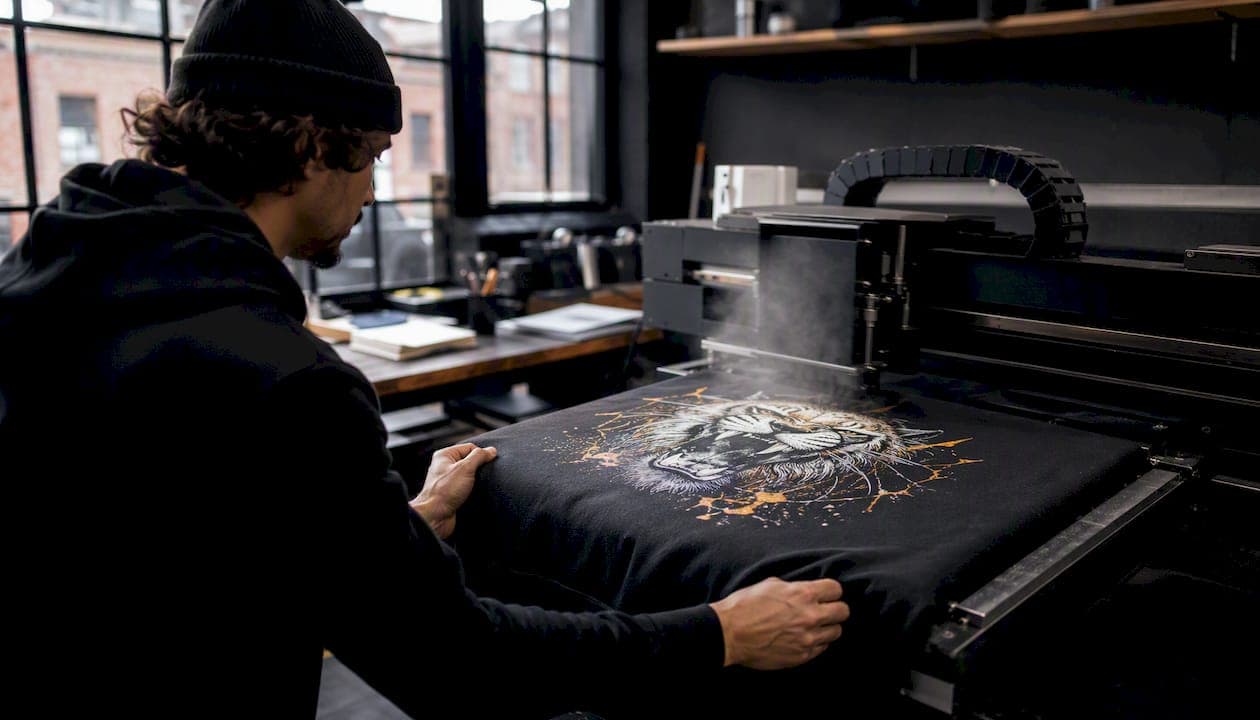
Pick DTG for photographic, full-color graphics on cotton tees and small runs. Pick embroidery for logos, uniforms, hats, and anything that needs to hold up through heavy use and still look premium. That's the short version. Everything below helps you lock in the right call for your specific drop.
Design type → method:
- Photo-realistic art, gradients, or complex multi-color graphics → DTG
- Clean logo, wordmark, or icon on structured fabric → embroidery
Order size → method:
- 1–50 pieces, no setup cost → DTG
- 50+ pieces with a repeating logo → embroidery (digitizing fee amortizes fast)
| Use Case | Best Method |
|---|---|
| Graphic tee (cotton) | DTG |
| Branded polo or uniform | Embroidery |
| Snapback or structured hat | Embroidery |
| Hoodie with large back print | DTG |
| Premium jacket with chest logo | Embroidery |
| Limited-edition swimwear graphic | DTG (sublimation for polyester) |
Key Takeaways
DTG wins on design complexity and small-run flexibility; embroidery wins on durability and premium feel, and the right choice comes down to fabric, design type, and how often the item gets washed.
| Point | Details |
|---|---|
| Design type drives the decision | Photographic or gradient art → DTG; clean logo or icon → embroidery. |
| Fabric determines viability | DTG requires cotton or high-cotton blends; embroidery works on hats, polos, jackets, and most structured fabrics. |
| Order size shifts the cost math | DTG has near-zero setup; embroidery's digitizing fee amortizes across 50+ pieces, making it cheaper per unit at volume. |
| Wash durability differs significantly | DTG can show fading in 15–40 washes; embroidery typically outlasts the garment. |
| Gfacegear uses both methods | DTG for limited-edition graphic tees and hoodies; embroidery for hats, jackets, and premium logo SKUs. |
Table of Contents
- How does DTG printing actually work?
- DTG advantages and limitations at a glance
- How machine embroidery works
- Embroidery advantages and limitations at a glance
- DTG vs embroidery: side-by-side comparison
- How to choose between DTG and embroidery for your project
- What does DTG vs embroidery actually cost, and how long does it take?
- How to care for DTG prints and embroidered items
- When to combine methods or choose an alternative
- How Gfacegear decides between DTG and embroidery
- The real mistake brands make when choosing a decoration method
- Gfacegear brings both methods to your next drop
- Sources
- FAQ
How does DTG printing actually work?
Direct-to-garment printing is a digital inkjet process. A garment goes flat onto a platen, the machine reads your file, and textile inks are fired directly into the fabric fibers. No screens. No plates. No minimum order.
The process runs in four steps:
- Platen loading: The garment is stretched flat and secured so the print head passes evenly across the surface.
- Pre-treatment: Dark garments get sprayed with a chemical solution that bonds the white-ink underbase to the fabric. Light garments often skip this step.
- Print pass: The machine lays down ink in a single or multi-pass run, building color and detail at resolutions that rival photographic output.
- Heat curing: A heat press or conveyor dryer sets the ink, locks color, and activates the pre-treatment bond.
According to Printful's technical guide, the white-ink underbase is the key variable on dark garments. A thin or uneven underbase produces muted, washed-out color. A well-applied one delivers vibrant, sharp results. That's why dark-garment DTG costs slightly more and takes a bit longer than light-garment runs.
Kornit's beginner guide confirms that 100% cotton and high-cotton blends are the optimal substrate. The ink bonds to natural fibers. Polyester and synthetics repel water-based inks, which means softer color and faster fading.
Pro Tip: Send files as 300 DPI PNG with a transparent background. Use the sRGB color profile and request a digital mockup before production. If your design goes on a dark garment, ask your vendor to show you a pre-treatment test print first.
DTG advantages and limitations at a glance
DTG's biggest strength is freedom. No design is too complex, no color count too high, and no order too small to make financial sense.
Advantages:
- Unlimited colors with no per-color cost increase
- Photographic and gradient-level detail that embroidery cannot replicate
- Low or zero setup fees, making single pieces and small drops viable
- Soft hand feel on well-cured prints (no raised texture)
- Fast turnaround for small runs, often 1–3 business days
Limitations:
- Cotton-dependent: results on polyester, nylon, or blended fabrics like DryBlend® constructions are less consistent and can look muted
- Lower durability than embroidery on items that see heavy, repeated washing
- Dark garments require pre-treatment and a white underbase, which adds cost and slightly affects hand feel
- Per-piece cost stays relatively flat regardless of volume, so it rarely beats embroidery at scale for simple logos
Shopify's DTG overview frames it well: DTG is the engine behind print-on-demand because it eliminates tooling costs entirely, letting brands test designs with small drops before committing to bulk. That flexibility is the trade-off for its fabric sensitivity and moderate wash durability.
For a limited-edition cotton tee drop with a bold lion graphic, DTG is the obvious call. For a staff polo that gets washed five times a week, it's the wrong tool.
How machine embroidery works
Embroidery builds a design from thread, not ink. A digitizer converts your artwork into a stitch file, specifying stitch type, direction, density, and sequence. The machine reads that file, hoops the garment or panel, and stitches the design automatically.
The workflow:
- Digitizing: Artwork is converted into a stitch file (.DST, .PES, or similar). This is a skilled step. A poorly digitized file produces loose stitches, puckering, or lost detail.
- Thread selection: Thread color is matched from a standard palette (Madeira, Isacord, and similar). Unlike DTG, you're working with a fixed thread library, not infinite digital color.
- Hooping and placement: The garment or panel is hooped and positioned. Placement precision matters, especially on structured items like hats.
- Automated stitching: The machine runs through the file, laying satin stitches (borders, text), fill stitches (solid areas), and run stitches (fine outlines) to build the design.
Common stitch types each serve a purpose. Satin stitches create smooth, shiny columns ideal for text and borders. Fill stitches cover large areas with a woven texture. Run stitches trace fine lines and outlines. The combination determines how the finished design reads from a distance and up close.
Embroidery works across a wide range of fabrics because thread is physically stitched into the material rather than bonded to its surface. Hats, polos, jackets, fleece, and denim all hold embroidery well. That substrate flexibility is one of its defining advantages over DTG.
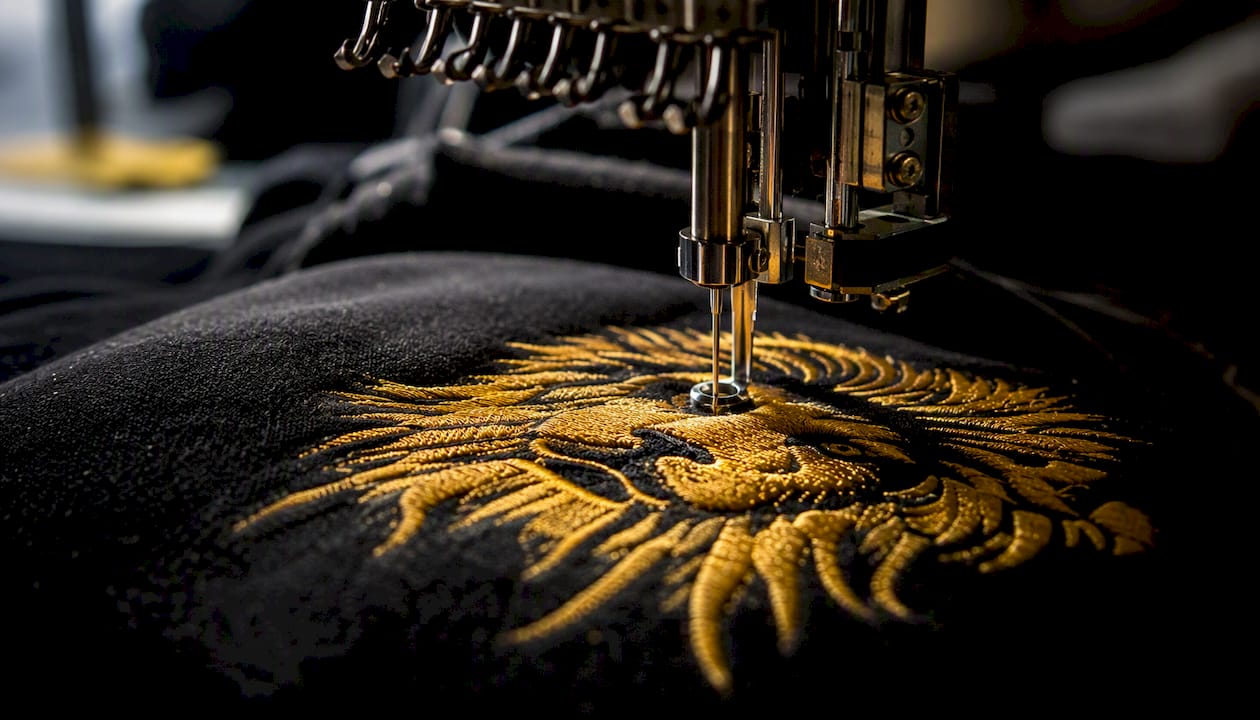
Pro Tip: Keep embroidered text at 4 mm height or larger. Below that, satin stitches crowd together and letters become illegible. Avoid gradients entirely — thread color transitions look blocky, not smooth. Simplify your artwork before sending it to digitizing.
Embroidery advantages and limitations at a glance
Embroidery's core value is permanence. Thread stitched into fabric doesn't fade, crack, or peel. That's why it dominates uniforms, corporate apparel, and premium streetwear branding.
Advantages:
- Exceptional durability, often outlasting the garment itself
- Premium tactile feel that signals quality to the wearer and viewer
- Consistent color on any fabric, light or dark, without pre-treatment
- Works on structured items (hats, caps, jackets) where DTG cannot
- Strong perceived value for logos and branded uniforms
Limitations:
- Cannot reproduce photographic detail or smooth gradients
- Small text below roughly 4–5 mm becomes illegible
- Upfront digitizing fee on every new design (typically a one-time cost per file)
- Per-stitch pricing means large, dense designs get expensive fast
- Heavy stitch counts on thin fabrics can cause puckering or a stiff, uncomfortable feel
Scalable Press's cost comparison notes that embroidery's per-unit cost drops as volume grows because the digitizing fee is a fixed one-time charge spread across the run. At low quantities, that fee makes embroidery more expensive per piece than DTG. At higher volumes with a repeating logo, it flips.
Embroidery is overkill for a one-off photographic tee. It's the only sensible choice for a hat, a polo collar, or a jacket chest logo that needs to look sharp after two years of regular wear.
DTG vs embroidery: side-by-side comparison
| Dimension | DTG | Embroidery |
|---|---|---|
| Durability | Moderate; fading possible after repeated washing | High; thread outlasts most garments |
| Cost and setup | Low setup, flat per-piece cost | One-time digitizing fee, per-stitch pricing |
| Turnaround | 1–3 business days (small runs) | Add 1–3 days for new digitizing; faster on repeat orders |
| Design complexity | Unlimited colors, photographic detail | Limited to thread palette; no gradients or photos |
| Best fabrics | 100% cotton, high-cotton blends | Hats, polos, jackets, fleece, denim, most structured fabrics |
| Hand feel | Soft, near-invisible on light garments | Raised, textured, tactile |
| Ideal use cases | Graphic tees, hoodies, photo prints, POD drops | Logos, uniforms, caps, premium branded apparel |
| Order size | 1–50 pieces (sweet spot) | 50+ pieces with repeating design |
| Care behavior | Wash inside out, cold, gentle cycle | Machine washable; avoid high-heat drying on heavy stitch areas |
The most common trade-off: DTG gives you detail and flexibility at low quantities; embroidery gives you durability and perceived premium quality at scale. Neither method beats the other across every dimension.
Hybrid decoration is where both shine together. A small embroidered chest logo paired with a large DTG back graphic is a common pattern in streetwear because it balances tactile quality at the focal point with graphic complexity across the larger panel. That combination is exactly how brands balance perceived value and graphic complexity in a single drop.
How to choose between DTG and embroidery for your project
Work through these steps in order. The answer usually shows up by step four.
- Confirm your design type. Is it a photograph, a gradient, or a complex multi-color illustration? DTG. Is it a clean logo, wordmark, or icon? Embroidery.
- Check your fabric. 100% cotton or a high-cotton blend? DTG works. Polyester, nylon, structured hat panels, or heavy fleece? Embroidery is safer.
- Estimate your order size and recurrence. Under 50 pieces, one-time drop? DTG's zero-setup model wins. Recurring logo orders of 50 or more? Embroidery's amortized digitizing fee makes it more cost-efficient.
- Set your durability expectation. Will this item be washed daily or weekly for years? Embroidery. Is it a limited-edition collector piece worn occasionally? DTG holds fine.
- Compare per-unit cost including setup. Get quotes with digitizing fees included for embroidery and with pre-treatment noted for dark DTG garments. The real cost difference often surprises people.
- Choose your vendor and method. Platforms like Printful and GotPrint both offer DTG and embroidery, so you can often source both from one partner.
Decision heuristics:
- Small run + photographic design → DTG, full stop
- Logo + uniform + repeat order → embroidery, full stop
- Logo with gradients? Simplify the artwork first, then embroider. Gradients don't translate to thread.
Pro Tip: Always order a single test sample before committing to a full run. A $20 sample print or embroidery test on the actual garment catches color shifts, placement issues, and hand-feel surprises before they hit 200 units.
For a deeper look at how DTG compares to screen printing for larger runs, the screen printing vs DTG breakdown covers the volume crossover point in detail.
What does DTG vs embroidery actually cost, and how long does it take?
Cost shapes differently for each method, and understanding that structure helps you budget accurately.
DTG cost shape:
- Setup cost: near zero (no screens, no plates)
- Per-piece cost: driven by ink coverage and print area; a large, full-color front print costs more than a small chest graphic
- Dark garments add pre-treatment cost
- Per-piece price stays relatively flat whether you order 1 or 100
Embroidery cost shape:
- One-time digitizing fee per design (varies by complexity; simple logos cost less, dense multi-color designs cost more)
- Per-piece cost based on stitch count, typically priced per 1,000 stitches
- As volume grows, the digitizing fee spreads across more units and the per-piece cost drops
Scalable Press's embroidery cost analysis confirms this: embroidery becomes more competitive per unit as quantity increases because the fixed digitizing fee is amortized. At low quantities, DTG is almost always cheaper per piece. At higher volumes with a repeating logo, embroidery often wins on unit cost.
Turnaround ranges:
- DTG small runs (1–20 pieces): typically 1–3 business days in production
- New embroidery orders: add 1–3 business days for digitizing on a new design file; repeat orders with an existing file run faster
- Bulk production for either method extends lead times; plan accordingly for seasonal drops
If you're planning recurring orders, the digitizing fee is a one-time sunk cost. After that first run, embroidery reorders are fast and cost-efficient. That's the math that makes embroidery the right call for any logo you'll use repeatedly across multiple drops.
How to care for DTG prints and embroidered items
Care is where DTG's durability gap becomes real. The method is excellent for design complexity, but it requires more attention in the wash.
DTG care best practices:
- Wash inside out to protect the print surface from abrasion
- Cold water, gentle cycle only
- Avoid bleach and fabric softeners, which break down ink bonds
- Low-heat tumble dry or air dry flat; high heat degrades the ink and pre-treatment layer
- Industry estimates suggest visible fading can appear in the range of 15–40 washes depending on ink system, pre-treatment quality, and wash conditions
Embroidery care:
- Machine washable on most settings; thread doesn't fade from water or detergent
- Avoid high-heat tumble drying on heavily stitched areas, which can cause slight distortion on structured panels
- Pilling and abrasion on surrounding fabric won't affect the stitching itself
- Embroidery generally outlasts the garment, making it the right choice for items with a long intended lifespan
For investment-grade apparel where fabric longevity matters as much as decoration, this guide to investment-grade fabrics covers material choices that complement both methods.
Repairability: Embroidery can be re-stitched or patched if a thread pulls. DTG prints cannot be repaired once they crack or fade. When the print goes, the garment either gets retired or repurposed.
When to combine methods or choose an alternative
Sometimes neither DTG nor embroidery alone is the right answer. Knowing when to layer them, or step outside both, is what separates a sharp production decision from a default one.
Hybrid decoration:
- Embroidered chest logo + DTG back graphic: the most common streetwear combination. The logo reads premium and tactile; the back panel carries the full graphic complexity DTG handles best.
- Embroidered sleeve hit + DTG full-front print: works well on hoodies and coaches jackets where the sleeve detail adds dimension without competing with the main graphic.
When alternatives win:
- Screen printing: For very large runs (100+ pieces) of a simple, single-color or limited-color design, screen printing often beats DTG on per-unit cost and produces a more durable print on cotton.
- Sublimation: For polyester fabrics and all-over prints, sublimation is the correct method. DTG cannot produce consistent results on polyester; sublimation dye bonds directly to synthetic fibers and produces vivid, permanent color. Relevant for performance wear and some swimwear constructions.
- DTF (Direct-to-Film): A newer transfer method that works on a wider range of synthetic fabrics than DTG. Useful for nylon, blends, and items where DTG's cotton preference is a problem.
Hats and structured items: Embroidery is the standard for a reason. Thread holds shape on curved, structured panels where a flat inkjet print head cannot operate. Embroidered hats remain the dominant choice for branding because the stitching reads consistently on dark and textured materials regardless of viewing angle.
For performance fabrics and all-over prints, the sublimation vs screen print comparison covers the edge cases in detail.
How Gfacegear decides between DTG and embroidery
Every drop at Gfacegear starts with the same question: what does this piece need to say, and how long does it need to say it?
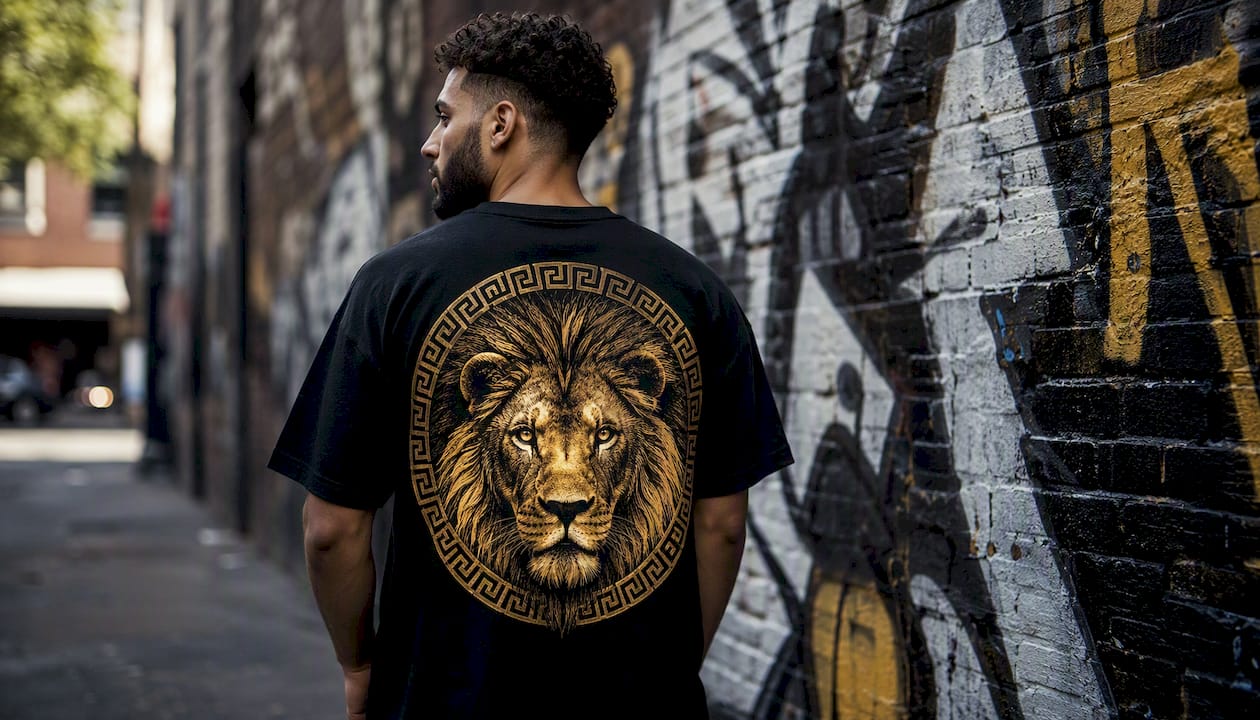
Limited-edition cotton tee drop (lion graphic): DTG is the call every time. A bold lion face with gold tones, fine mane detail, and a Greek Key border cannot be embroidered without losing the photographic depth that makes it hit. The cotton base is ideal for DTG inks, the run is small by design (limited drops, not bulk), and the soft hand feel keeps the garment wearable. The Gfacegear lookbook shows exactly how that graphic complexity reads on a finished tee.
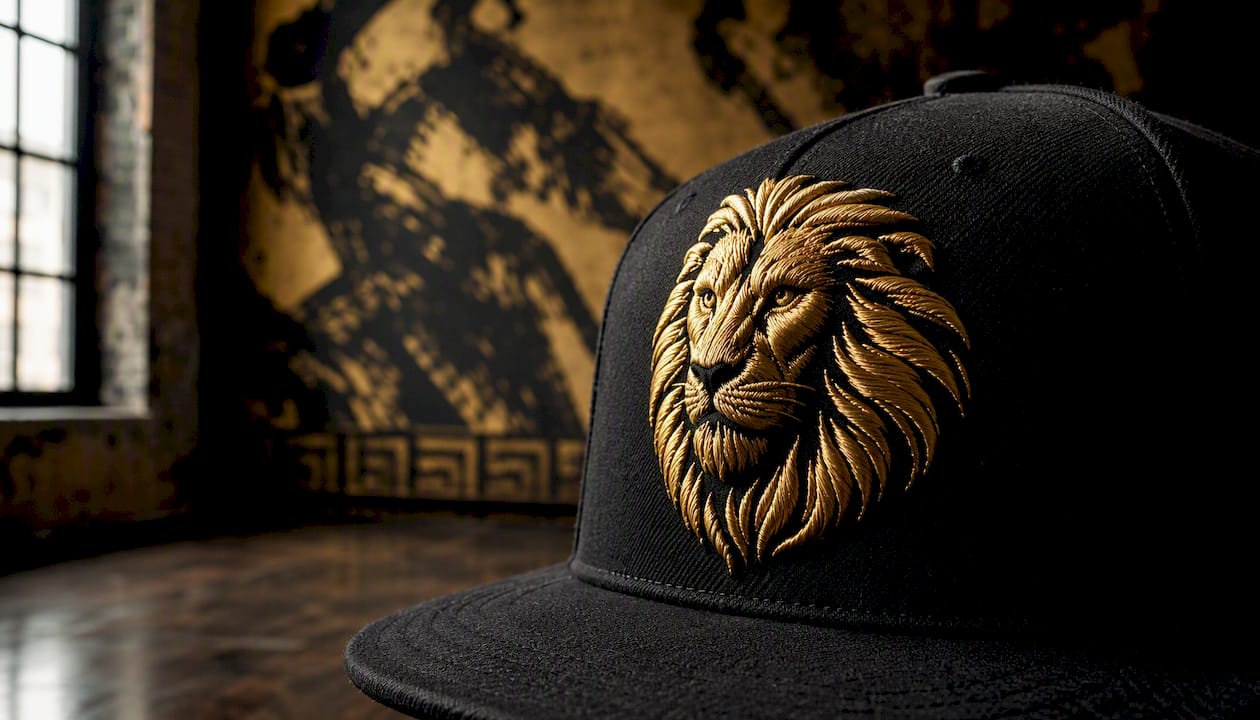
Branded hat or premium jacket: Embroidery, no question. A structured snapback or a coach's jacket chest logo needs to hold shape, read clean from across the room, and survive two years of regular wear. The tactile quality of a raised embroidered logo also signals premium positioning, which matters for a brand built on the ROAR identity. Thin tees with small chest hits are the one exception where embroidery can feel stiff; on hats and outerwear it's always the right move.
Long dress tee or hoodie with a large back panel: This is where the hybrid approach earns its place. A small embroidered logo at the chest or sleeve, combined with a DTG back graphic, gives the piece both premium detail and full graphic complexity. The production cost is higher, but the perceived quality justifies it for key SKUs.
The internal signals Gfacegear uses: fabric weight and composition, intended price point, expected wash frequency, and whether the design has gradients or photographic elements. When all four point the same direction, the method choice is obvious. When they split, a test sample settles it.
Pro Tip: Order one sample of each method on the actual garment before committing to a run. Color shifts between a digital mockup and a real print are common, and a $30 test sample is cheaper than reprinting 100 units.
The real mistake brands make when choosing a decoration method
Most brands default to one method and apply it everywhere. That's the mistake.
Embroidery on a thin cotton tee looks stiff and feels heavy. The backing material required to stabilize the hoop shows through lightweight fabric, and the raised stitching sits awkwardly on a garment designed to drape. Brands that embroider everything because it "looks premium" end up with uncomfortable tees that customers don't reach for.
DTG on workwear or uniforms is the opposite error. A garment washed three times a week will show fading within months if the ink system and pre-treatment aren't top-tier. Choosing DTG for durability-critical items because it's cheaper upfront costs more in the long run through faster replacement cycles.
The right framework is simple: match the method to the garment's job. A collector tee worn to events needs graphic complexity and a soft feel, not thread durability. A branded polo worn daily needs to look sharp after 100 washes, not carry a photographic print.
One more thing most guides skip: customer care expectations. If your customer doesn't know to wash inside out in cold water, your DTG print will fade faster than your specs suggest. Either communicate care instructions clearly on the tag and packaging, or choose a method that forgives rough handling. Embroidery forgives. DTG requires a little education.
Gfacegear brings both methods to your next drop
You've got the knowledge. Now put it to work. Gfacegear's print-on-demand model covers both DTG and embroidery across the full lineup: graphic tees, hoodies, hats, long dresses, limited-edition swimwear, and more. No minimum order locks you into bulk. No single method limits your design vision.
For limited drops with photographic lion graphics or complex streetwear art, DTG on cotton delivers the detail your design demands. For hats, structured outerwear, and any SKU where the logo needs to outlast the season, embroidery is ready. VIP members get early access to new drops, sitewide discounts, and exclusive perks that make recurring orders even sharper on cost.
Browse the full collection and explore current drops at the Gfacegear lookbook. See a design you want to make your own, or bring a new concept to life. The Pride is waiting.
Sources
- Direct-to-garment printing - Wikipedia
- What is DTG printing and how does it work — Printful Help Center
- Direct-to-Garment printing beginners guide — Kornit
FAQ
What are the main disadvantages of DTG printing?
DTG printing is limited to cotton and high-cotton blend fabrics, produces less durable results than embroidery on heavily washed items, and requires pre-treatment on dark garments that adds cost and can affect hand feel. Color vibrancy on polyester and synthetic fabrics is inconsistent.
Is embroidery cheaper than DTG at scale?
Embroidery carries a one-time digitizing fee per design, but as order volume grows that fee spreads across more units and the per-stitch cost drops, making embroidery more cost-competitive than DTG for repeat logo orders of 50 or more pieces.
How many washes before a DTG print fades?
Visible fading on DTG prints can appear in the range of 15–40 washes depending on the ink system, pre-treatment quality, and wash conditions. Washing inside out in cold water on a gentle cycle extends that range significantly.
Why is DTG printing more expensive than it looks for dark garments?
Dark garments require a pre-treatment spray and a white-ink underbase before the color layers print. That extra step adds material cost, machine time, and a slight effect on hand feel, which is why dark-garment DTG quotes run higher than light-garment equivalents.
Can you combine DTG and embroidery on the same garment?
Yes, and it's a common streetwear approach. A small embroidered chest logo paired with a large DTG back graphic gives you the tactile premium feel of thread at the focal point and the full graphic complexity of digital printing across the larger panel.