
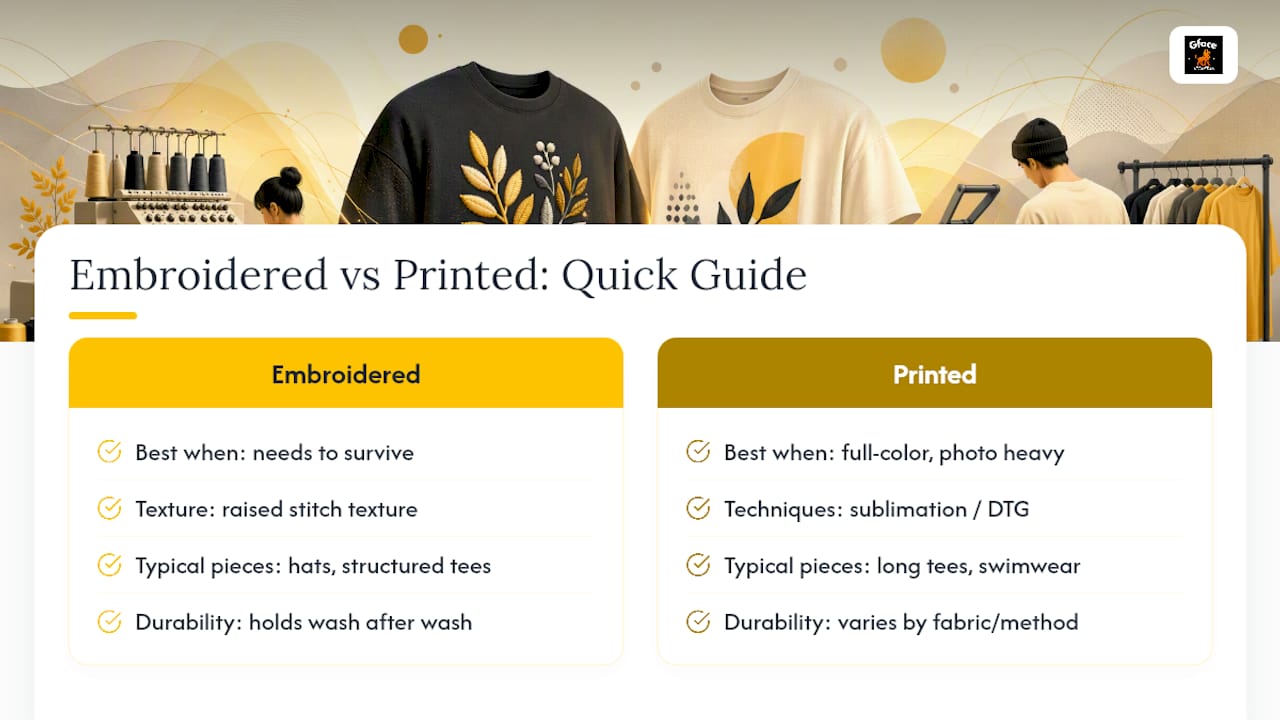
Choose embroidery for logos, small structured placements, and anything built to survive years of washing, like team polos, hats, and workwear. Choose printing for photographic detail, full-color artwork, large-area graphics, or when your fabric is polyester-heavy and sublimation is on the table. Run size, design complexity, and fabric type decide the winner faster than personal preference ever will.
TL;DR:
- Embroidery is more durable for long-term wear, often withstanding over 100 washes, while printed options typically start degrading after 40 to 60 washes.
- Screen printing becomes more cost-effective at quantities above 24 to 50 units, whereas embroidery costs depend on stitch count rather than quantity.
- DTF and DTG printing are ideal for small orders or full-color artwork, with faster turnaround times and no per-color setup fees, unlike screen printing.
- Embroidery suits woven or structured fabrics like polos and hats, while sublimation and DTF excel on polyester-heavy or mixed fabrics for full-coverage, vibrant graphics.
- Proper care involves turning garments inside out and avoiding high-heat drying, with embroidery requiring minimal maintenance beyond fixing loose threads.
Table of Contents
- Embroidered Vs Printed: How Each Method Actually Works
- What Are the Key Differences in Durability, Look, and Cost?
- How Do Cost and Lead Time Change With Order Size?
- Which Method Fits Which Fabric and Placement?
- How Should You Wash and Care for Each Method?
- Which Method Should You Choose for Your Project?
- GfaceGear Practitioner Notes: Choosing Methods for Streetwear Drops
- Craft, Sustainability, and What Actually Drives the Choice
- How GfaceGear Handles Embroidery and Printing on Every Drop
- Sources
- FAQ
Embroidered Vs Printed: How Each Method Actually Works
Every decoration method leaves a different mark on the garment, literally. Embroidery stitches thread directly into fabric, building a raised, textured logo that survives a beating. The rest of the field, screen printing, DTG, DTF, sublimation, and heat transfer, all deposit ink or dye onto the surface instead of weaving into it. That single difference explains almost every trade-off in this guide.
Here's the breakdown of what each method does well, and what it costs you in setup or turnaround:
- Embroidery: A digitized file guides a machine to stitch thread into the garment. It handles solid shapes, text, and simple logos beautifully but struggles with gradients or photo-realistic detail. Setup means digitizing (converting art into a stitch file) plus a sample run, so turnaround runs a few days longer than most print methods.
- Screen printing: Ink is pushed through a mesh screen, one screen per color. It reproduces bold, flat colors with excellent saturation and holds up well on cotton. Because each color needs its own screen, setup cost is fixed regardless of order size, which is why it rewards bigger runs.
- DTG (direct-to-garment): A specialized inkjet prints directly onto fabric, similar to a desktop printer working on cotton. It handles full-color, photographic artwork with no per-color charge and no screens to burn, but it's slower per piece and less durable on heavy-wash items.
- DTF (direct-to-film): Art prints onto a film, then heat-presses onto the garment. It bonds to more fabric types than DTG and holds up better against abrasion, making it a flexible middle ground for mixed-fabric small runs.
- Sublimation: Dye converts to gas under heat and bonds at the molecular level with polyester fibers, so the print becomes part of the fabric rather than sitting on top. It only works reliably on polyester-rich blends.
- Heat transfer: A pre-printed design presses onto the garment with heat and pressure. It's fast and cheap for one-offs but the least durable option on this list.
Lead times track roughly with setup complexity: heat transfer and DTG can turn around in a day or two, screen printing needs a few extra days for screen burning, and embroidery needs digitizing time upfront but runs fast once the file's ready.
What Are the Key Differences in Durability, Look, and Cost?
Durability is where embroidered vs printed clothing splits hardest. Embroidered logos commonly survive 100+ wash cycles without visible decline, while printed logos, especially heat transfers, often start showing wear after 40 to 60 washes. That's not a small gap. It's the difference between a hoodie that still looks sharp after two years of weekly wear and one that's peeling at the edges by winter.
Where each method fails, and why:
- Heat transfers peel and crack first, usually starting at the edges where the vinyl or film meets fabric stress points like elbows and collars.
- Screen printing cracks under repeated stretching and high dryer heat, but holds color well if cared for.
- DTG can fade or crack on high-friction spots (waistbands, underarms) faster than screen print, since the ink layer is thinner.
- Sublimation resists cracking entirely on the right fabric, because the dye is inside the fiber, not on top of it.
- Embroidery rarely fails outright. The stitching can fray at loose thread ends, but that's a minor fix, not a full redo.
Texture is the other half of the story. Embroidery has a raised, tactile quality that reads as premium the moment someone touches it, which is exactly why hospitality brands and corporate buyers lean on stitched logos for uniforms. Printed graphics stay flat against the fabric, which is actually the right call for anything photographic or full-bleed, since raised stitching can't reproduce a gradient or a face.
Cost structure flips depending on scale. Screen printing gets cheaper per piece as quantity rises because you're spreading a fixed screen cost across more units. DTG and DTF stay flat regardless of quantity, so a single custom tee costs about the same per piece as unit fifty. Embroidery's cost depends on stitch count and digitizing time, not color count, so a dense, large logo costs more than a small wordmark even at the same quantity.
How Do Cost and Lead Time Change With Order Size?
Order size is the single biggest lever on price, and it works differently depending on the method. Screen printing rewards volume hard: setup costs get baked into every screen you burn, so the breakpoint typically sits around 24 to 50+ units before it beats digital methods on price per piece. Order fewer than that and you're paying for screens you barely use.
- Under 24 units, multiple colors, or personalization: DTG or DTF wins. No per-color setup fee, no screens, and you can print one shirt with a name on it just as easily as fifty identical ones.
- 24+ units, one to three colors, simple graphic: Screen printing wins on price per piece almost every time.
- Any quantity, structured logo placement: Embroidery cost tracks with stitch count and digitizing time, not order size, so a small chest logo on 10 polos costs roughly the same per piece as 100.
- One-off sample or proof run: DTG, DTF, or a quick embroidery sample, both skip the heavy setup that makes screen printing painful below its breakpoint.
Digitizing is the quiet cost driver in embroidery. A dense, large-format design takes longer to stitch out and longer to digitize than a small wordmark, so a full-back embroidered graphic can cost more than a full-color printed one on the same shirt. If your budget is tight and your logo is simple, embroidery on a small placement, chest or sleeve, is usually the most economical stitched option.
Which Method Fits Which Fabric and Placement?
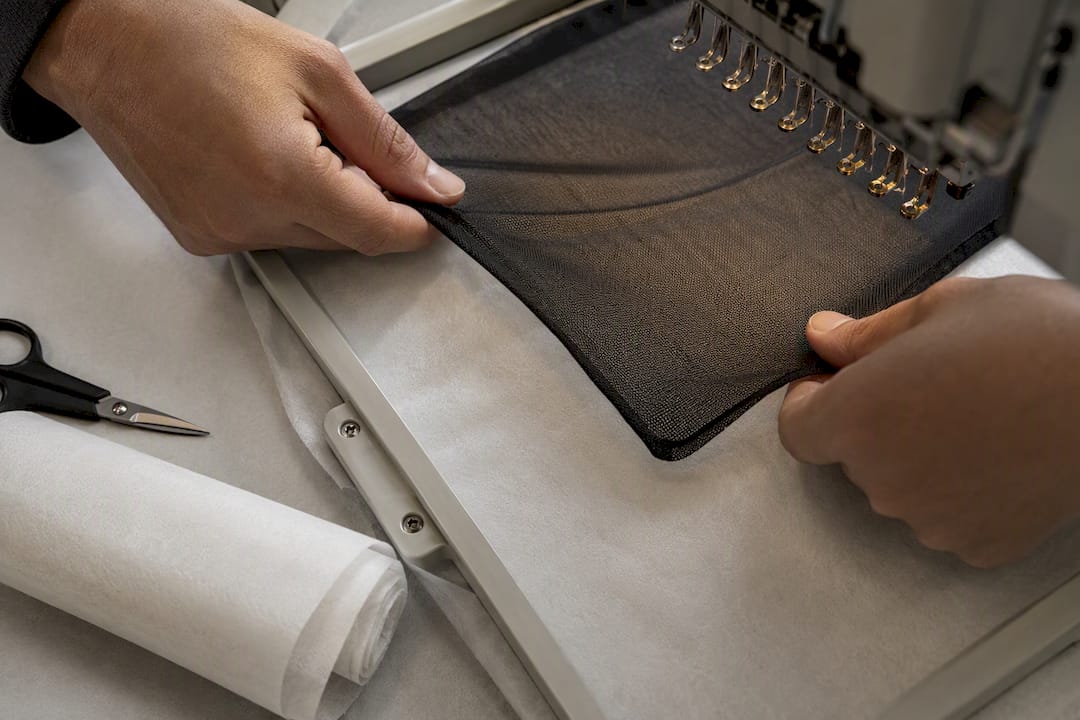
Fabric compatibility narrows your options faster than budget does. Polos, structured jackets, and other woven or heavier-weight garments pair naturally with embroidery, since the stitching needs some structure to sit into cleanly. Backing material stabilizes thin or stretchy fabric during stitching, which matters a lot on performance wear, skip it and you risk puckering.
Sublimation and DTF step in when polyester takes over. All-over prints, athletic sets, and anything on polyester-rich blends (roughly 65%+ polyester) need sublimation to bond correctly, since the dye has to fuse with polyester fibers at the molecular level. Try it on cotton and the dye won't bond. DTF is the more flexible fallback here, it works across more fabric types and holds up to abrasion better than older transfer methods, which is why it's becoming the default for mixed-material small runs.
Hats and caps are their own category entirely:
- Embroidery is the standard for caps because curved, structured surfaces hold stitching cleanly and the raised logo reads well from a distance.
- Flat-brim or trucker-style caps sometimes take screen print or patch applications, but embroidery remains the more durable, premium-looking default.
- Cost on caps runs by stitch count just like apparel, so a small front-panel logo is cheap; a wraparound design costs more.
Pro Tip: If you're decorating anything with stretch, leggings, fitted tees, swim fabric, ask your vendor about stabilizer backing before committing to embroidery. Without it, dense stitching can pucker thin knits permanently.
How Should You Wash and Care for Each Method?
Care routines aren't universal, and treating a screen-printed hoodie the way you'd treat an embroidered one shortens its life. Here's the method-specific playbook:
- Turn garments inside out before washing. This protects both raised embroidery threads and printed surfaces from direct friction against the machine drum and other clothes.
- Wash in cold water on a gentle cycle. Heat is the enemy of printed ink, it softens adhesive layers and accelerates cracking, while cold water also protects embroidery thread color from bleeding.
- Skip the dryer's high heat setting, or air dry when possible. High heat is the most common cause of print failure. It's also what causes heat transfers to peel at the edges first.
- Avoid direct ironing over a printed or embroidered area. If you must iron, do it inside-out with a pressing cloth between the iron and the design.
- Ask your vendor about ink formula and curing before a full production run. Improperly cured plastisol ink cracks fast; a properly cured print holds up far longer, and a reputable vendor should be able to explain their process.
Heat transfers are the most fragile option on this list and need the gentlest handling of anything you own with a logo on it, per Arklavo's comparison of embroidered and printed shirts. Embroidery, meanwhile, is close to wash-and-forget. Loose thread ends are the only real failure point, and those are a five-minute fix, not a reason to retire the garment.
Which Method Should You Choose for Your Project?
Run through this four-step check before you commit to a method:
- Classify the artwork. Solid logo or wordmark points to embroidery. Photographic, gradient, or full-color art points to printing.
- Count your units. Under 24 pieces favors DTG or DTF. 24 to 50+ favors screen printing. Any quantity works for embroidery, cost just scales with stitch count instead.
- Check the fabric. Polyester-heavy blends open the door to sublimation. Cotton and structured wovens work for embroidery, screen print, or DTG. Mixed fabrics lean DTF.
- Rank longevity against budget. If the piece needs to survive years of wear, weight the decision toward embroidery or sublimation. If it's a seasonal drop or one-off, printing methods are fine and usually cheaper.
Three scenarios to make this concrete:
- Team polos for a small business: Embroidery. Small chest logo, structured fabric, needs to survive daily wear for years.
- One-off birthday merch for 8 people: DTG or DTF. Full-color art, tiny quantity, no setup cost penalty.
- Full-chest photographic graphic on a hoodie drop: Screen printing (if the run is 24+ and colors are limited) or DTG (if colors are unlimited and the run is small).
Before committing to a full production run, order a physical sample and put it through a real wash cycle. Check stitch density up close on embroidery and look for cracking at stress points on any printed sample. It's a small step that catches problems before they show up on fifty finished units instead of one.
GfaceGear Practitioner Notes: Choosing Methods for Streetwear Drops
Every GfaceGear drop starts with the same question: does this design need to survive, or does it need to make a statement? Our lion crest and Greek Key medallion pieces, the ones built for the long haul on hats and structured mens tshirts, go embroidered almost every time. The raised stitch carries the ROAR identity with the kind of texture a flat print can't touch, and it holds up wash after wash.
Full-color, photo-heavy graphics, especially on long tshirt dresses and limited-run swimwear, go to print. Sublimation handles our swim fabric correctly since it's polyester-based, and DTG covers smaller test batches before we commit to a full drop size.
On-demand production means tight windows. We don't get the luxury of long screen-printing lead times on every piece, so digital methods carry a lot of our small-batch and limited-edition work. Our advice if you're prepping your own files: send vector art for embroidery digitizing, high-resolution flat files for print, and always expect a slight shift in color between screen and finished garment, fabric absorbs ink differently than a monitor displays it.
Craft, Sustainability, and What Actually Drives the Choice
Method choice says more about brand intent than most people realize. A stitched logo tells a customer this piece is built to last, a season-agnostic staple. A bold printed graphic says this is the drop, wear it now, feel the moment. Neither is wrong. They're different promises.
The sustainability angle cuts an interesting way, too. Embroidery wins on longevity, a garment that survives years of washing avoids the landfill trip a cracked print sends it on. But digital printing has been closing its own environmental gap. Adobe and Kornit's collaborative print workflows are cutting water and chemical use in on-demand production, meaning fewer wasted garments from overproduction, which was always print's bigger sustainability problem than the ink itself.
My honest take: don't pick a method because it sounds premium. Pick it because it matches what the piece is supposed to be. Let the product's job decide the technique, not the other way around.
— Victor
How GfaceGear Handles Embroidery and Printing on Every Drop
This brand is the alternative to guessing which decoration method fits your streetwear vision, using print-on-demand infrastructure to match method to garment, drop after drop. Our lion sneakers, hats, mens tshirts, long tshirt dresses, and limited-edition swimwear each get evaluated the same way you just learned: artwork class, fabric, and how long the piece needs to hold up.
When you're building a custom order or eyeing a limited drop, you don't need to reverse-engineer stitch counts or screen breakpoints yourself. We handle the method call based on what the design and fabric actually need, whether that's an embroidered crest on a structured cap or a sublimated print across swim fabric. Curious how a specific design would translate to fabric? Head to Gfacegear to browse current drops or reach out for production guidance before your next order. Put on your Gameface and let the piece speak before you even open your mouth.
Sources
- Embroidered vs Printed Shirts: Which Is Better for Your Brand? – Arklavo
- Screen Printing vs. Digital Printing vs. Sublimation: A Buyer's Guide - Custom Ink Blog
- The ongoing transformation of printed apparel — Adobe blog
FAQ
What Are the Disadvantages of Embroidery?
Embroidery struggles with photographic or gradient artwork, costs more on large or dense designs since price tracks stitch count, and can pucker thin, stretchy fabrics without proper stabilizer backing.
Is It Cheaper to Embroider or Print?
It depends on quantity and design: printing (especially screen printing) is usually cheaper at 24+ units with simple color counts, while embroidery cost is driven by stitch count and digitizing time rather than order size, so it can be cheaper or pricier depending on the design's complexity.
What Are the Three Main Types of Embroidery?
Common categories include flat embroidery (standard stitched logos on flat fabric), 3D or puff embroidery (raised foam underlay for a bolder look, often on caps), and appliqué embroidery (fabric patches stitched onto the garment for texture and depth).
What Are the Differences Between Embroidered and Printed Hats?
Embroidered hats hold up better on curved, structured surfaces and read as more premium, while printed hats are typically cheaper for large, detailed, or photographic graphics but wear faster with regular use, similar to the durability gap seen across other embroidered vs printed clothing.