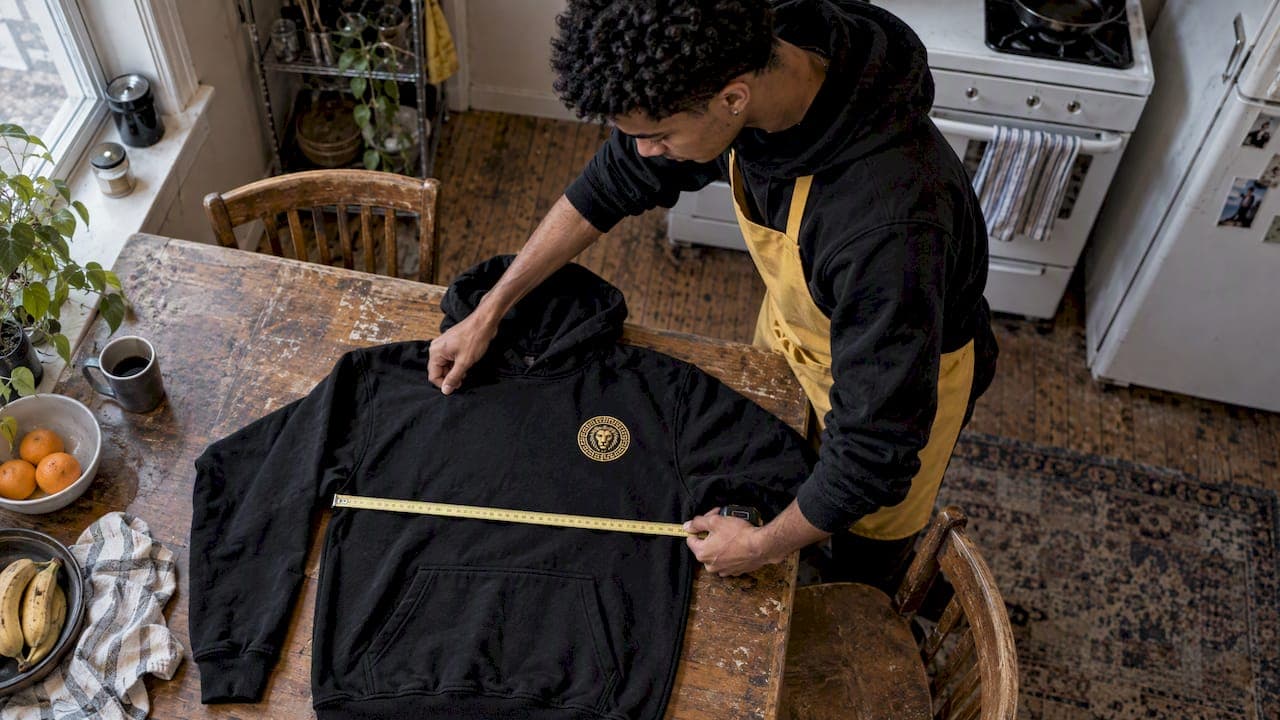
The fastest way to nail your hoodie size is to measure a hoodie you already own and love, then match those finished garment numbers to a size chart instead of guessing from your body alone. If you want a slimmer silhouette, size down within an inch of tolerance; for layering or an oversized streetwear look, size up. We built our own hoodie line at GfaceGear around clear measurements and easy exchanges, so you're never stuck guessing twice.
TL;DR:
- Across XS to XXXL, chest widths run 18 to 24 inches, body lengths 26 to 32 inches, and sleeves 23 to 29 inches.
- A flat chest width doubles to estimate circumference, while brands add one to two inches of ease depending on fabric and cut.
- Slim fits allow 0 to 2 inches of ease, regular fits use 2 to 4 inches, and oversized cuts start at 4 inches.
- If your measurements fall between sizes, choose the smaller option for a fitted look or the larger one for comfort or layering.
- Washing can change a hoodie’s fit, so read its care label before laundering cotton blends or fleece; improper care can alter dimensions over time.
Table of Contents
- Standard hoodie size chart in inches
- How to measure your body and a reference hoodie
- How fit style changes the size you should choose
- Converting inches to centimeters and understanding care labels
- Why trust this guide: hands-on sizing from GfaceGear
- A brand perspective on streetwear sizing priorities
- GfaceGear hoodies and membership: your next move
- FAQ
- Sources
Standard hoodie size chart in inches
Finished garment measurements tell you more than a size label ever will. These numbers reflect flat chest width (measured across the garment, armpit to armpit), body length (from the high point of the shoulder to the hem), and sleeve length (shoulder seam to cuff).
| Size | Chest Width (in) | Body Length (in) | Sleeve Length (in) |
|---|---|---|---|
| XS | 18 | 26 | 23 |
| S | 19 | 27 | 24 |
| M | 20 | 28 | 25 |
| L | 21 | 29 | 26 |
| XL | 22 | 30 | 27 |
| XXL | 23 | 31 | 28 |
| XXXL | 24 | 32 | 29 |
A flat chest measurement doubles to give you the full body circumference, so a 20-inch flat width on a medium means roughly 40 inches around the chest. Most brands build in an allowance of one to two inches depending on fabric weight and cut, which is why two mediums from different drops can still fit a little differently.
When your measurement lands between two sizes, a few rules make the call easier:
- Chest fits, length feels short: size up for a longer, streetwear-style drop.
- Shoulders feel tight: size up rather than relying on stretch.
- Measurements fall exactly between two sizes: choose the smaller size for a fitted look, the larger for comfort or layering.
How to measure your body and a reference hoodie
Getting accurate numbers takes five minutes and a flexible tape measure. Work through your body first, then check a hoodie you already wear well.
- Chest: wrap the tape around the fullest part of your chest, under your arms, keeping it level.
- Shoulder width: measure across your back from one shoulder seam edge to the other.
- Sleeve length: start at the center back of your neck, run the tape over the shoulder seam, down to your wrist bone.
- Body length: measure from the high point of your shoulder straight down to where you want the hem to land.
- Reference garment: lay a hoodie you love flat, measure armpit to armpit for chest width, then top of shoulder to hem for length.
- Convert flat to circumference: double the flat chest number to estimate how much room you actually have around your torso.
Pro Tip: Grab a hoodie that already fits the way you want, flatten it on a bed or table, and measure it before you measure yourself. It removes the guesswork entirely.
Having a second person help with your body measurements keeps the tape level and the numbers honest. Write everything down in inches so it matches the charts you're comparing against.
How fit style changes the size you should choose
Slim, regular, and oversized aren't just marketing words. They describe how much extra room, or positive ease, sits between your body and the fabric.
- Slim fit: roughly 0 to 2 inches of positive ease, built for a closer silhouette.
- Regular fit: typically 2 to 4 inches of ease, the most common streetwear baseline.
- Oversized fit: 4 inches or more, built for layering and a relaxed drop.
If you're tall, prioritize body length first and let the chest measurement guide the rest. Broad shoulders call for the opposite approach: measure shoulder width first, then check whether the chest and length still work for your frame.
A hoodie worn alone over nothing calls for a closer regular fit. Planning to layer a sweatshirt or tee underneath means sizing up. A streetwear drop built with extra length, the kind we design into our own Hoodies collection, often reads bigger on the hanger than it wears on the street.

Converting inches to centimeters and understanding care labels
One inch equals 2.54 centimeters, so a 20-inch chest width converts to about 50.8 centimeters. To convert any measurement yourself, multiply the inch figure by 2.54.
| Inches | Centimeters |
|---|---|
| 18 | 45.7 |
| 20 | 50.8 |
| 22 | 55.9 |
| 24 | 61.0 |
Letter sizes like S, M, and L vary from brand to brand, which is exactly why finished garment measurements matter more than the label sewn inside the collar.
Every hoodie's fit can shift slightly after washing, and the FTC's care labeling rules require manufacturers to attach instructions for a reason: improper laundering is a common cause of dimensional change over time. The eCFR's Part 423 regulations spell out exactly how conspicuous and specific those care labels must be, so reading the tag before you wash a cotton blend differently than you'd wash a fleece is worth the ten seconds it takes.
Why trust this guide: hands-on sizing from GfaceGear
We write our sizing content the same way we build our drops: measure first, guess never. Our team has put together fit resources across the catalog that back up everything in this guide.
- Our zip-up hoodie picks for 2026 include sizing notes pulled straight from product testing.
- Our graphic hoodie guide covers how prints and panel construction can shift the fit.
- Our jersey size guide uses the same finished-measurement approach for print-on-demand drops.
- Our hoodie pilling guide shows how proper care keeps fit and surface quality intact after repeated washes.
Use these resources alongside the chart above any time you're sizing a GfaceGear piece.
A brand perspective on streetwear sizing priorities
Streetwear runs longer and looser than a basic tee for a reason. Extra body length and relaxed shoulders are what give a hoodie that dropped, confident silhouette instead of a shrink-wrapped one, and that's a deliberate choice, not a fluke of manufacturing.
When we spec measurements for a limited drop, we protect that intentional length while keeping every number transparent on the product page. A bold cut only works when you know exactly what you're getting, which is why we'd rather hand you the finished measurements than leave you comparing letter sizes across brands.
— Victor
GfaceGear hoodies and membership: your next move
Once you've got your numbers, picking from our Hoodies lineup takes minutes. Every product page carries the same finished-garment chart you just learned to read, so there's no second-guessing between drops.

- Measure your go-to hoodie flat, then compare it to the chart on the product page.
- Join The Pride Membership for $9.99 per month to unlock early access and sitewide perks on every new drop.
- Lean on our size-exchange support if a fit needs adjusting after it arrives.
Readers managing fit around a cast or brace may find the adaptive clothing sizing guide from Fracture Club useful for easy-on, easy-off considerations. Gear up, measure once, and let the world hear you ROAR.
FAQ
How do I know my hoodie size?
Measure a hoodie you already own and love flat, taking the chest width and body length, then match those numbers to a size chart like the one above. This beats guessing from your body alone because it accounts for the ease built into the design.
Should I get a L or XL hoodie?
Compare your chest and shoulder measurements against the chart: a large typically runs 21 inches of flat chest width and 29 inches of body length, while an XL adds about an inch to each. Choose the large for a closer regular fit and the XL if you plan to layer or want extra length.
What size hoodie fits a 5'10" frame?
Height alone doesn't determine hoodie size, chest width and desired body length do. A frame of average build typically falls between medium or large depending on chest measurement and your preferred fit style.
What size is XL in a hoodie?
An XL hoodie typically measures around 22 inches of flat chest width, 30 inches of body length, and 27 inches of sleeve length, though exact numbers vary slightly by brand and fabric. Always check the specific product's finished measurements rather than relying on the label alone.
Sources
- Care Labeling of Textile Wearing Apparel & Certain Piece Goods | Federal Trade Commission
- eCFR :: 16 CFR Part 423 -- Care Labeling of Textile Wearing Apparel and Certain Piece Goods as Amended