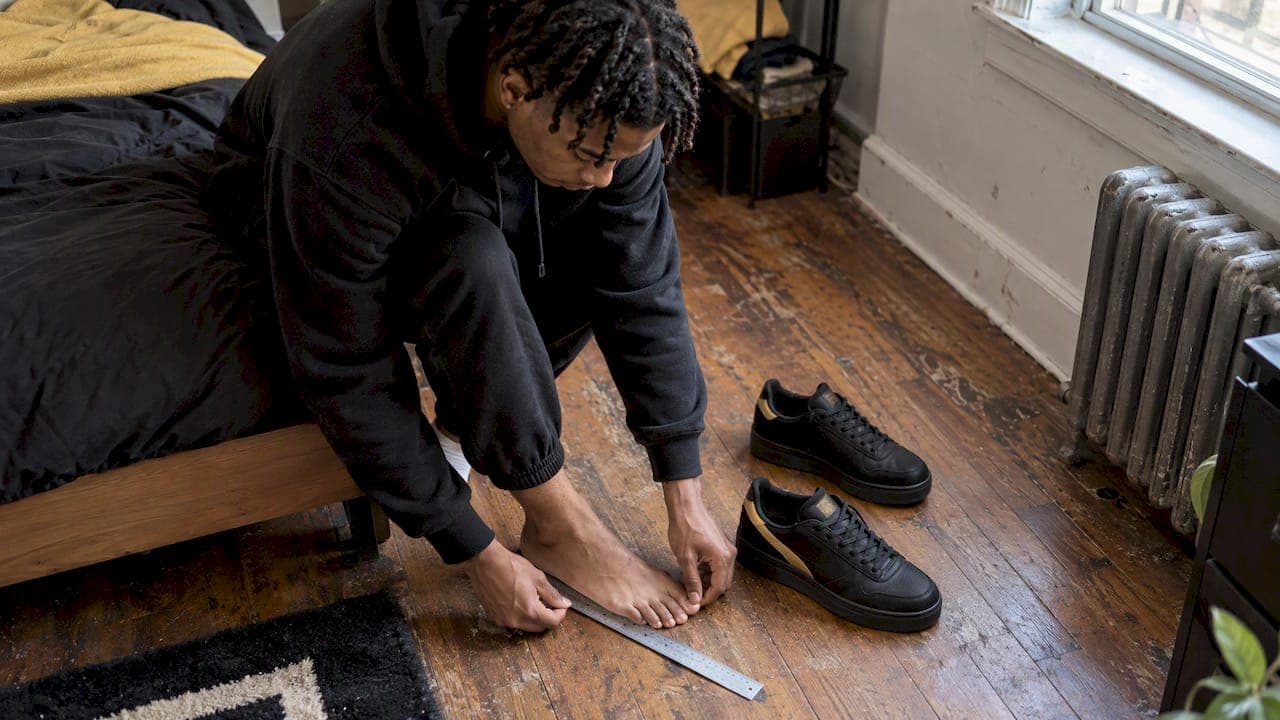
Measure your longest foot in centimeters and use the product's CM or Mondopoint row, not a remembered US or EU label, as your size anchor. Numeric labels like "US 9" or "EU 42" shift between brands and lasts, so they're approximations at best. Lock in your cm number first, check width and fit notes second, and you'll land on the right sneaker before you ever hit checkout.
TL;DR:
- Measuring foot length in centimeters provides the most reliable anchor, as US, UK, and EU labels vary between brands and lasts.
- Using Mondopoint standards based on millimeter measurements ensures consistency, but always confirm the shoe's listed length and width details.
- Cross-check your measurement against the specific product's size chart rather than relying solely on generic conversion tables or labels.
- Convert men's and women's sizes by adding or subtracting about 1.5 sizes, but prioritize length measurement for accuracy.
- Always verify fit notes and try to allow about half an inch of toe room to prevent squeezing or incomplete sizing, especially when buying online.
Table of Contents
- Sneaker size conversion charts for men, women, and kids
- How to measure your foot at home for an accurate size
- Converting between men's, women's, unisex, and youth sizes
- Why Mondopoint, ISO, and the Brannock device matter
- A checkout checklist to size sneakers right the first time
- A streetwear perspective on getting sneaker fit right
- Why the conventional sizing advice falls short
- Find your fit and gear up with GfaceGear
- Where these numbers and standards come from
- Sources
- FAQ
Sneaker size conversion charts for men, women, and kids
A sneaker size conversion chart only works when you treat centimeters as the anchor and everything else as a translation. EU, UK, and US labels are built on different lasts and rounding conventions, so two "size 9" sneakers from different brands can differ by half a size or more. That's why the ISO 9407:2019 standard bases Mondopoint sizing directly on measured foot length in millimeters, not on a label someone invented decades ago.
Here's a general men's conversion chart. Treat these as starting points, then confirm against the specific product's own size chart.
| CM (foot length) | US Men | UK | EU |
|---|---|---|---|
| 24.0 | 6.5 | 6 | 38 |
| 25.0 | 7.5 | 7 | 39 |
| 25.5 | 8 | 7.5 | 40 |
| 27 | 9 | 8.5 | 42 |
| 27.5 | 10 | 9 | 42 |
| 28.5 | 10.5 | 10.5 | 44 |
| 29.5 | 12 | 10.5.5 | 45 |
A women's chart follows the same logic, with its own label scale.
| CM (foot length) | US Women | UK | EU |
|---|---|---|---|
| 21.5 | 5 | 2 | 34 |
| 22 | 6 | 3 | 35 |
| 23 | 7 | 4 | 37.5 |
| 24.1 | 7.5 | 5 | 38 |
| 24.8 | 8.5 | 6 | 38 |
| 25.0 | 9 | 6.5 | 39 |
| 26.7 | 10.5 | 8 | 42 |
Kids' sizing runs on a separate scale entirely, and it changes fast as feet grow.
| CM (foot length) | US Youth | UK | EU |
|---|---|---|---|
| 16.5 | 10.5 | 10 | 27 |
| 18.4 | 13 | 12.5 | 31 |
| 20.3 | 2 (youth) | 1.5 | 33.5 |
| 22.2 | 4 (youth) | 3 | 35 |
| 23.8 | 5.5 (youth) | 5 | 38 |
A few things to keep straight when you're scanning these numbers:
- Centimeters are the anchor, every US, UK, or EU number here is a translation, not the measurement itself.
- A size you've always worn in one brand can measure differently in another because of last shape and rounding.
- Common reference points like EU 42, US men's 9, or US women's 10.5 all sit near the 27 cm mark, but confirm on the actual product page.
- Kids' sizes typically switch to youth or adult numbering somewhere around age 12, so check the chart rather than assuming.
Before you trust any chart, including the ones above, look at the specific sneaker's product page. A running shoe built on a narrow performance last and a chunky streetwear silhouette can both claim "size 9" and fit two different feet. Our jersey size guide walks through the same principle for apparel: always verify the converted number against the actual product chart before you commit.
How to measure your foot at home for an accurate size
You don't need a shoe store to get a reliable number. A wall, a sheet of paper, and a ruler will get you within a millimeter of what a professional fitting tool would tell you.
- Place a blank sheet of paper on a hard floor against a wall.
- Stand on the paper with your heel touching the wall, weight distributed evenly like you're actually standing, not leaning back.
- Mark the tip of your longest toe on the paper, this isn't always the big toe.
- Measure the distance from the wall edge to that mark in millimeters.
- Repeat on your other foot. Feet are rarely identical, and the difference can be 5 millimeters or more.
- Record the measurement from your longer foot, that's the one you size for.
- Round up to the nearest 5 millimeters if you land between standard Mondopoint gradings.
Measure wearing the socks you'd actually wear with the sneakers, and measure later in the day when feet are slightly swollen from walking, not first thing in the morning. If you use orthotics, measure with them in place. A store's Brannock device gives you the same core number plus a width reading in one step, which is worth doing in person if you're between sizes or buying a style with a notably narrow or wide last. For comparison, our guide on measuring pants inseam at home uses the same wall-and-paper logic, so once you've got the method down, it carries over to other fit checks.
Pro Tip: Measure both feet every time you buy, feet change shape and length over the years, especially after pregnancy, weight changes, or just getting older.
Converting between men's, women's, unisex, and youth sizes
Switching between gendered size scales trips up more shoppers than any other part of sneaker buying. The general rule: to go from men's to women's sizing, add about 1.5 sizes. To go from women's to men's, subtract about 1.5. So a men's 9 lands near a women's 10.5, and a women's 7 lands near a men's 5.5. These offsets are consumer-guide conventions, not a fixed law, so always cross-check against the cm measurement on the product page rather than doing the math in your head and stopping there.
Unisex sizing, common in a lot of streetwear and skate silhouettes, typically follows the men's scale. If a drop lists only one number line and doesn't specify, assume it's built on men's sizing and adjust accordingly if you normally shop women's.

Youth sizing adds another layer. Big kids' sizes run into early adult territory, a youth size 7 is roughly equivalent to a women's 8.5 or a men's 7. Shopping youth sizes as an adult with smaller feet can save money on some releases, but it limits your choices since youth lines rarely carry a brand's full catalog or widths.
A few edge cases worth knowing before you buy:
- At the extreme ends of a size run, brands sometimes skip half sizes entirely, so you may need to size up or down a full number.
- Some international brands label only in EU sizing with no US conversion listed, which makes the cm measurement your only reliable cross-check.
- A correct length conversion doesn't guarantee correct width, a men's-to-women's or women's-to-men's switch can shift how a shoe fits across the ball of the foot even when the length math is right.
Why Mondopoint, ISO, and the Brannock device matter
Mondopoint, the system behind ISO 9407:2019, bases shoe sizing on actual measured foot length in millimeters, typically graded in 5 millimeter steps. That's the whole appeal: it ties the number on the box to something you can measure yourself, instead of a label invented by a given market. The catch is that not every manufacturer follows it the same way. Some list a centimeter number that reflects the last's internal length rather than your actual foot length, which can throw off a conversion that otherwise looks precise.
The Brannock device, the metal foot-measuring tool you've stood on in shoe stores, solves a different half of the problem: width. It documents US width designations from AAA through EEE, moving in linear increments, which gives a shopper a second number beyond length. Width has no single global standard the way Mondopoint does for length, so a "medium" in one country's sizing doesn't always match a "medium" somewhere else.
- Mondopoint ties size to measured foot length, typically in 5 millimeter increments, which makes it the most dependable anchor across brands.
- Some manufacturers list last length instead of foot length, so a listed cm number can run slightly short of your actual measurement.
- The Brannock device adds width letters (AAA to EEE) that length-only charts can't capture.
- Lasts, materials, and a shoe's intended use (running, basketball, lifestyle) all shift fit even when two pairs share a labeled size.
Conversion tables, including every one in this article, are guidelines. Treat the chart as a starting line, not a finish line.
A checkout checklist to size sneakers right the first time
Returns cost everyone time, and most of them come down to skipping one of a few simple checks. Run through this before you click buy.
- Measure your longer foot in centimeters using the wall method above.
- Match that cm number to the product's own size chart, not a generic conversion table.
- Check the listed width, or read fit notes that mention "runs narrow" or "roomy toe box."
- Confirm there's roughly half an inch of space beyond your longest toe, AAOS guidance points to about that much room for proper fit, and recommends measuring while standing since feet flatten and lengthen under weight.
- Read the retailer's return and exchange policy before you buy, especially for limited drops that may not restock your size.
One sourced figure worth remembering: AAOS recommends about half an inch of toe room and notes that sizing can vary between brands and styles, which is exactly why the cm-first method beats guessing from memory.
If your toes are brushing the end of the shoe after the half-inch check, size up rather than squeezing in. If length feels right but your foot feels pinched across the width, look for a wider last or a different model before jumping a full size, sizing up to fix a width problem usually just creates a new length problem. High-top and low-top silhouettes also fit differently around the ankle and midfoot, something we break down in our high vs low sneaker comparison. For a broader six-step approach to verifying fit before checkout, the same philosophy shows up in our true-to-size clothing checklist.

A streetwear perspective on getting sneaker fit right
Victor's take, built from years of watching streetwear drops come and go: cm beats memory every time. People walk into a release convinced they're "a 9" because that's what they've always bought, and that's exactly how mismatched pairs end up back in the mail. Check the model-specific notes before anything else, a chunky lifestyle silhouette and a slim performance last can both claim your size and feel completely different on foot.
Fit also depends on what you're building toward. A higher-volume last gives you room to layer thicker socks or go for a bulkier, stacked look. A slimmer last reads cleaner under straight-leg pants or a tailored fit. Check out our sneaker outfit ideas for how fit and silhouette choice shape the final look.
GfaceGear lists sizing details on each product page in the shop, so measure in cm first, then cross-check there before you order.
Why the conventional sizing advice falls short
Most sneaker guides hand you a chart and call it done. That's backwards. A chart without a real cm measurement is just a guess dressed up as data. The gap between what people expect ("just tell me my size") and what actually works ("measure your foot, then check the specific product") is where most bad fits happen.
The conventional wisdom also overweights the men's-to-women's offset as if it's a fixed formula. It's a useful starting point, nothing more, and treating it as gospel is how people end up a half size off on sneakers that don't even run true to that offset in the first place.
What actually matters, in order: your cm measurement first, the product's own chart second, width and fit notes third, and only then the US/EU/UK label as a rough cross-reference. Readers who flip that order, starting with the label and treating cm as an afterthought, are the ones filling out return forms.
— Victor
Find your fit and gear up with GfaceGear
Once you've got your cm measurement locked in, finding the right pair gets a lot simpler. GfaceGear's sneaker lineup lists sizing details on each product page, so measure first, then match your number before you order, especially on limited drops where a wrong size means waiting on the next release instead of an easy swap.

The Pride Membership is a monthly subscription offering sitewide discounts, early access to limited drops, and perks for frequent shoppers. Here's what's in it for you:
- Early access to limited sneaker drops before they go public.
- Sitewide discounts on every order, sneakers included.
- A membership built for people who shop often and want fewer surprises at checkout.
Measure your foot, check the chart, and shop the current sneaker drop with your number already locked in.
Where these numbers and standards come from
- ISO 9407:2019, the Mondopoint foot-length sizing standard.
- Brannock Device Company, on measurement accuracy and US width designations.
- AAOS newsroom, on toe room and standing measurement.
- Clinical footwear fit research, on multidimensional fit assessment.
- EcomEye, on presenting size charts to shoppers.
Sources
- Avoid injuries this spring | AAOS newsroom
- ISO 9407:2019 — Footwear sizing standards (preview)
- About Us | The Brannock Device Company
- Clinical research on footwear fit (PMC article)
FAQ
How do you calculate sneaker size from a foot measurement?
Measure your longer foot in centimeters using the wall-and-paper method, then match that number to the CM or Mondopoint row on the product's own size chart. From there, check the listed width and any fit notes before converting to a US, UK, or EU label.
What size is EU 42 in US sizing?
EU 42 generally lines up with a men's US size 9, sitting around 27 centimeters of foot length. Treat it as a starting point and confirm against the specific shoe's chart, since lasts vary between brands.
Is a youth size 6.5 the same as a women's size 7?
They're close but not identical, youth sizing and women's sizing use slightly different scales even though the numbers look similar. Check the cm measurement on both charts rather than assuming the numbers translate directly.
Is a men's size 6 the same as a women's size 7?
Roughly, yes, the common conversion adds about 1.5 sizes going from men's to women's, which puts a men's 6 near a women's 7.5. Confirm with your cm measurement, since this offset is a general guideline rather than an exact rule.