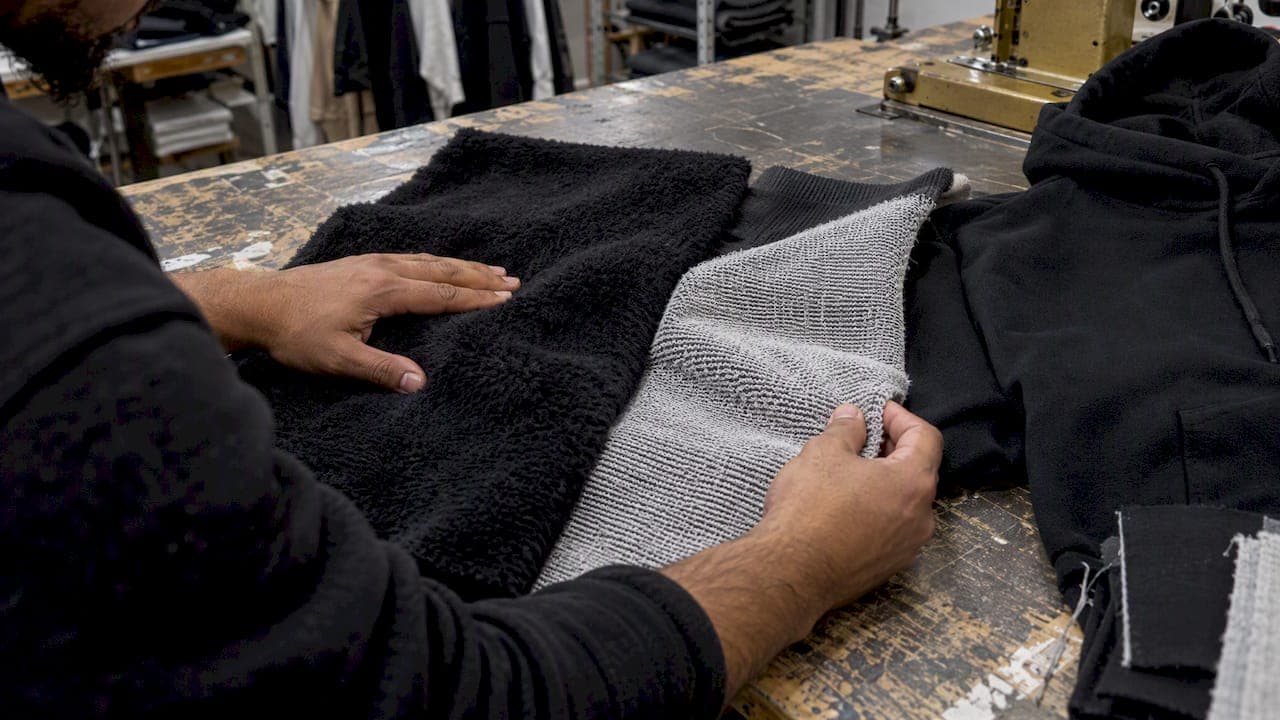
Pick fleece when warmth and outer-layer insulation matter most, and pick French terry when breathability, moisture release, and lighter layering come first. Fleece is the warmer choice for cold-weather hoodies. French terry, a looped midweight knit, suits athleisure and mid-layers. We match the fabric to the garment and the season.
TL;DR:
- Check the fabric’s back and listed weight: intact loops indicate French terry, while a fuzzy, brushed nap signals fleece; labels alone can blur the distinction.
- For fine graphics, choose French terry or lightly brushed fleece, since heavy nap softens detail and may require adjusted printing settings or heavier embroidery backing.
- Wash both fabrics cold and dry them on low or hang them; high heat can flatten fleece’s pile and shrink cotton terry.
- Compare fiber content, construction, and weight: price and durability depend more on materials and finishing than on whether the label says fleece or terry.
Table of Contents
- How do fleece and French terry compare on warmth, breathability, and texture?
- How does knit construction create loops or a napped pile?
- Which fabric works best for hoodies, layering, and athleisure?
- How should you wash fleece and French terry?
- What should you know about printing and embroidery on each fabric?
- What do people get wrong about fleece and French terry?
- Where did fleece and French terry come from?
- How do fleece and French terry compare on price?
- Which fabric is better for the environment?
- What fibers go into fleece and French terry?
- How do stretch, drape, and softness differ?
- Why do we pick fabrics the way we do for each drop?
- Which GfaceGear hoodies fit your fabric needs?
- FAQ
- Sources
How do fleece and French terry compare on warmth, breathability, and texture?
Both fabrics start from a similar knit base. What changes is the back of the fabric, and that one change drives almost everything you feel when you wear it.
Fleece is brushed to raise a pile, and that pile traps insulating air against your body. French terry keeps its loops intact, which leaves room for air and moisture to move. Here is how that plays out:
- Warmth: Fleece wins. The napped pile holds heat, so it works as a true cold-weather layer.
- Breathability: French terry wins. Open loops let heat and sweat escape, which is why it feels fine on a mild day.
- Texture: French terry has a smooth face and a looped back. Fleece has a fuzzy, velvety back that feels soft the second you put it on.
- Weight: French terry commonly runs in a midweight band, while fleece stretches from midweight up to heavyweight.
- Moisture handling: Loops release moisture faster. A dense nap holds onto it longer.
- Durability: Fiber content and finish decide this more than the fabric name. A heavily brushed face can pill sooner, while a stable cotton-blend terry tends to hold its shape.
According to Three Layer's fabric guide, French terry is commonly midweight, while fleece ranges from midweight to heavyweight. That weight gap is why a heavyweight fleece hoodie can stand in for a light coat while a terry hoodie stays a layering piece.
Silver Bobbin describes the same split from the sewing side: fleece generally traps heat, while French terry breathes and wicks moisture better. Is fleece warmer than terry? Yes, in nearly every case, and the trade is airflow.
How does knit construction create loops or a napped pile?
You do not need a textile degree to choose well, but one construction fact explains everything above.
French terry is a jersey-face knit with uncut loops on the back. CottonWorks notes that industry professionals describe it as a knit with float loops on the back, not a true terry with a sinker-loop pile. That distinction affects tension in the fabric and how it behaves in the wash.
Fleece takes that same kind of loopy back and brushes it. The process is called napping. The brushing raises fibers into a pile that holds air. CottonWorks' knit basics explain that manufacturers can float loops on one side and nap them to produce fleece, or leave the loops intact to produce French terry.
Here is what that means when you shop:
- Un-napped means terry. If the back shows distinct loops, you are looking at French terry.
- Brushed means fleece. If the back looks fuzzy and uniform, the loops have been raised or cut into a nap.
- Brushing level sets the weight class. Light brushing on a midweight base gives you a mild fleece. A deeper nap on a heavier base gives you the cold-weather kind.
- The two are close relatives. French terry is often described as an un-napped cousin of fleece, which is why some brands blur the labels. When a tag says "fleece-lined" or "French terry" without a weight, ask for the ounce or GSM number.
Weight and finish tell you more than the name does.
Which fabric works best for hoodies, layering, and athleisure?
Start with what you will actually do in the garment. Fabric Atlas lists sweatshirts, joggers, and loungewear as the home turf of French terry, thanks to a midweight, drapey hand that manages moisture. Fleece takes over when the temperature drops and the hoodie becomes your outer layer.
Run through these three questions before you buy:
- What season is it? Spring, early fall, and warm climates point to French terry. Late fall and winter point to fleece.
- Is it a mid-layer or the outer layer? Under a jacket, terry keeps you from overheating. On its own in the cold, fleece keeps you warm.
- Will it carry a detailed print? Smooth faces hold fine lines better, so detailed graphics lean toward terry or a lightly brushed fleece.
For layering, terry is the easier friend to a jacket because it adds comfort without bulk. We cover the styling side in our streetwear layering guide, and our hoodie vs sweatshirt breakdown shows how weight changes the whole feel of a piece.
Pro Tip: When ordering a printed hoodie with fine detail, choose French terry or a lightly brushed face so the graphic stays crisp.
How should you wash fleece and French terry?
Good care protects the fit, the nap, and the print. Most problems after purchase come from heat.
- Wash cold or on a gentle cycle. This works for both fabrics and protects prints and embroidery.
- Dry low or hang dry. High heat flattens fleece loft and can shrink cotton-rich terry.
- Fleece: Skip hot dryers, since heat crushes the pile you paid for. Shrinkage is usually low, but loft is easy to lose.
- French terry: Cotton content can shrink more, so tumble on low or air dry to keep the shape.
- Turn graphic pieces inside out. The print faces less friction that way.
Care matters for cutting and repair too. Utah State University Extension notes that consistent grain and nap direction prevent shading and improve how fleece looks and wears.
Pro Tip: Wash fleece with similar soft fabrics, not towels or rough items, and the nap stays fuller for longer.
What should you know about printing and embroidery on each fabric?
Surface texture decides how a design lands. Printers and shoppers who understand that avoid most disappointments.
- French terry: The smooth jersey face lays ink evenly and holds fine lines well, so detailed artwork has the best shot here. Three Layer notes that terry prints well because of that smooth face.
- Lightly brushed fleece: It prints comparably to terry, with only slight softening of the finest details.
- Heavy-nap fleece: The pile fights the design. Decorators adjust off-contact distance and squeegee pressure, and embroidery needs a heavier backing so stitches do not sink.
- Transfers: Expect DTF or DTG transfers on deeply napped fleece to show a bit of surface texture.
- Always test. Run a sample on the actual garment before committing to a full run.
What do people get wrong about fleece and French terry?
A few myths keep showing up in shopping carts.
"Fleece and French terry are the same thing." They share a knit base, but the finish changes how they behave. One keeps loops, the other raises a pile.
"French terry is too hot for summer." It is the lighter choice of the two. A midweight terry hoodie works on cool summer evenings, and lighter terry tees and shorts handle real heat. Our guide to breathable summer fabrics goes deeper on that.
"Fleece always means polyester." Many fleeces are polyester, but the word describes a finish and a pile, so cotton-rich brushed fabrics exist too. Check the tag.
"Thicker always means warmer." Weight helps, but the nap and fiber matter just as much. A dense heavy terry can feel cooler than a lighter fleece.
"Fleece never pills." Brushed surfaces can pill with friction, especially in low-quality blends. Fiber and finish do more work than the fabric name.
"Terry cloth is the same as French terry." The towel kind has a full loop pile on both sides. French terry has a smooth face and loops on the back only.
Read the weight, check the back, and ignore the slogan.
Where did fleece and French terry come from?
French terry is the older idea. Looped knits have long served sportswear and loungewear because they soak up and release moisture while staying soft. The cotton jersey-face-with-loops structure became a go-to for sweatshirts and joggers because it balances comfort and breathability.
Fleece came later, as makers learned to brush that kind of knit and raise a warm pile. The goal was simple: trap more air for more insulation without adding the heft of heavy wool. As synthetic fibers became common, fleece spread into outerwear, blankets, and hoodies, where it earned a reputation for low-fuss warmth.
The two fabrics have been close relatives from the start. CottonWorks describes the shared logic: float loops on one side, then either leave them intact for French terry or nap them for fleece. That is why modern brands can offer both from related knit families, and why a hoodie in either fabric still feels like the same garment family.
For streetwear, that history matters. Hoodies grew up as workwear and sportswear, so the fabric choice was always about job and climate before it was about looks.
How do fleece and French terry compare on price?
Price follows weight, fiber, and finishing more than the fabric name. A heavier fleece may use more yarn and extra brushing steps, so it can cost more to make than a lighter terry. A premium cotton terry with a soft hand can close that gap or flip it.
Here is what moves the number:
- Weight: More ounces per square yard means more fiber and a higher base cost.
- Fiber: Combed or organic cotton costs more than a standard blend, whichever structure it uses.
- Finishing: Extra brushing, pre-shrinking, or softening treatments add steps and cost.
- Construction: Reinforced seams, quality ribbing, and heavier hardware lift the price of the finished garment.
Do not shop by the word "fleece" or "terry" on the label. A well-made terry hoodie can outlast a bargain fleece that pills in a season. Compare ounce or GSM numbers, read the fiber content, and judge the garment by how it is built.
Our hoodies and jackets are made on demand. Check current pricing on the product page for the exact piece you want.
Which fabric is better for the environment?
There is no clean winner, and anyone who tells you otherwise is skipping the details. The footprint depends on fiber, dyeing, and how long you keep the garment.
Cotton-based French terry draws on a natural fiber, but cotton farming uses land and water, and sourcing varies a lot. Polyester fleece is typically made from petroleum-based fibers and can shed tiny fibers in the wash. Those microfibers are a real concern, and a mesh wash bag or a lower-agitation cycle helps reduce them.
Practical moves help more than labels:
- Buy for longevity. The most sustainable hoodie is the one you wear for years. Quality construction beats a cheap piece you replace each season.
- Wash less, wash cooler. Cold, gentle cycles cut energy use and reduce fiber shedding.
- Check the tag. Organic or responsibly sourced cotton and recycled polyester both exist, and either can lower the impact of a piece.
- Skip the dryer when you can. Air drying saves energy and protects both fabrics.
Our made-to-order model also matters here. Producing pieces on demand means less overproduction sitting in a warehouse, which is one of the quieter ways the apparel industry creates waste.
What fibers go into fleece and French terry?
Fiber content shapes comfort, durability, and care more than the structure does.
Cotton and cotton blends. French terry is often cotton or a cotton blend. Fabric Atlas describes it as a looped knit, often cotton or cotton-blend, with breathability and a midweight hand. Cotton gives a soft, natural feel and takes prints well, though it can shrink if you dry it hot.
Polyester and polyester blends. Many fleeces lean on polyester for loft, quick drying, and low shrinkage. Synthetic content also affects how a fabric breathes and how comfortable it feels over a long day, a tradeoff our friends at Contour cover in their look at nylon versus polyester comfort.
Blends. A cotton-poly mix tries to split the difference: some softness and breathability from the cotton, some durability and shape retention from the polyester.
Organic and responsibly sourced options. Organic cotton and recycled polyester are available in the market. If sourcing matters to you, look for it on the tag rather than assuming it.
When you shop, ask two questions: what is the fiber, and what is the weight? Those two answers predict more about the garment than the fabric name ever will.

How do stretch, drape, and softness differ?
Comfort is where these fabrics feel most different on the body.
Stretch. Both are knits, so both give. French terry tends to move easily and recovers well, which is why it works in joggers and fitted athleisure. Fleece stretches too, but a thick nap adds bulk that can limit how close the garment sits.
Drape. Fabric Atlas calls French terry midweight and drapey, and it holds shape through washing. It hangs cleanly and gives hoodies and sweatpants a relaxed, structured line. Fleece sits fuller and puffier, which suits oversized silhouettes.
Softness. Fleece wins the first-touch test. The brushed pile feels plush against the skin. French terry feels smoother and more textured, a cooler, cleaner softness that gets better with wear.
Fit. Because fleece adds loft, many people size up for layering or keep the same size for a snug, warm fit. Terry is easier to size true, since it does not add much volume.
Pick plush if you want to feel wrapped up, pick drapey if you want to move.
Why do we pick fabrics the way we do for each drop?
Fabric choice is a streetwear decision before it is a technical one. When we plan a drop, we start with the season and the job the piece has to do. Heavyweight outerwear gets fleece-like warmth. Hoodies and athleisure pieces that need to breathe lean on French terry style construction.
Then we weigh the art. A bold lion graphic or a Greek Key medallion needs a surface that carries detail, so print and embroidery quality shape the fabric call as much as warmth does. If the fabric fights the design, we change the fabric, not the design.
That is the lens we hope you use too. Before you pick a style, think about when you will wear it and what is on the front of it. Season and decoration tell you more than the label does.
— Victor
Which GfaceGear hoodies fit your fabric needs?
Ready to put this into practice? Browse our hoodies collection to find a style that suits your needs. Step out in the piece that matches your weather and let the World Hear You ROAR.
Use this quick checklist before you grab one:
- Season: Cold and windy calls for heavyweight warmth. Mild or active calls for lighter layering.
- Decoration: Detailed graphics shine on smooth faces, so check the print style before you choose.
- Fit: Decide if you want a snug layer or an oversized drape, then size to match.
The Pride Membership brings sitewide discounts, early access, and VIP perks, which help when a limited drop moves fast. Join the Pride and lock in first look at the next one.

Browse the full hoodie collection and find your fit.
FAQ
Which is warmer, fleece or terry?
Fleece is warmer. Its brushed pile traps insulating air, while French terry keeps open loops that let heat and moisture escape. Fleece typically reaches higher weights, as Three Layer's guide explains.
Is French terry too hot for summer fleece alternatives?
French terry is not too hot for most warm-weather use. Its looped back breathes and releases moisture, so lighter terry pieces work well in mild and warm conditions. Choose a lighter weight for peak heat.
What is fleece French terry?
It usually means a French terry fabric that has been brushed on the back. That finish raises a soft nap on a looped base and adds warmth. Check the weight and finish on the tag to see how warm it will be.
Is French terry a good fabric?
Yes, for the right job. It is breathable, manages moisture, drapes well, and holds shape through washing, which makes it a strong pick for sweatshirts, joggers, and loungewear, according to Fabric Atlas.
Sources
- French Terry vs Fleece: Warmth, Breathability, Printing
- Single & Double Knits | CottonWorks™
- French Terry vs Fleece: What’s the Difference?
- French Terry