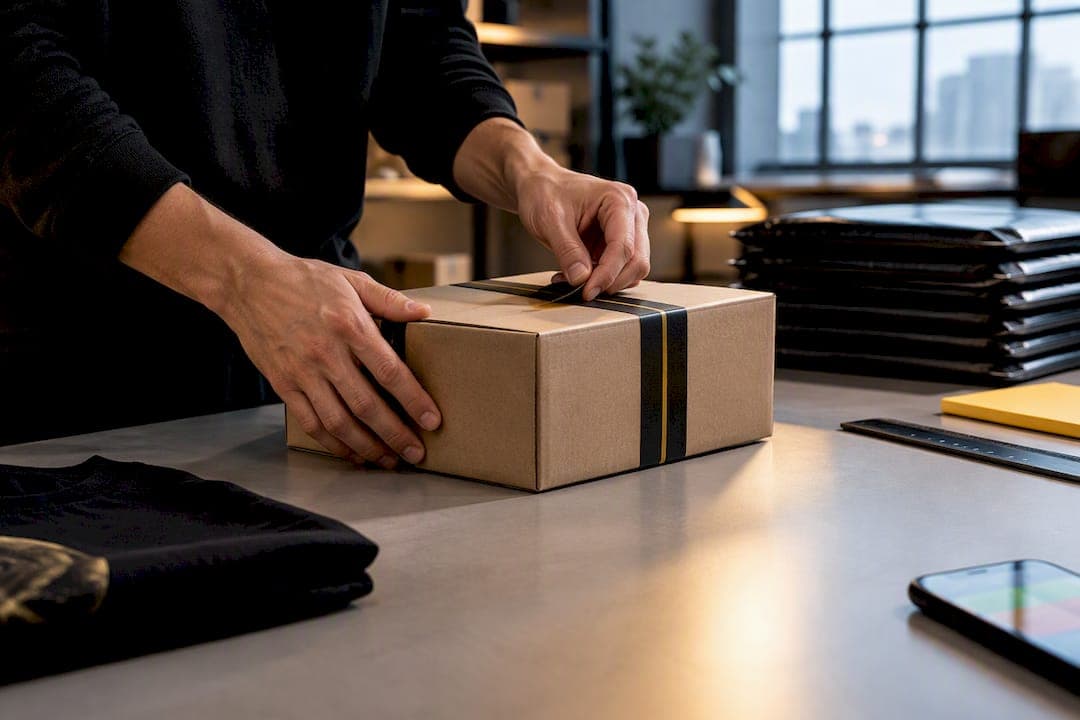
Quote 5 to 10 business days for domestic on-demand orders, production plus transit combined, and never publish a shipping date without that buffer built in. That range covers most apparel, accessories, and small-batch drops, but heavier or embroidered pieces run longer. The one move that protects your reputation: always show production time and shipping time as separate, honest numbers, not one vague promise.
TL;DR:
- Production times for basic print-on-demand apparel typically range from 2 to 3 business days, with heavier or embroidered items taking up to 5 days or more.
- Fulfillment location, product complexity, and carrier choice significantly influence total shipping windows, which can extend beyond 10 business days for oversized or detailed items.
- A realistic delivery estimate combines vendor SLAs, carrier transit times, and a 1 to 2-day buffer, with actual times verified through quarterly test orders.
- Tracking statuses like "Label Created" or "Out for Delivery" have specific, often misunderstood meanings; proactive communication reduces customer support inquiries.
- During peak seasons, adding 2 to 4 days to standard buffers and planning backward from holiday deadlines help prevent late deliveries and stockouts.
Table of Contents
- Quick end-to-end ranges sellers can use
- Production time by method and product
- Carrier transit and tracking statuses sellers must understand
- How to estimate delivery windows for your store
- Peak seasons, holiday cutoffs, and inventory strategies
- Post-purchase messaging and operations that reduce WISMO tickets
- GfaceGear field notes: how we set timelines for limited drops and hero SKUs
- Why accurate timelines are a growth lever, not just customer service
- Grab your gear without the guesswork
- Sources
- FAQ
Quick end-to-end ranges sellers can use
Every print-on-demand order has two clocks running: how long the piece takes to make, then how long the carrier takes to move it. Combine them and you get a realistic domestic window of about 5 to 10 business days for standard apparel and accessories, according to a comparative analysis of major POD platforms. Large-format items like canvas prints or oversized jackets often sit at the higher end, sometimes stretching past that window entirely.
Three things move that number around:
- Fulfillment location: a facility close to your customer cuts days off transit versus a partner shipping cross-country.
- Product complexity: a basic tee prints faster than an embroidered hat or an all-over sublimated jersey.
- Carrier choice: ground shipping is cheaper but slower, while expedited options can shave 1 to 2 days off standard transit.
Expedited add-ons help when a customer needs speed, but they only fix the shipping half of the clock. Production still has to finish first, so an expedited label on a slow-to-produce item barely moves the needle.
Production time by method and product
Production time is the part sellers underestimate most, and it varies hard by method. Direct-to-garment (DTG) printing on a basic tee usually clears production in 2 to 3 business days. Embroidery, all-over prints, and large-format canvas work take longer because the equipment runs slower and setup is heavier, according to the same platform comparison, which puts general production windows at 2 to 5 business days depending on method and season.
- DTG tees and basic shirts: fastest production, typically 2 to 3 business days.
- Embroidered hats and heavy jackets: slower setup, frequently 4 to 5 business days or more.
- All-over print and large canvas pieces: highest complexity, often the longest queue in the shop.
If you sell across categories, a breakdown of embroidered versus printed methods is worth a read before you set expectations on hats or jackets, and a comparison of screen printing and DTG explains why some runs queue longer than others. Get your vendor's actual production SLA in writing, then verify it against real order data instead of trusting the number on their landing page.
Pro Tip: Place a test order every quarter on your top three SKUs and time it yourself, vendor SLAs drift and you want to catch it before your customers do.

Carrier transit and tracking statuses sellers must understand
Once a package leaves the facility, tracking language becomes the customer's whole world, and most of it gets misread. "Label Created" means a shipping label exists, not that the item has shipped. "Out for Delivery" means the package is loaded onto a truck for that day's route, a transit scan generated at the local depot, and it usually arrives by end of day but can slip to the next business day if the route runs long, per Pango AI's breakdown of USPS statuses.
| Status | What it actually means | What to tell the customer |
|---|---|---|
| Label Created | Shipping label generated, item not yet scanned by carrier | "Your order is packed and ready for pickup." |
| In Transit | Package moving between carrier hubs | "Your order is on the move, this stage can take a couple of days." |
| Out for Delivery | Loaded on a local route for that day | "Expected today, sometimes it lands the next business day." |
| No scan for 2-4 days | Normal hub-to-hub movement, not loss | "This is common during ground transit, no action needed yet." |
Quiet scan gaps of two to four days are usually just movement between hubs rather than a lost package, and carriers scan less often on ground service, according to Ship to USPS tracking. That same source recommends waiting 2 to 3 business days past the expected date before opening a ticket, and reserving real escalation for problem statuses like Alert or Insufficient Address.
How to estimate delivery windows for your store
Build your product-page promise the same way every time, and it stops being a guess.
- Pull the vendor's production SLA for that exact product and method, not a store-wide average.
- Add carrier transit time for your customer's region, using the slower realistic estimate, not the best case.
- Layer in a buffer of 1 to 2 days for normal weeks and more during peak demand.
- Publish the total as a range, never a single date, so the promise survives a slow week.
- Re-test quarterly with sample orders to confirm the vendor is still hitting its own numbers.
Pin your hero SKUs, the pieces driving most of your revenue, to whichever facility has proven the fastest and most consistent turnaround. Let long-tail or seasonal items ride on backup providers where a few extra days won't cost you a sale. A look at regional fulfillment speed across leading providers is useful groundwork before you lock in which facility gets your best sellers.
Pro Tip: Treat your published shipping window like a promise you have to keep, not a hope you're publishing.
Peak seasons, holiday cutoffs, and inventory strategies
Q4 breaks every clock you built the rest of the year. Production queues back up, carriers slow down, and the buffer that covered you in July stops being enough in December.
- Add 2 to 4 extra days to your standard buffer during major holiday weeks.
- Calculate order-by dates backward from the holiday, using your slowest realistic combined window, not your average one.
- Open pre-orders or cap limited runs when demand outpaces what your production partner can clear in time.
- Hold small safety stock on hero SKUs so your top sellers keep shipping fast while everything else runs on standard on-demand timing.
Post-purchase messaging and operations that reduce WISMO tickets
Most "where is my order" tickets come from silence, not delay. Fix the silence and the tickets drop.
- Order confirmation: state production time and shipping time separately, with the combined range spelled out plainly.
- Shipment created: confirm the label exists and give the expected transit window, not a delivery date.
- In transit with no movement: proactively note that quiet scan periods are normal for 2 to 4 days.
- Out for delivery: set the expectation that it usually means today, but can slip to the next business day.
- Arriving late: trigger an automated note once you pass your published window, before the customer has to ask.
Pro Tip: An automated "still on track" email at the midpoint of your shipping window cuts support tickets more than any FAQ page ever will. A fast, reliable tracking page also depends on your store loading quickly, and a rundown of caching plugins for Shopify is worth a look if your tracking or order pages lag.
GfaceGear field notes: how we set timelines for limited drops and hero SKUs
Our brand identity centers on offering gear people want quickly, so we prioritize our key items like tees, jerseys, and limited-edition swimwear drops at facilities with the best turnaround times and maintain light safety stock on fast-moving pieces at launch. A typical limited drop runs 3 to 4 business days in production, then 3 to 5 days in transit, and we message customers at order confirmation, at ship, and again if anything crosses our published window. We run sample orders on every new drop before it goes live, checking real turnaround against what the facility promised, because a production timeline strategy for on-demand apparel only works if you verify it yourself.

Why accurate timelines are a growth lever, not just customer service
The sellers who win long term aren't the ones promising the fastest delivery, they're the ones who deliver exactly what they promised, every time. A brand that says 8 days and hits 8 days builds more trust than one that says 3 days and lands on 6. Speed matters, but predictability is what turns a first-time buyer into someone who trusts your next drop without asking questions.
— Victor
Grab your gear without the guesswork
Every product on the site ships on the same honest math laid out above: real production time, real carrier transit, real buffer, no vague promises. Our hero pieces—tees, jerseys, and the limited-edition swimwear drops especially—run on the fastest facilities we track, so when you throw on a ROAR piece, you know exactly when it lands, not just that it's coming eventually. Browse the Swimwear drop, check the Hoodies and Jackets lineup, or see the full range of sneakers, dresses, pants, and more. Join The Pride Membership for $9.99 a month and get early access to the next limited run before it sells out, start here.
Sources
- USPS tracking statuses explained: What each update means | Pango AI
- Ship
- Print on Demand Shipping Times: Printful vs Printify vs Gelato (2026)
- PrintBase vs. Printful in 2026: Which Print-on-Demand Platform Wins? – Ecommerce Times
FAQ
How long is the shipping time for print-on-demand orders?
Domestic print-on-demand orders typically take 5 to 10 business days end to end, combining production and carrier transit, according to a comparative platform analysis. Heavier or embroidered items often land at the higher end of that range.
Is print-on-demand still profitable in 2026?
Print-on-demand remains a viable model for sellers who manage production timing and shipping expectations carefully, since margins depend heavily on avoiding returns and refunds caused by missed delivery promises. Vendors with owned U.S. facilities tend to deliver more consistent, profitable results than networks with fewer proximate nodes, per merchant-reported fulfillment data.
Is print-on-demand considered drop shipping?
Print-on-demand shares drop shipping's model of not holding inventory before a sale, but items are manufactured to order rather than pulled from existing stock. That difference is exactly why production time has to be quoted separately from shipping time on every product page.
Does "out for delivery" mean I get it today?
"Out for Delivery" means the package was loaded onto a local delivery route that day, and it usually arrives by end of day, according to Pango AI's tracking status guide. It's not a guaranteed delivery time, and the package can occasionally slip to the next business day if the route runs long.