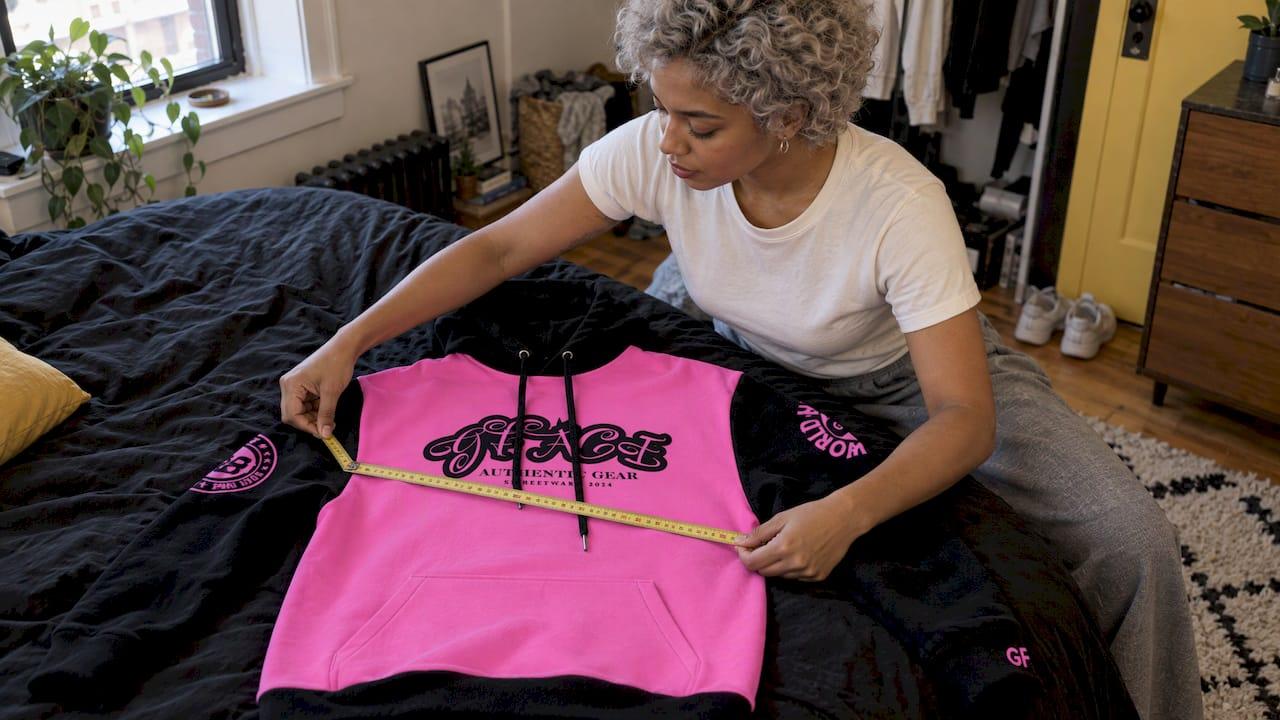
Unisex sizing means one size scale for everyone, built on a straighter, roomier cut that doesn't try to follow a specific body shape. In practice most unisex clothing is cut from men's measurements, so it runs boxier through the chest and shoulders and longer through the body than a women's cut. Pick your size by the garment's measurements, not the letter on the tag. That's how you get the fit you saw in your head, whether you're copping a tee, a hoodie or a pair of sneakers.
At Gfacegear, we're Brooklyn born and we print on demand for men and women, so we think about this every time a Roarwear piece goes live. Here's the full breakdown.
TL;DR
- Unisex sizing is a single size scale for every wearer, usually cut on a men's block: straight torso, wider shoulders, no waist shaping.
- Women commonly size down one size in unisex tees and hoodies for a closer fit. Stay true to size or go up for the oversized look.
- The letter is shorthand. Lay your best-fitting piece flat, measure it, and match it to the chart's chest and length numbers.
- Unisex shoes usually follow the men's scale. Your unisex size is generally your men's size, or your women's size minus 1.5 to 2.
- Sizes vary from brand to brand, so a Medium isn't the same Medium everywhere.
Table of Contents
- What unisex sizing actually means
- How unisex clothing fits compared to men's and women's cuts
- Do unisex sizes run bigger?
- How to convert women's or men's sizes to unisex
- Measure the garment, not your guess
- Washing, shrinkage and the numbers on the chart
- Unisex shoe sizing: a different game
- Unisex versus fitted: which one to choose
- Shop your size on Gfacegear
- Our take on unisex sizing
- FAQ
- Sources
What unisex sizing actually means
"Unisex" on a tag says a garment is made to be worn by anyone. It doesn't mean a perfect average of men's and women's bodies. Traditional sizing runs two charts: one for men, one for women, each shaped around different proportions. Unisex sizing drops that split and runs one scale, usually from XS up through the big sizes, with each size defined by how big the garment is, not by who it's for.
The key phrase is "garment measurements." A unisex Medium is a Medium because the chest is a certain number of inches wide and the body is a certain number of inches long. Your gender doesn't enter into it. Your body does.
There's also no legal standard for apparel sizes in the US. Each brand builds its own base pattern, then scales it up and down. So the same letter can land a couple of inches apart from one label to the next. That's the root of almost every "it didn't fit" story, and it's why measurements beat letters every time.

How unisex clothing fits compared to men's and women's cuts
Most unisex apparel starts from the men's block and then removes the shaping. That means a straighter side seam, no bust room built in and no pulled-in waist. The garment hangs from the shoulders instead of following your torso. That's why unisex reads as relaxed, boxy and a little longer.
Compared with the two traditional cuts, here's the usual pattern:
| Feature | Women's cut | Unisex cut | Men's cut |
|---|---|---|---|
| Shoulders | Narrower, often sloped | Wider, flatter | Wide |
| Torso | Shaped, tapers at the waist | Straight, no taper | Straight to slightly boxy |
| Length | Shorter | Longer than women's | Long |
| Overall feel | Fitted | Relaxed, boxy | Classic, roomy |
Outdoor apparel makers put it in similar words. One co-founder quoted in REI's piece on brands dropping gender labels described their unisex tees as a bit looser than a traditional women's cut and a bit tighter than a traditional men's cut. His advice for getting size right: read the size chart, contact customer service, and try things on in person when you can.
For streetwear, that straight, boxy build is a feature. Graphics, lion prints and the Greek Key medallion need a clean, flat surface to hit. A straight torso gives the artwork room to roar. It's also why unisex pairs so easily with an oversized or relaxed fit, which we break down in four measurements that separate relaxed fit from oversized.
Do unisex sizes run bigger?
Short answer: they feel bigger, especially if you normally buy women's. You get more room in the chest and shoulders and more length in the body. If you're used to men's sizing, a unisex piece will feel familiar, maybe a touch trimmer.
Three things shape how big a unisex piece wears:
- Chest width. This is the number that matters most. A wider flat chest means a looser, more oversized fit.
- Body length. Longer bodies sit lower on the hip. That's a plus for a long-line look, and the reason a long tee can double as a dress.
- Shoulder placement. Wider-set shoulders drop the seam toward your upper arm. That's the drop-shoulder look streetwear loves.
Hoodies run roomier than tees of the same letter size because they're built to layer. Expect more width across the chest and more sleeve. Our hoodie sizing guide walks through matching the garment in five minutes.
How to convert women's or men's sizes to unisex
Here's the rule of thumb that holds up for most tees and hoodies:
- If you usually wear women's: go down one size in unisex for a closer fit. A women's Medium usually lands near a unisex Small. Stay true to your usual size, or go up one, if you want that big, slouchy look.
- If you usually wear men's: your men's size is your unisex size. Unisex is cut on the same scale.
- If you're between sizes: check the length and shoulder numbers on the chart. Those decide whether a piece looks intentional or just too big.
Treat that as a starting point, not a law. Because each brand grades from its own pattern, a Medium at one label can run a couple of inches off a Medium at another. The reliable move is to skip the conversion and compare numbers instead.
Measure the garment, not your guess
This is the five-minute method that kills most returns.
Step 1: Grab a piece that already fits
Pick a tee or hoodie you love the fit of. Lay it flat on a bed or floor and smooth it out.
Step 2: Measure chest and length
Measure straight across the chest from armpit seam to armpit seam. That's the flat chest width. Then measure from the highest point of the shoulder down to the hem for body length. Write both down.
Step 3: Mind the flat versus full trap
Size charts list chest as a flat, one-side measurement. Your body measurement is the full way around. Double the flat number to compare. A flat chest of 22 inches means a garment that goes around 44 inches. If your chest measures 40 inches and you want a relaxed fit, a 44-inch garment gives you 4 inches of ease. If you want oversized, look for 6 to 10 inches of ease.

Step 4: Match against the chart
Find the size whose chest and length numbers sit closest to your favorite piece, then adjust for the look you want. Tighter, stay close. Roomier, go up one.
Step 5: Allow for a little wiggle
Makers work to a tolerance, so a piece can land an inch or so off its listed numbers. Don't panic over a one-inch swing. If your measurement sits right on the border between two sizes, think about which way you want to wear it.
Tall? Length is your pain point, and our streetwear guide for tall guys shows how to buy length first so you don't have to tailor. Want a tee that falls like a dress? Go long on length and let the straight cut do the work.
Washing, shrinkage and the numbers on the chart
Cotton jersey can shrink when it meets hot water and a hot dryer. That shifts the exact numbers you measured, mostly in length. If you plan to wash on warm and dry on high, give yourself a little room. Cold wash and low or air dry keep a piece close to the size you bought. For more on how washing affects clothing fit, the garment's care label is your first stop.
Unisex shoe sizing: a different game
Sneakers follow their own logic. Most unisex shoes run on the men's scale. So your unisex size is your men's size, or your women's size minus 1.5 to 2. Reviewed's conversion guide gives the example of a women's 8 landing at roughly a men's or unisex 6.5.
| If you wear | Your unisex size is about |
|---|---|
| Men's 8 | Unisex 8 |
| Women's 9.5 | Unisex 7.5 to 8 |
| Women's 8 | Unisex 6 to 6.5 |
Width matters too. The same guide notes that unisex shoes can be built on a last, the foot-shaped mold a shoe is made around, that runs narrower than a typical men's shoe. If your feet run wide, factor that in. The safest method is the same as with clothes: measure your foot heel to toe and match it to the chart. We lay out a centimeter-first approach in our sneaker size conversion guide.
Same idea applies to accessories. Hats go by head circumference, covered in our hat size guide. Jerseys have their own drop and length rules, so check the jersey size guide before you lock in.
Unisex versus fitted: which one to choose
Pick unisex when you want:
- A boxy, relaxed or oversized silhouette
- Big graphics that sit flat and bold
- A long tee that works as a tee dress
- Pieces you and your partner can both wear
Pick a fitted cut when you want a body-hugging line, like a baby tee. A fitted look built on a straight unisex base can come out looser than the style intended, so for body-contour styles go down a size or two. That's a style call, not a rule.
Need outfit ideas? See eight oversized tee outfits with fit fixes from Victor.
Shop your size on Gfacegear
You've got the method. Now put it on. We print on demand, so every piece is made when you order it, and we make for men and women across tees, hoodies, jackets, jerseys, swimwear, hats and sneakers.

Start with shirts for the long-tee-dress and men's tee looks, grab a hoodie for the roomy layer, or catch the limited swimwear drop before it's gone. Want first look at drops? The Pride Membership is $9.99 per month and brings sitewide discounts, early access and VIP perks. Browse the whole shop and show up fully.
Our take on unisex sizing
Unisex was never about making everyone the same. It's about giving everyone the same starting line.
When we design Roarwear, the lion and the Greek Key medallion need room to breathe. A straight, roomy cut gives the artwork a clean canvas and gives you the freedom to wear it your way: sharp and fitted, loose and long, or big and unapologetic.
So here's our advice. Don't shop the letter. Shop the numbers. Measure what you love, match it to the chart, and decide how loud you want the fit to be. Then step out in your Gameface and let the world hear you ROAR.
Victor
FAQ
What does unisex sizing mean?
It means one size scale for all wearers, instead of separate men's and women's charts. Most unisex pieces are cut on the men's block, so they run straighter and roomier. The size is defined by the garment's measurements, not by gender.
What size am I in unisex sizing?
If you wear men's sizes, take the same size. If you wear women's, most people go down one size for a closer fit, or stay true to size for an oversized look. For the most accurate pick, measure a piece that fits you and compare it to the chart.
Do unisex sizes run bigger than women's sizes?
Yes, they usually feel bigger. The chest and shoulders are wider and the body is longer than in a women's cut. That's why many women size down one step.
How do I convert women's shoe sizes to unisex?
Unisex shoes generally follow the men's scale, so subtract 1.5 to 2 from your women's size. A women's 8 is roughly a unisex 6.5, per Reviewed. If your feet are wide, measure heel to toe and check the brand's chart.
Sources
- REI Co-op: Outdoor Brands Are Dropping Gender Labels
- Reviewed: How to convert men's, women's, and unisex shoe sizes
- Feared Beard: Apparel