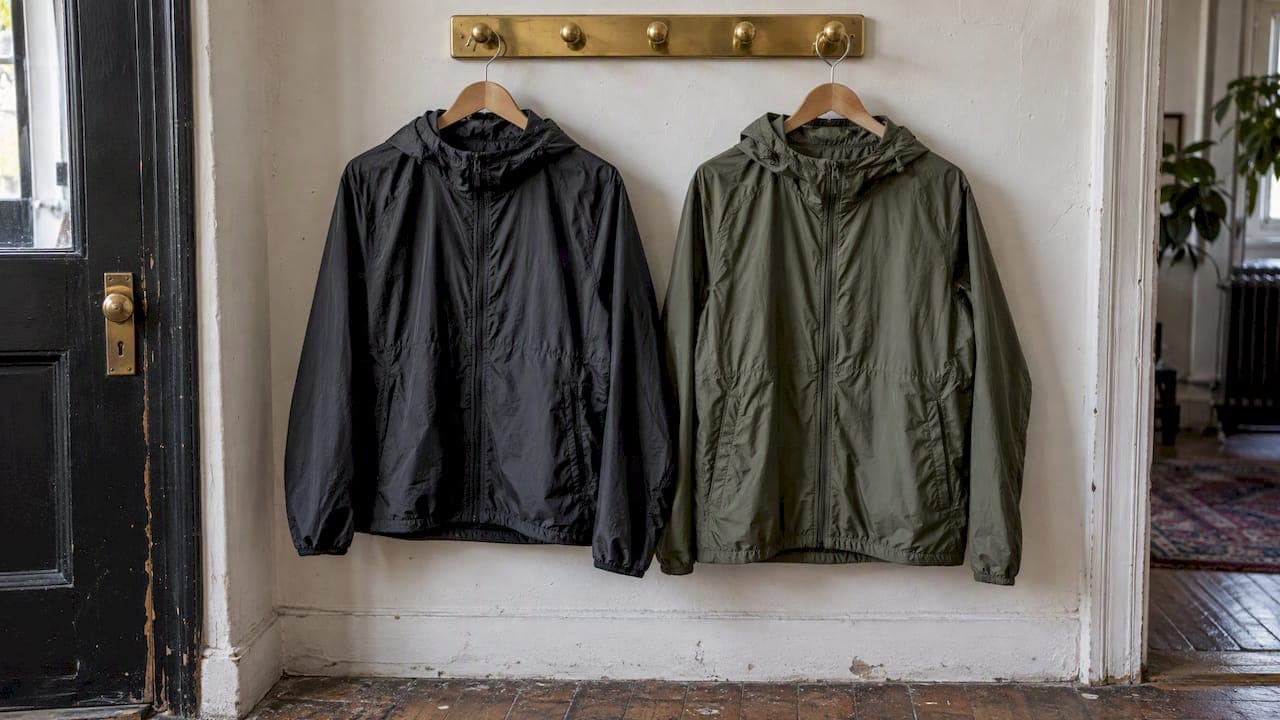
Nylon is the tougher, stretchier, silkier-feeling fabric. Polyester soaks up less water, dries faster, holds color and shrugs off sun. Neither is "better." The right jacket depends on how you wear it: scraping past brick walls on the subway stairs, getting caught in a sideways April rain, or layering up for a January walk across the Brooklyn Bridge. Here's how to lock in the right call.
TL;DR
- Pick nylon when abrasion, stretch and a soft, slick feel matter most: bombers, windbreakers, anything that gets tossed in a bag and dragged around.
- Pick polyester when you want less water absorption, faster drying, strong color and UV resistance: rain-prone commutes, sunny days, bold prints.
- The fiber is only half the story. Weave, weight, coating (DWR) and any membrane decide how a jacket handles rain and wind.
- For winter, the shell fabric blocks wind. Warmth comes from insulation and layers underneath.
- Care matters. Wash gently, dry low, and expect water repellency to fade with washing.
Table of Contents
- The quick difference between nylon and polyester
- Durability: which one lasts longer?
- Rain and water: hydrophobic vs hydrophilic
- Windbreakers: nylon vs polyester
- What about winter? Which fabric is best?
- Look, feel and prints
- How to care for each, and make them last
- Is polyester unhealthy? What the evidence says
- How to choose: a fast decision guide
- Perspective: why we care about the shell
- Ready to gear up? Shop the shell
- FAQ
- Sources
The quick difference between nylon and polyester
Both are synthetic, both are lightweight, both show up in almost every windbreaker, bomber and track jacket you've ever owned. The differences are real, though.
Immersion Research sums up the shell debate this way: nylon is generally more abrasion-resistant, while polyester absorbs less water and resists UV better. Polyester is also less likely to wet out once the water-repellent finish wears off, so it stays lighter and dries faster.
The federal government's old but still useful fiber guide from NIST lines up with that. It lists nylon as strong, abrasion-resistant, lightweight, elastic and quick to dry. Polyester it describes as wrinkle-resistant, dimensionally stable, strong and resistant to sunlight.
Here's the side-by-side:
| Trait | Nylon | Polyester |
|---|---|---|
| Abrasion resistance | Generally higher | Good, usually a step behind |
| Stretch and softness | More flexible, silky hand | Stiffer, more stable |
| Water absorption | Absorbs more | Absorbs less |
| Drying speed | Quick, but a bit slower | Faster |
| UV and sun fade | Weaker | Stronger |
| Color and prints | Good | Easy to dye, holds vivid color |
| Wrinkles | Resists | Resists well |
| Typical jackets | Bombers, shells, windbreakers | Track jackets, linings, rain shells, printed jackets |
Read the table as tendencies, not guarantees. A cheap thin nylon can lose to a well-made heavy polyester every day of the week.
Durability: which one lasts longer?
If you're hard on your gear, nylon has the edge. It resists abrasion better, which matters at elbows, cuffs, hem and the spot where a backpack strap rubs your shoulder.
But fiber isn't the whole answer. New Mexico State University's outerwear guide says construction matters as much as fiber. Plain-weave outerwear fabrics such as nylon taffeta and ripstop vary in toughness with yarn ply, and heavier fabric is normally tougher.
So when you're shopping:
- Feel the weight. A heavier hand usually means a tougher jacket.
- Look for ripstop grids if you want light fabric with extra tear resistance.
- Check seams, zipper tape and cuffs. They fail before the shell does.
Polyester's durability shows up in a different way: it doesn't fade as fast in sun and stays dimensionally stable. If your jacket lives on your back all summer, that counts.
Rain and water: hydrophobic vs hydrophilic
Polyester naturally repels water. Nylon, as Immersion Research notes, is hydrophilic: it can absorb water. That's why a nylon jacket whose finish has worn off can feel heavy and clingy, while polyester stays lighter.
Two things to keep straight:
- Water-repellent means water beads and rolls off for a while. A polymer finish (DWR) does this.
- Waterproof means a heavy coating or membrane plus sealed seams. NMSU's guide separates the two the same way.
We break the difference down further in our guide to water resistant vs waterproof jackets. And if you're torn between a light shell and a real rain layer, read windbreaker vs rain jacket for streetwear.
The three-layer shell twist
In a technical rain shell, the face fabric is often nylon or polyester, but it isn't doing the waterproofing alone. Gear Patrol describes the typical three-layer build as an exterior textile, a waterproof-breathable membrane and an inner backer. The membrane supplies most of the waterproof-breathable performance. So a "nylon" jacket and a "polyester" jacket can behave totally differently depending on what's behind the face fabric.
Windbreakers: nylon vs polyester
This is where most people land when they search. For a windbreaker, you want light, packable, wind-blocking and not sweaty.

Nylon windbreakers feel soft and slick, move easily and take a beating. Advnture's synthetic fabric guide calls nylon naturally flexible and abrasion-resistant, but says its breathability varies with yarn width and weave.
Polyester windbreakers are light, easy-care, wrinkle-resistant and quick-drying. The same guide says polyester wicks moisture but can feel clammy in heavy sweat and may hold odor with repeated wear.
Here's the part most comparison pages skip. Breathability isn't set by the fiber name. A technical report from Backpacking Light explains that both air permeability (airflow through the fabric) and moisture-vapor transmission affect how a windbreaker releases heat and moisture, and that weave, porosity and yarn structure drive air permeability.
In plain words: a tight weave blocks more wind but breathes less. A looser weave breathes more but lets more wind in. Pick for your day.
- Walking, commuting, errands: either fiber works. Choose on feel, fit and color.
- Running or fast movement: lean toward a lighter, more breathable weave, and expect to unzip.
- Sunny, bright days: polyester's UV resistance helps colors stay put.
Want the full streetwear take? Our post on rainy day streetwear shows how to build the whole fit around a shell.
What about winter? Which fabric is best?
Short answer: neither fiber keeps you warm by itself. A thin woven nylon or polyester shell cuts wind. It doesn't trap much heat.
NMSU's guide notes that low-porosity fabrics block wind and water, but outerwear needs some porosity so body moisture can evaporate. That's the winter balancing act: block the wind without trapping sweat.
When you're picking a winter jacket, check these in order:
- Insulation: down or polyester fiberfill does the heating. The shell just holds it in.
- Wind blocking: tighter weave, lower porosity.
- Water handling: a DWR finish or a membrane for slush and wet snow. Polyester's lower water absorption is a real plus here, since a soggy shell weighs you down.
- Toughness: nylon's abrasion resistance helps if the jacket gets scraped, sat on or stuffed in a bag.
- Layering room: leave space for a hoodie underneath. Our breakdown of fleece vs French terry and zip hoodie vs pullover helps you pick the mid-layer.
The winter formula for city life is simple: wind-blocking shell on the outside, a warm mid-layer in the middle, a soft base against your skin. Layers beat one heavy coat because you can adjust on the train, in the lobby, on the street.
Look, feel and prints
Streetwear is visual. Fabric changes how a jacket reads.
- Nylon tends to have a smooth, slightly glossy look with fluid movement. It catches light and gives that classic bomber sheen.
- Polyester takes dye easily and holds vivid color, which is why bold graphics, metallics and gold or blue tones pop on it. Industry guides, such as this textile explainer, tag it as wrinkle-resistant too, so it looks sharp out of a bag.
If you want loud color and a print that stays loud, polyester is a safe bet. If you want a soft, slick drape and a jacket that stretches with you, look at nylon.
How to care for each, and make them last
Good news: both are easy. The NIST fiber guide says nylon can be machine-washed and tumble-dried at low temperature, and polyester can be machine-washed and tumble-dried, subject to the garment's care label. Always follow the label first.
A few habits that protect your jacket:
- Wash gentle and cool. Zip it up, turn it inside out.
- Dry low. Heat is what warps coatings. For a deeper look at how dryer heat damages coated nylon, see this piece on nylon care and dryer heat.
- Skip fabric softener. It can leave residue that interferes with water repellency.
- Don't over-wash. Spot clean when you can.
Expect water repellency to fade. A peer-reviewed study in Materials found that repeated washing gradually reduced water repellency in tested functional fabrics, and it dropped below the study's acceptable grade after the fifth wash. The takeaway from the same research: finish chemistry, structure and wash history matter, so a fiber label can't predict rain performance over time. When water stops beading, it's time to refresh the finish, not toss the jacket.
The same care logic applies to the rest of your rotation. Our guides on washing limited edition swimwear and stopping hoodie pilling keep the whole closet fresh.
Is polyester unhealthy? What the evidence says
People ask this a lot. Be precise about it. The concern that has real research behind it isn't the fiber itself. A peer-reviewed study in Environmental Science & Technology found that aging and washing fluorinated DWR-coated nylon and polyester fabrics released PFAS-related substances into the environment. That's about certain water-repellent chemistries, not nylon or polyester fibers in general.
So if this worries you, check whether a jacket's water-repellent finish is described as PFAS-free. If a jacket doesn't need to repel rain, a plain uncoated fabric avoids the question. For a specific health concern, such as skin sensitivity or a reaction to a garment, talk to a dermatologist or your doctor.
How to choose: a fast decision guide
| If you want... | Go with |
|---|---|
| A tough bomber that takes scrapes | Nylon |
| A jacket that dries fast after a downpour | Polyester |
| Bright color and prints that last in the sun | Polyester |
| A soft, stretchy, slick feel | Nylon |
| A light wind layer for the commute | Either, check the weave |
| A winter shell | Either, plus insulation and layers |
And when in doubt, check the label. Many jackets use a blend or a nylon shell with a polyester lining, so you get a bit of both.
Perspective: why we care about the shell
We're Brooklyn-born, and we design for people who move through the city all day: trains, stoops, studios, rooftops. A jacket in that life takes abuse. It gets dragged, rained on, sat on and shown off, usually all in the same week.
Here's how we think about it. Fabric is a tool, not a flex. Don't buy a fiber name. Buy the weight, the weave, the finish and the fit. Then match it to your day. A bold piece should look loud on a gray morning and still hold its color after a summer of sun. And the best layer is the one you'll actually wear, again and again, with your Gameface on.
That's the Roarwear mindset: pick gear that backs you up, then step out like you mean it.
— Victor
Ready to gear up? Shop the shell
We make print-on-demand streetwear built around the lion and the Greek Key medallion, and the jackets are where the look comes together. Browse our jackets, or go straight to the GFACE Gold Men's windbreaker or the Men's Blue windbreaker. Check each product page for its fabric details before you order.
Building the full fit? Pair your jacket with shirts, hoodies or limited-edition swimwear for the warm months. Want first dibs on drops? The Pride Membership is $9.99 per month and brings sitewide discounts, early access and VIP perks.

FAQ
Is it better to wear nylon or polyester?
It depends on the job. Nylon is generally tougher and stretchier, so it suits jackets that take abuse. Polyester absorbs less water, dries faster and resists sun, so it suits rain, heat and bold color.
Which jacket is best for winter, nylon or polyester?
Neither fiber provides the warmth. Insulation and layering do that, and the shell blocks wind and wet. Polyester's lower water absorption helps in slush, while nylon's toughness helps with wear, so choose based on how you'll use it.
Is a nylon or polyester windbreaker better?
Both work well. Nylon feels softer and holds up to scrapes, while polyester is light and quick-drying. Breathability depends heavily on the weave, so a tight weave blocks more wind and a looser one lets you vent more.
Why do some people avoid polyester?
Some people dislike how it can feel clammy in heavy sweat and hold odor. Others worry about chemicals. The research we found ties PFAS release to certain fluorinated water-repellent coatings, not to the fibers themselves.
Sources
- Nylon and Polyester Shells, Immersion Research
- Consumer Information Series 1: fibers and fabrics, NIST
- Making Outerwear with Down or Polyester Fiberfill, New Mexico State University
- A quick guide to synthetic fabrics for outdoor gear, Advnture
- What Properties Influence the Air Permeability of Wind Shirt Fabrics, Backpacking Light
- Which Waterproof Fabric (and Jacket) Should I Buy?, Gear Patrol
- Quality and Quantity Assessment of the Water Repellent Properties of Functional Fabrics, Materials
- Fate of Per- and Polyfluoroalkyl Substances from Durable Water Repellent Fabrics, Environmental Science & Technology