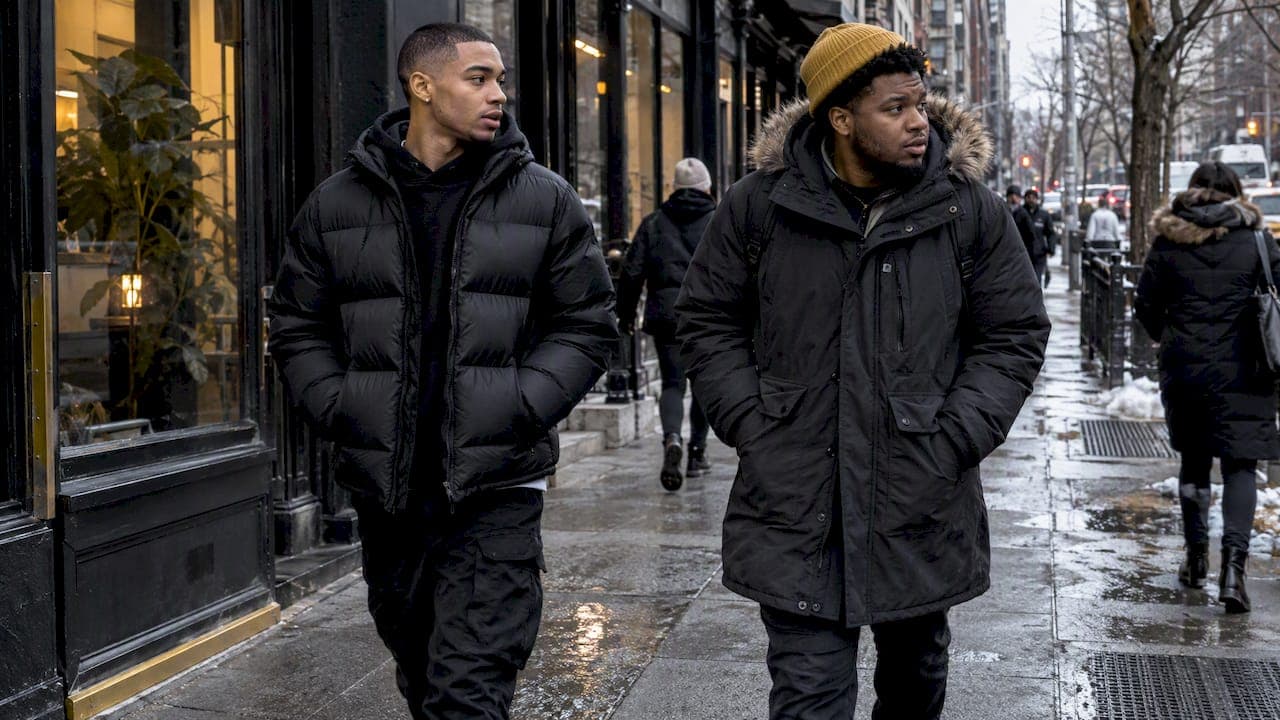
A parka is the warmer pick for harsh, windy, wet winter days. A puffer is the better pick for dry cold, layering and moving fast. Neither is simply "warmer" in every situation. The right coat depends on how long you stand outside, how far you walk, and what the wind is doing on your block.
This guide breaks down the real differences: length, insulation, shell, hood, weight and style. It also tells you which one to grab for a Brooklyn commute, a Philly walk to class, or a night out when the fit matters as much as the forecast.
TL;DR
- Parka: longer, wind-blocking shell, deep hood, built for harsh and wet winter days and for standing around in the cold.
- Puffer: shorter and lighter, quilted insulation, best for dry cold, layering, mobility and packing small.
- Warmth: a high-fill down puffer can rival a parka in dry conditions, but a parka usually protects better when wind and moisture show up.
- Style: puffers read sporty and street, parkas read utility and clean. Both can carry bold graphics and a strong fit.
- Buying move: match the coat to your coldest, windiest routine, not your average day.
Table of Contents
- What actually separates a puffer from a parka
- Which is warmer: puffer or parka?
- What the weather in NYC and Philly really asks for
- Style: puffer vs parka on the street
- How to choose: a quick decision guide
- Fit and sizing tips that save your winter
- Our take: gear the coat to the whole fit
- Build the layers under the coat with GfaceGear
- Common mistakes to avoid
- FAQ
- Sources
What actually separates a puffer from a parka
People mix these up because the categories overlap. You can buy a parka with puffer-style insulation. You can buy a long puffer that looks like a parka. So think in terms of what each coat is built to do.
A puffer is defined by its construction: quilted baffles stuffed with insulation. Gear Patrol points out that down jackets are, for the most part, puffers, but not every puffer uses down. Some use synthetic fill. The puffed look comes from those stitched chambers holding the insulation in place.
A parka is defined by its coverage. Men's Health describes the parka as the hero of cold-weather outerwear, with full-length coverage and better wind protection than puffers, which prioritize lightweight warmth. Think hood, length, pockets and a shell that fights weather.
Side by side
| Feature | Parka | Puffer |
|---|---|---|
| Typical length | Mid-thigh to knee | Hip |
| Main job | Block wind, rain and snow | Trap heat with low weight |
| Insulation | Down or synthetic, often paired with a heavier shell | Quilted down or synthetic baffles |
| Hood | Deep, often insulated or trimmed | Varies, sometimes none |
| Weight | Heavier | Lighter, often packable |
| Best for | Wet, windy, long exposure | Dry cold, layering, active days |
| Vibe | Utility, clean, long silhouette | Sporty, bold, cropped or boxy |
The length difference is the easiest tell. According to 119 Fire Control, parkas typically extend to mid-thigh or knee length for added coverage, while puffers usually sit at hip length to prioritize mobility. A CIC News guide says parkas run longer than standard jackets, reaching the hips, thighs or even knees depending on the cut.
Which is warmer: puffer or parka?
Here is the honest answer: it depends on the day.
A puffer with high-fill-power down is a warmth machine for its weight. 119 Fire Control notes that a down puffer rated 700+ fill suits active, dry-cold days because of its warmth-to-weight ratio and packability. If you are walking fast, hopping on the train and staying dry, that puffer keeps you locked in.
A parka wins when conditions get ugly. Its extra length covers your hips and thighs. Its shell cuts wind. Its hood closes in around your face. The same source says experts favor parkas for consistent, harsh winters and for stationary moments like waiting on a freezing platform.

The biggest myth is that a puffer is automatically warmer because it looks fatter. Puff is loft, and loft is only part of the story. A short puffer leaves your legs and lower back exposed, and a breezy shell lets wind steal heat. A parka covers more of you and defends against more weather.
Three things that decide real-world warmth
- Coverage. More of your body under the coat means less heat loss. Parkas win.
- Wind and moisture control. A tight, weather-resistant shell matters more than most buyers think. If you are comparing shells, our breakdown of water resistant vs waterproof jackets shows what to check before you buy.
- Insulation quality. Fill power for down, or the weight and type of synthetic fill. Higher quality means more warmth for less bulk.
What the weather in NYC and Philly really asks for
We are New York and Philly people, so let's use local numbers. The National Weather Service's Central Park normals, based on 1991 to 2020, put the winter average at 42.0°F for the high and 30.4°F for the low. That sits right around freezing at night, before wind chill does its thing.
Fall is the warm-up lap. The NWS JFK October almanac shows normal temperatures sliding through the month, and by Halloween nights are heading toward the 40-degree line. That is puffer weather, and it is layering weather.
By December and January, the picture changes. Wind between buildings, slush at crosswalks and long waits for the bus or train are the real enemies. That is where a parka earns its place.
Our rule of thumb for the Northeast:
- October to early December: a puffer, or a lighter jacket over a hoodie.
- Mid-December through February: a parka, or a heavy puffer with a hoodie underneath for the coldest days.
- March: back to the puffer or a shell.
Style: puffer vs parka on the street
Warmth is not the only thing you are buying. You are buying how you show up.
The puffer look
Puffers are loud in the best way. Glossy shells, bold color, cropped or boxy shapes. They sit over a hoodie and a long tee, sneakers on the feet, hat pulled low. They give your silhouette volume, which is why they dominate street fits. Want ideas? Check our guide to the best puffer jackets for streetwear and the puffer vest outfits that work year round.
The parka look
Parkas stretch the line. The longer cut gives you a clean, grounded silhouette, especially in olive, black or navy. It frames a fit instead of fighting it. A long tee dress or a long tee under a parka looks intentional, and the hood adds attitude when you pull it up.
Pairing with what you wear underneath
- Puffer + graphic tee + track pants + lion sneakers. Cropped coat, clean lines, let the shoes speak.
- Parka + long tee dress + boots or sneakers. The hem peeks out below the coat. Strong layered look.
- Parka + heavyweight hoodie + hat. The workhorse fit for a January commute. If you are picking your hoodie, our hoodie weight guide and fleece vs French terry breakdown help you choose the right base layer.
- Puffer + zip hoodie + men's tee. Easy to take layers on and off between the train and the classroom. See zip hoodie vs pullover.
How to choose: a quick decision guide
Answer these honestly.
- How much time do you spend standing outside? A lot: parka. A little: puffer.
- Is your cold wet or dry? Wet and windy: parka. Dry: puffer.
- Do you need to pack it or stuff it in a bag? Puffer, since many compress small.
- How active are you? Moving constantly: puffer, because a parka can overheat you. Mostly stationary: parka.
- Do you want one coat for the whole season? Parka. Want two options? Puffer for fall and spring, parka for deep winter.
What about windbreakers and shells?
If your weather is mild, a lighter outer layer may be all you need. We broke that down in windbreaker vs rain jacket and picked favorites in our best streetwear windbreakers list. For wider outerwear ideas, see our best streetwear jackets for men guide.
Fit and sizing tips that save your winter
- Size for layers. Try the coat on with the thickest hoodie you plan to wear under it. If your arms lift when you reach forward, size up.
- Check the hem. Puffers should cover your waistband when you raise your arms. Parkas should clear your hips when you sit.
- Test the hood. Pull it up and turn your head. You should see sideways without the hood staying put and blocking your view.
- Look at the closures. Zipper plus a storm flap blocks more wind than a zipper alone.
- Check the pockets. Handwarmer pockets matter more than you think when your gloves are in your bag.
Our take: gear the coat to the whole fit
Here is where we stand, as a Brooklyn-born brand that lives in this weather.
We do not believe in picking a coat by label. We believe in building a cold-weather fit that works from the ground up: shoes, base layer, mid layer, coat, hat. The coat is the roof. But a roof on a weak foundation still leaks.
That is why we start with the pieces you wear every day. A solid pair of lion sneakers anchors the fit. A long tee dress or a men's tee gives you a base that shows when the coat opens. A hat keeps heat in and finishes the look. Then the coat goes on, and whichever you choose, puffer or parka, it frames the rest instead of hiding it.

Our honest advice for anyone in New York or Philly: if you commute on foot and by transit all winter, get the parka for the deep freeze and keep a puffer for the shoulder seasons. If you only get one, choose based on your worst day, not your best. Warm and covered beats cute and shivering, and with the right layers underneath, you get both.
Wear it loud. Wear it with pride. Gameface on, every time you step out.
— Victor
Build the layers under the coat with GfaceGear
Your coat gets the headlines, but the fit starts underneath. Browse our shirts, hoodies and jackets, then round it out with hats, sneakers and more in the full shop. Everything is made to order, with lion and Greek Key designs and Boricua pride built in.
Want better access? The Pride Membership is $9.99 per month and brings sitewide discounts, early access to limited drops and VIP perks. Join the Pride, then shop the drop.
Common mistakes to avoid
- Buying for the photo. A cropped puffer looks great, but if you wait outside for a bus in January, you will feel the gap.
- Ignoring the hood. A hood that does not fit over a hat or a beanie is not much use in wind.
- Overlayering inside a parka. Too many layers can overheat you on a heated train. Use zip-front mid layers so you can adjust.
- Skipping the shell. If rain or sleet is common, check the outer fabric before you pay for loft.
- Treating one coat as the answer all season. Temperatures swing in the Northeast. Plan for a lighter and a heavier option.
FAQ
Is a puffer jacket a winter coat?
Yes, in many cases. A puffer works as a winter coat for dry cold and for active days, especially with a hoodie underneath. For windy, wet or very cold stretches, a longer parka usually covers more and protects better.
What is a parka jacket?
A parka is a longer, insulated, hooded coat designed for harsh weather. It typically reaches the mid-thigh or knee, with a weather-resistant shell and a deep hood. Its job is coverage and protection, not just loft.
Is a parka warmer than a down jacket?
Usually, in harsh conditions, yes. A high-fill down jacket is very warm for its weight and can rival a parka on dry days. A parka adds length, wind resistance and a better hood, which matters when it is windy, wet or you are standing still.
What temperature do you wear a parka?
There is no single number, because wind and wetness change how cold feels. In New York, where the winter average low is around 30°F, most people reach for a parka from mid-December through February, and a puffer in the fall and early spring.
Sources
- Which is Warmer: Puffer vs. Parka, 119 Fire Control
- 8 Best Parkas for Men, Men's Health
- The Best Puffer Jacket for Every Winter Adventure, Gear Patrol
- First winter in Canada? Four questions you need to ask when buying a winter jacket, CIC News
- Normals and Extremes, Central Park, NY, National Weather Service
- JFK October almanac, National Weather Service